
Calories in Mysore Pak: 130 or 520? Here's the Real Answer
MyFitnessCoach
July 31, 2026
You pick up one small golden square at a Diwali table and finish it in four bites. Then you spend ten minutes wondering what you just did to your day. That guessing game is what this article ends.
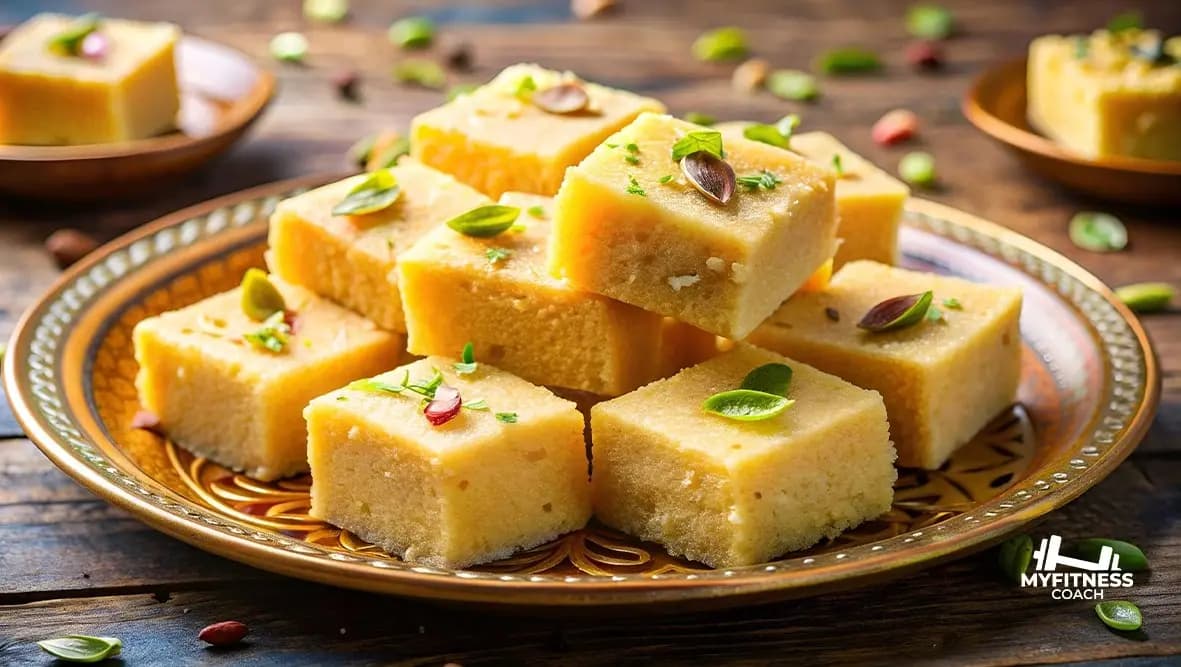
Mysore pak has about 130 to 156 calories in a standard 25 to 30 gram piece, and roughly 520 calories per 100 grams. It is a South Indian sweet made from gram flour (besan), sugar and a heavy pour of ghee. That ghee is why the numbers run so high.
"I have spent two years building nutrition content and food-logging guidance for MyFitnessCoach users."
Indian sweets cause more logging errors than any other food group. Not because databases are wrong. Because nobody agrees on what "one piece" means.
Here is what you will get below. Honest numbers by weight, the reason every website tells you something different, a portion table you can actually use, and how mysore pak stacks up against other mithai. Plus a way to fit this sweet into your day without pretending you did not eat it.
A note on the number we use throughout: every calculation in this article runs on 520 calories per 100 grams, the working average of published values for classic besan mysore pak. Varieties range from 450 to 640 per 100 grams, and that range is explained in its own section below.

Table of Contents
Subscribe to our newslettter
Why Every Site Gives a Different Number for Calories in Mysore Pak
The calories in mysore pak vary across websites because each source measures a different portion. Some list a 25-gram piece, some a 50-gram bakery slab, and recipe sites calculate a piece cut from a ghee-heavy home batch. Same sweet, different weight, wildly different number.
We checked eight published listings for this one sweet. Per-piece figures ran from 110 calories to 562 calories. That is a five-fold spread for a food that sits in the same glass case at every sweet shop.
| Source type | What it reports | Works out to |
| Packaged brand label (100g pack) | 574 per 100g | ~144 per 25g |
| Indian food database | 500 per 100g | 125 per 25g piece |
| Fresh sweet-shop label | 275 per 50g piece | 550 per 100g |
| App database entry (branded) | 110 per piece | small ~20g piece |
| App database entry (branded) | 175 per piece | larger ~34g piece |
| Recipe-calculated site | 562 per "piece" | a very large ghee-rich cut |
None of these sources are lying. They are describing different sized pieces.
So the useful takeaway is not a single magic number. It is this: weigh once, then reuse that weight forever. And it gets easier, because mysore pak is cut in uniform trays, so one weighing usually covers every piece from that batch.
The number on your plate depends on the knife, not the recipe.
Calories in Mysore Pak Per Piece, by Piece Size
One standard mysore pak piece of 25 grams has about 130 calories. A larger 50-gram bakery piece runs closer to 260 calories. Use the piece's weight, not its name, since sweet shops cut anywhere from thumb-sized cubes to thick slabs.
Most home and shop pieces cluster around a matchbox footprint. That is roughly 25 to 30 grams, or about one inch square and half an inch thick.
| Piece size | Weight | Calories | Fat | Carbs |
| Bite-size cube | 15 g | 78 | 5.4 g | 6.8 g |
| Small square | 25 g | 130 | 9 g | 11 g |
| Standard shop piece | 30 g | 156 | 11 g | 13.5 g |
| Thick bakery slab | 50 g | 260 | 18 g | 22.5 g |
| Two standard pieces | 60 g | 312 | 21.6 g | 27 g |
| Half-kilo box, one-eighth share | 62 g | 322 | 22 g | 28 g |
All figures calculated at 520 calories, 36 g fat and 45 g carbohydrate per 100 grams.
The middle rows cover most real-world eating. A single normal piece is a 130-calorie decision, not a 500-calorie one. The 500-plus figures you have seen almost always describe 100 grams, which is three to four pieces.
But here is the thing people miss. Nobody eats one piece from a fresh box. Two is the honest average, and two puts you at roughly 260 to 312 calories, which is a small meal.
How many calories are in 2 pieces of mysore pak?
Around 260 to 312 calories, depending on whether the pieces are 25 or 30 grams each. If they are thick bakery slabs at 50 grams apiece, two pieces cross 500 calories.
Mysore Pak Nutrition Facts Per 100g
Per 100 grams, mysore pak delivers roughly 520 calories. That is about 36 grams of fat, 45 grams of carbohydrate, and only 6 grams of protein. Sugar makes up most of those carbs. Fibre is near zero, and micronutrients are limited apart from a little iron from besan.
| Nutrient | Per 100 g | Per 25 g piece | Share of a 2,000-calorie reference day |
| Calories | 520 | 130 | 26% |
| Total fat | 36 g | 9 g | ~54% |
| Saturated fat | 20 g | 5 g | ~90% |
| Carbohydrate | 45 g | 11 g | 16% |
| Sugars | 34 g | 8.5 g | ~68% |
| Protein | 6 g | 1.5 g | ~11% |
| Fibre | 0–1 g | ~0 g | 0–3% |
| Iron | 2–6 mg | 0.5–1.5 mg | a small share of daily needs |
Reference values used: 67 g fat, 22 g saturated fat, 275 g carbohydrate, 50 g free sugars, 55 g protein, 30 g fibre. Individual requirements vary — ICMR-NIN reference intakes differ by age, sex and activity level.
That saturated fat row is the one worth pausing on. The World Health Organization recommends keeping saturated fat under 10% of daily energy, which is about 22 grams on a 2,000-calorie day. So 100 grams of mysore pak uses roughly 90% of that. One 25-gram piece uses about a quarter of it, which is manageable. Half a box is not.
The sugar figure is worth the same pause. WHO's stricter recommendation is to keep free sugars under 5% of energy, about 25 grams a day. A single 100-gram serving of mysore pak clears that on its own.
What is the glycemic index of mysore pak?
There is no published glycemic index value for mysore pak specifically, and any site quoting an exact number is estimating. What we can say from its ingredients: besan on its own is a low-GI food, but the refined sugar dominates the recipe, and many commercial versions add maida. A fast glucose response is a reasonable expectation. The heavy fat content also slows gastric emptying, which can push part of that response later rather than removing it.
Mysore pak is one of the few sweets where fat, not sugar, supplies most of the calories.
Mysore Pak vs Other Indian Sweets: Calorie Comparison
Mysore pak sits at the higher end of the mithai range because it is dense and dry, with almost no water weight to dilute the calories. Syrup-soaked sweets like rasgulla and gulab jamun look indulgent but carry far more water per gram.
| Sweet | Calories per 100 g | Typical piece | Calories per piece |
| Kaju mysore pak | 600–640 | 30 g | 180–192 |
| Mysore pak (classic) | 500–560 | 30 g | 150–168 |
| Kaju katli | 480–520 | 15 g | 72–78 |
| Besan laddu | 450–490 | 35 g | 158–172 |
| Soan papdi | 440–480 | 25 g | 110–120 |
| Jalebi | 400–430 | 30 g | 120–129 |
| Gulab jamun (with syrup) | 300–330 | 45 g | 135–149 |
| Rasgulla | 180–200 | 45 g | 81–90 |
Ranges reflect variation between home, shop and packaged preparations. Weigh your own piece where accuracy matters.
The pattern is simple. Dry, ghee-based sweets are the calorie-dense ones. Water-heavy sweets are lighter per gram even when they taste sweeter.
Which has more calories, mysore pak or gulab jamun?
Mysore pak, per gram, by a wide margin. Per piece the gap narrows, because gulab jamun pieces are usually larger and heavier with syrup. Gram for gram, mysore pak carries far more fat.
Homemade vs Store-Bought vs Ghee Mysore Pak Calories
Homemade mysore pak is usually the highest in calories, because home cooks pour ghee generously and rarely drain it. Store-bought and packaged versions are more consistent, running 500 to 575 calories per 100 grams. "Ghee mysore pak" sold as a premium line sits at the top of the range.
| Type | Calories per 100 g | Fat per 100 g | Why it differs |
| Home kitchen, traditional | 550–600 | 40–51 g | Heavy ghee, no draining, thick cut |
| Fresh sweet-shop (daily made) | 520–560 | 35–40 g | Standardized recipe, some ghee drained |
| Packaged brand (shelf-stable) | 500–575 | 34–51 g | Label-controlled, sometimes part vanaspati |
| Bakery "soft" style | 450–500 | 25–34 g | More milk or water, slightly less ghee |
| Premium ghee line | 570–590 | 45–51 g | Ghee is the selling point |
One detail almost every article skips: a good chunk of the ghee gets drained off at the end of cooking. Traditional recipes call for far more ghee than the finished sweet retains. That is why recipe calculators, which count every gram of ghee added to the pan, overstate the real number.
Some people argue the opposite, that home cooking is always the lighter option because you control the ingredients. Fair in principle. In practice, home batches of mysore pak use more ghee than any shop would, because the texture depends on it.
Quick sanity check: if the piece leaves a visible ghee mark on the paper, treat it as the higher end of the range.
What Actually Drives the Calories: Ghee, Sugar, Besan
Ghee drives the calories in mysore pak more than sugar does. Fat carries nine calories per gram against four for sugar, so ghee doubles its weight in energy terms. In a typical piece, fat supplies roughly 60 to 65% of total calories, sugar about 30%, and besan the small remainder.
According to the USDA FoodData Central entry for butter oil (ghee), one tablespoon carries about 112 calories and 12.7 grams of fat. A traditional tray recipe can use a cup or more.
Run the math on a 12-piece tray:
- Ghee, 1 cup added to the pan: about 1,800 calories
- Sugar, 2 cups: about 1,550 calories
- Besan, 1 cup: about 350 calories
- Total added to the pan: roughly 3,700 calories
Now here is the part where the recipe calculators get wrong. A 12-piece tray of finished mysore pak weighs around 400 grams, which at 520 calories per 100 grams is about 2,080 calories retained, or roughly 173 per piece. The missing 1,600-odd calories are ghee that drains off or never gets absorbed.
That gap is the single biggest reason recipe-based calorie counters for this sweet come out two to three times too high.
It also means the obvious fix is less powerful than it looks. Cut the ghee by a quarter and you remove about 450 calories from the pan, but only around 250 to 300 from what actually ends up on the plate, because some of what you removed would have drained away anyway.
Besan is the only ingredient contributing real protein and iron, and it is the smallest share by calories.
Sugar gets the blame in most Indian sweets. Here, ghee quietly does more of the work.
Kaju, Milk and Soft Mysore Pak: The Calorie Differences
Kaju mysore pak carries the most calories of any variety, because cashew paste adds fat on top of the ghee. Classic besan mysore pak sits in the middle. Soft or milk versions come in lowest per 100 grams, since added milk raises moisture and dilutes the fat share slightly.
| Variety | Calories per 100 g | Calories per 30 g piece | Standout feature |
| Classic hard besan | 500–560 | 150–168 | Porous, crumbly, ghee-forward |
| Soft mysore pak | 450–500 | 135–150 | More moisture, softer bite |
| Milk mysore pak | 460–510 | 138–153 | Milk solids, slight protein bump |
| Ghee premium | 570–590 | 171–177 | Highest fat share |
| Kaju mysore pak | 600–640 | 180–192 | Cashew fat stacked on ghee |
Kaju versions are the trap. They look smaller and feel lighter in the hand, yet a standard piece runs 180 to 192 calories against 150 to 168 for the classic. Per 100 grams, cashew content pushes fat past 45 grams in some published figures.
Note that the widely circulated claim of "600 calories per piece" for kaju mysore pak is a per-100-gram figure being misread as a per-piece figure. A normal piece is nowhere near that.
Milk versions give you a marginal protein gain, maybe two grams a piece. That is not enough to call any version of this sweet a protein food.
Can You Make Lower-Calorie or Sugar-Free Mysore Pak?
You can reduce mysore pak calories meaningfully, but not dramatically, because ghee is structural rather than optional. The three levers that work are less ghee, a sugar substitute, and a thinner cut. Expect a 20 to 30% reduction at best before the texture breaks.
What each change actually buys you:
- Cut ghee by 25%: saves roughly 250 to 300 calories across a 12-piece tray, about 20 to 25 per piece. Texture gets denser and less porous.
- Swap sugar for erythritol or a stevia blend: removes most of the 1,550 sugar calories, the single biggest available saving. But sugar in mysore pak crystallises and sets the structure, so a straight one-to-one swap usually fails. Partial replacement works better than full.
- Cut thinner pieces: changes nothing about the recipe and everything about your portion. A 20-gram cut is 104 calories.
- Roast the besan more, add a little milk: the "soft" style route, landing around 450 to 500 per 100 grams.
Honest verdict: the thinner cut is the lever with the best effort-to-result ratio. Recipe engineering on this sweet fights the recipe itself.
How to Fit Mysore Pak Into Your Daily Calories
Fit mysore pak into your day by planning the piece before you eat it, not after. One 25 to 30 gram piece costs 130 to 156 calories. That fits most maintenance and fat-loss targets. Trade it against another fat or carb source that day, and stop at one or two pieces.
Three trades that work in practice:
- Skip the evening handful of nuts. That is a near-identical calorie and fat swap.
- Pair the piece with protein and fibre, like a bowl of curd or dal, to slow the glucose rise.
- Eat it after a meal rather than alone at 4pm, when a solo sweet tends to lead to a second one.
“10000 times better than my fitness pal. Amazing workout and love the food barcode scanner!”
Robert Frost
Planned sweets are almost never the problem. Unplanned second helpings are.
There is also the exercise angle people search for. A 130-calorie piece is roughly 25 to 30 minutes of brisk walking for a 70 kg adult, or about 3,000 extra steps. That is a real cost, but a payable one. Worth knowing that [sweating itself is not a measure of calories burned] does sweating burn calories]) duration and intensity are what count.
Can I eat mysore pak while trying to lose weight?
Yes, in single pieces, logged, with the rest of the day adjusted. Daily half-boxes are what stall progress. The sweet is not the variable that decides your result. The count of unlogged pieces is.
How to Log Mysore Pak Correctly, Step by Step
Log mysore pak by weight, never by the word "piece". Weigh one piece on a kitchen scale, note the grams, then match it to a per-100-gram database entry and scale down. Save that entry as a custom food so festival weeks take seconds instead of guesswork.
Follow this order:
- Put one piece on a kitchen scale and note the weight in grams.
- Search a per-100-gram entry rather than a per-piece entry, since per-piece entries hide their assumed weight.
- Multiply: grams ÷ 100 × the per-100-gram calories. A 30-gram piece at 520 per 100 g gives 156.
- If it is a packaged box, scan the barcode instead. Labels beat estimates every time.
- Save the result as a custom food named with its weight, like "Mysore pak 30 g".
- Log the second piece if you eat one. Half-logged days are worse than unlogged ones.
No scale nearby? Use the matchbox rule. A piece the size of a small matchbox is close to 25 grams, and a piece twice that thickness is closer to 50.
Tracking Indian sweets by eye is where most food diaries fall apart. If you would rather skip the math every festival season, the MyFitnessCoach food log saves a custom "mysore pak, 30 g" entry once, and after that it is two taps. The same approach works for any dense Indian food; the method we use for steam momo calories and rice bowl calories is identical.
A logged approximation beats a perfect number you never enter.
Is Mysore Pak Bad for Weight Loss?
Mysore pak is not bad for weight loss in single pieces. But it is calorie-dense and low in fibre and protein, so it satisfies less per calorie than most foods. At roughly 520 calories per 100 grams, three pieces cost a quarter of a day's energy without filling you up.
The satiety gap is the real issue. Six grams of protein and almost no fibre per 100 grams means the food leaves quickly. Your appetite control goes with it. For comparison, how many calories in an egg delivers similar protein for a fraction of the calories.
For anyone managing blood sugar, the picture is stricter. A fast glucose rise combined with heavy fat can produce a delayed second rise, which is harder to manage than sugar alone. Guidance from bodies including the American Diabetes Association supports treating high-sugar, high-fat sweets as occasional measured portions eaten alongside protein. Check with your own doctor or dietitian first.
How many pieces are too many?
Two pieces in a sitting is the practical ceiling for most people on a 1,600 to 2,200 calorie target. Beyond that you are spending a meal's worth of calories on a food that will not hold you until the next one.
What is a lighter swap that still tastes like a festival?
Rasgulla is the genuinely lighter mithai at 180 to 200 calories per 100 grams. Besan laddu cut small, date-and-nut barfi, or a smaller piece of the same mysore pak paired with curd also work. The swap that works best is the one you would actually choose again.
Frustration usually comes from the unknown, not the calories. Once you know a piece costs 130, the decision gets simple, and simple decisions are the ones that stick.
This article is for general information and is not medical advice. Anyone managing diabetes, heart disease or a specific therapeutic diet should get personal guidance from a doctor or registered dietitian.
Final Word
Now you know what a piece actually costs, and that the calories in mysore pak depend on your knife more than your recipe. Weigh one piece this festival season, save it once, and you will never guess again. Enjoy the sweet on purpose.
Frequently Asked Questions
Similar Articles
Stay informed with these similar articles.

MyFitnessCoach
July 29, 2026
Does Sweating Burn Calories? The Real Answer (2026)
Sweating burns a negligible number of calories on its own. It is a cooling process, not a fat-burning one. The calories come from the muscle work that raised your temperature in the first place.
MyFitnessCoach
July 23, 2026
Steam Momo Calories: 6 Smart Facts You Must Know
You just finished a plate of steamed momos and now you're wondering if you blew your calorie budget for the day. Good news you probably didn't.
MyFitnessCoach
July 7, 2026
How Many Calories In Rice Bowl — The Ultimate Guide (2026)
You scoop rice into a bowl, pile on chicken and a drizzle of sauce, and then you pause with your fork halfway to your mouth, wondering what you just built. That pause is the whole reason this guide exists. How many calories are in a rice bowl comes down to three things: the type of rice, how much of it you actually scooped, and everything sitting on top of it.