
6 Day Gym Workout Schedule: Split, Sets and Recovery
MyFitnessCoach
August 21, 2026
You finish your fourth session of the week feeling strong, then Thursday comes and your body just says no.
That gap between what you planned and what you can actually recover from is where most six-day programs die. A 6 day gym workout schedule is a training week where you lift on six days and take one full rest day, usually splitting the body so each muscle group gets trained twice.
I've programmed six-day weeks for gym members and app users since 2022. The ones who last aren't the most motivated. They're the ones who matched training load to sleep, food, and stress before they ever picked a split.
This guide gives you the full week, sets and reps, the readiness check to run first, what to eat, and what to do when Wednesday falls apart.

Table of Contents
Subscribe to our newslettter
Can Your Body Actually Handle 6 Days? Run This Check First
Before starting six training days, check four markers for one week: sleep hours, resting heart rate on waking, grip strength, and morning mood. If sleep sits under seven hours or resting heart rate climbs five-plus beats above your normal, add frequency later. Recovery capacity sets your ceiling, not motivation.
Here's the part nobody tells you. Six days isn't harder than four because of the extra gym time. It's harder because your recovery budget stays the same while the withdrawals go up.
According to the U.S. Department of Health and Human Services Physical Activity Guidelines for Americans, adults need 150 minutes of moderate aerobic activity plus muscle-strengthening work on two or more days each week. Six days clear that bar several times over. The question was never whether it's enough. It's whether you can absorb it.
Run this for seven days before you commit.
| Marker | Green light | Wait |
| Sleep | 7+ hours, most nights | Under 6.5 hours |
| Resting heart rate | Steady week to week | Up 5+ bpm for 3 days |
| Grip strength | Holding steady | Dropping session to session |
| Morning mood | Normal or keen to train | Flat, irritable, dreading it |
| Training history | 6+ months consistent | Under 3 months |
Three or more green lights means go. Two or fewer means run a four or five-day week first and check again in a month.
Heart rate variability makes this easier if you track it. HRV picks up recovery debt earlier than soreness does, usually two to three days before you feel run down.
If your grip is fading and your mood is flat, that's not weakness. That's data.
Robert Stephens , one of our app users, ran the check and found her resting heart rate was up six beats. She held at five days for three weeks, fixed her sleep, then moved to six without the crash she'd had the year before.
The Full 6 Day Gym Workout Schedule (Sets, Reps, Rest)
This 6 day gym workout schedule uses a push/pull/legs split run twice per week. Each muscle group gets trained every 72 hours, sessions run 40 to 50 minutes, and Sunday is a complete rest day. Start each workout with the compound lift listed first, then move to accessories.
Volume sits deliberately on the lower end per session. That's what makes six days survivable.
Day 1 — Push (Chest, Shoulders, Triceps)
- Barbell bench press — 4 x 6-8, rest 2-3 min
- Seated dumbbell shoulder press — 3 x 8-10
- Incline dumbbell press — 3 x 10-12
- Cable lateral raise — 3 x 12-15
- Overhead triceps extension — 3 x 10-12
Day 2 — Pull (Back, Biceps, Rear Delts)
- Barbell row — 4 x 6-8, rest 2-3 min
- Lat pulldown — 3 x 8-10
- Chest-supported row — 3 x 10-12
- Face pull — 3 x 15
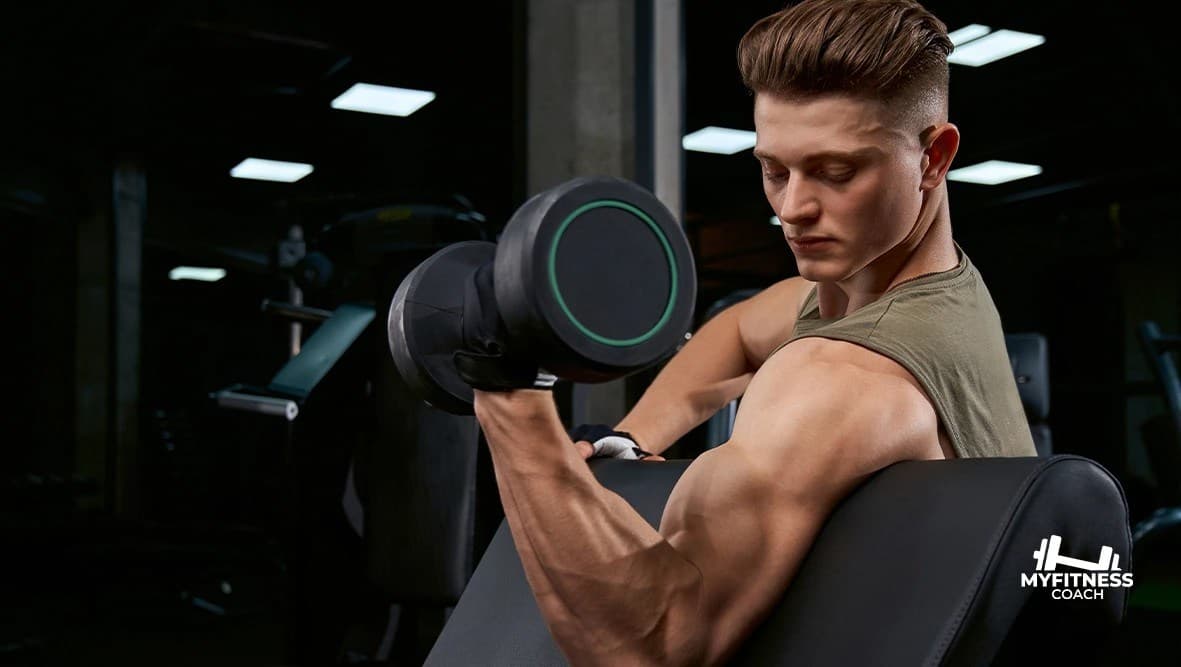
- Incline dumbbell curl — 3 x 10-12
Day 3 — Legs (Quads, Hamstrings, Calves)
- Back squat — 4 x 5-6, rest 3 min
- Romanian deadlift — 3 x 8-10
- Leg press — 3 x 10-12
- Seated leg curl — 3 x 12-15
- Standing calf raise — 4 x 12-15
Day 4 — Push (Volume Focus)
- Incline barbell press — 4 x 8-10
- Machine chest press — 3 x 10-12
- Dumbbell lateral raise — 4 x 12-15
- Cable fly — 3 x 12-15
- Rope pushdown — 3 x 12-15
Day 5 — Pull (Volume Focus)
- Weighted pull-up or assisted pull-up — 4 x 6-10
- Single-arm dumbbell row — 3 x 10-12
- Straight-arm pulldown — 3 x 12-15
- Reverse pec deck — 3 x 15
- Hammer curl — 3 x 10-12
Day 6 — Legs + Core
- Deadlift — 3 x 4-5, rest 3 min
- Bulgarian split squat — 3 x 10 per leg
- Leg extension — 3 x 12-15
- Hip thrust — 3 x 10-12
Day 7 — Full rest.
Not a light cardio day. Not a stretch day. Off.
Days 1-3 are your heavy days. Days 4-6 run lighter loads with higher reps, which is what keeps joints happy across a six-day week.
If a movement here is new to you, our guides on renegade rows and combo exercises cover setup and common form errors before you load them.
Six days of moderate work beats four days of heroic work you can't repeat next week.
Progress by adding weight when you hit the top of the rep range on every set with two reps still in the tank. That's progressive overload, and it's the only thing on this page that guarantees results.
4 Proven 6 Day Workout Split Options Compared
The four main 6 day workout split styles are push/pull/legs, upper/lower/full, the Arnold split, and body-part specialization. PPL suits most lifters, upper/lower favors strength, Arnold builds chest and back thickness, and specialization fixes lagging muscles. Choose based on your goal and available session time.
| Split | Best for | Session length | Training age | Weak spot |
| Push / Pull / Legs (x2) | Balanced size and strength | 40-50 min | 6+ months | Legs get hit only twice |
| Upper / Lower / Full (x2) | Strength on the big three | 50-60 min | 12+ months | Longer sessions |
| Arnold (chest+back, shoulders+arms, legs) | Upper body thickness | 45-60 min | 18+ months | High shoulder load |
| Body-part specialization | Fixing a lagging muscle | 30-45 min | 12+ months | Slower overall balance |
Most people reading this should pick PPL. It's the default for a reason every muscle gets trained twice weekly, and the sessions are short enough to repeat six times.
According to a 2016 meta-analysis by Brad Schoenfeld and colleagues in Sports Medicine, training a muscle group twice per week produced greater growth than training it once, with volume held equal. Every split in that table hits the twice-weekly mark. That's the shared reason they all work.
The Arnold split gets picked far more often than it should be. It stacks shoulder work on top of a heavy chest and back day, and shoulders take the longest to recover from any joint in the upper body.
The best 6 day training split is the one whose sessions you can still repeat in week nine.
How To Eat For A 6 Day Workout Routine
A 6 day workout routine needs roughly 1.6 to 2.2 grams of protein per kilogram of bodyweight daily, spread across three or four meals. Calories should sit at maintenance or slightly above for muscle gain, and no more than 20% below maintenance for fat loss. Under-eating is the most common reason six-day plans stall.
This is the section every competitor skipped, and it's the one that decides whether the plan works.
Six sessions a week means six recovery demands. If you're eating like you train for three days, you're paying for a program you can't cash.
The American College of Sports Medicine puts protein needs for active adults at 1.2 to 2.0 g/kg per day. For someone training six days, sit at the top of that range. A 175 lb (79 kg) lifter is looking at roughly 130 to 175 grams daily.
Simple targets to hit every day:
- Protein: 1.6-2.2 g per kg bodyweight
- Carbs: 3-5 g per kg on training days, lower on rest day
- Water: 3+ liters, more in a Phoenix or Dallas summer
- Sleep: 7-9 hours, non-negotiable
Carbs matter more on a six-day week than a three-day one. Glycogen doesn't fully refill between sessions if you keep them low, and by Friday your working weights drop for no obvious reason.
Our 7-day meal plan gives you a starting framework if you'd rather not build meals from scratch.
Marcus, an app user in Ohio, hit every session for three weeks and lost strength anyway. His logged protein averaged 84 grams. Once he pushed it past 150, his bench went back up within a fortnight.
You don't grow in the gym. You grow in the kitchen and in bed the gym just sends the signal.
Not sure how much you should be eating for this? MyFitnessCoach tracks your macros against your training load automatically, so you can see when your food isn't keeping up with your sessions. Snap a photo of your meal and the app logs it. See how it works.
What To Do When You Miss A Day (Because You Will)
When you miss a day in a 6 day gym workout schedule, shift the missed session forward and push the rest day back by one. If you miss two or more days in a week, skip the missed sessions entirely and resume on schedule. Never stack two sessions into one day to catch up.
Life happens. Work runs late, kids get sick, the flight gets delayed.
Here's the rule I give everyone: one missed day is a shift, two missed days is a write-off.
Miss Wednesday? Run Wednesday's session on Thursday, slide everything down, take Monday off instead. You lose nothing.
Miss Wednesday and Thursday? Pick up on Friday with Friday's workout. The missed sessions are gone. Chasing them creates a nine-day week that fits inside seven, and that's how injuries start.
Three rules that keep the plan intact:
- Never double up two sessions in one day
- Never cut the full rest day to catch up
- Never move a leg day directly next to another leg day
Some people argue you should just extend the week and finish all six sessions no matter what. The logic isn't wrong: total weekly volume does drive growth. But it quietly turns your rest day into another training day, and across a twelve-week block that debt compounds into the exact burnout you were trying to avoid.
A missed workout costs you nothing. A missed rest day costs you three weeks.
6 Day Workout Plan For Fat Loss vs Muscle Gain: What Actually Changes
The 6 day workout plan structure stays identical for fat loss and muscle gain. What changes is calories, rest periods, and added cardio. For fat loss, keep the same weights, shorten rest to 60-90 seconds, add 20 minutes of low-intensity cardio after three sessions, and eat in a modest deficit.
The mistake almost everyone makes is dropping the weights when they cut. That's backwards.
In a deficit, your lifting weights are the signal telling your body to keep the muscle it has. Drop them and you lose muscle alongside the fat.
| Variable | Muscle gain | Fat loss |
| Calories | Maintenance +200-300 | Maintenance -300-500 |
| Rest between sets | 2-3 min | 60-90 sec |
| Reps | 6-12 | 8-15 |
| Added cardio | Optional | 20 min after 3 sessions |
| Expected rate | 0.5-1 lb/month gain | 0.5-1% bodyweight/week loss |
From our own testing across app users running six-day blocks, the group that held their working weights during a cut kept noticeably more strength at week eight than the group that reduced load and raised reps. Same calories, same split. The only difference was refusing to lighten the bar.
If you're adding cardio, keep it low intensity and put it after lifting, never before. Our guide on ideal heart rate for fat burning covers the zones worth staying in.
Fat loss on six days is possible, but it's the harder version. Recovery is already stretched by frequency, and a deficit stretches it further.
Cut calories, not your working weights.
Deloads And Warning Signs In A 6 Day Training Split
Run a deload every sixth week on a 6 day training split. During a deload week, keep the same six sessions and the same exercises, but cut sets by half and reduce load by 40%. Warning signs that you need one early include stalled lifts for two weeks, disturbed sleep, and joint pain that lingers past 48 hours.
A deload feels like wasted time. It isn't.
Six weeks of high frequency builds fatigue faster than your body clears it. The deload lets that fatigue drain so the strength you built underneath finally shows up.
Pull the deload forward if you notice any two of these:
- Same weight feels heavier three sessions running
- Waking at 3am consistently
- Elbow, knee or shoulder ache lasting past two days
- Resting heart rate up 5+ bpm for a week
- Genuinely dreading the gym
That last one gets dismissed as a mindset problem. It usually isn't. Motivation dropping off a cliff is one of the earliest reliable signals of accumulated fatigue.
bianca diy , who's been using the app for eight months, ignored two stalled weeks and pushed through. She ended up taking eleven days off with an irritated shoulder. A four-day deload would have cost her far less.
A deload week is the cheapest insurance in training.
Build A 6 Day Gym Workout Plan Around Your Own Week
Build a 6 day gym workout plan by placing your two hardest sessions on days you have the most time and lowest stress, then filling the rest around them. Keep at least 48 hours between two sessions for the same muscle group, and always place the full rest day after your heaviest day, not before it.
The template above assumes a Monday start and a Sunday off. Almost nobody's week looks like that.
How do I set up a gym schedule 6 days a week around shift work?
Anchor the two heavy compound days (squat and deadlift) to your longest off-days. Everything else can move. Order matters more than day names push, pull, legs, push, pull, legs, rest.
Can I do a 6 day a week workout routine at home?
Yes, with adjustments. A 6 day exercise routine at home needs bands or adjustable dumbbells to keep progressive overload possible. Bodyweight-only versions work for the first few months, then progress stalls without added load.
What about a 6 day gym workout schedule for beginners?
Most beginners shouldn't start here. Three or four days builds the same results in the first six months with far less injury risk. Come back to six days after two solid quarters of consistent training.
Is there a 6 day gym workout schedule for women specifically?
The split doesn't change. Programming responds to training age and recovery, not gender. Many women do better adding a little more lower-body volume, and our 12-week shred plan for females covers that adjustment in detail.
Building this by hand takes real effort. Tracking whether you're progressing across eighteen exercises takes more.
The plan on paper is 20% of the work. Logging it honestly is the other 80%.
Conclusion
Pick your split, run the readiness check for a week, then start. That's the whole first step.
Everything else on this page the deloads, the missed-day rules, the food targets only matter once you're actually training. A 6 day gym workout schedule rewards the person who shows up on week nine, not the one who trains hardest in week one.
Your body will tell you when to back off. Learn to hear it early.
Ready to run this properly? MyFitnessCoach logs every set, tracks your macros against your training load, and flags recovery drops through HRV before they cost you a session. Start your plan today.
Frequently Asked Questions
Similar Articles
Stay informed with these similar articles.

MyFitnessCoach
May 9, 2025
Why Kneecaps Sweat? 5 Surprising Causes & Proven Fixes
Ever noticed your knees getting sweaty for no reason? You're not alone. Sweaty kneecaps might seem odd, but they're more common than you think.
MyFitnessCoach
March 6, 2025
Arm Swing Exercise: Effective Way to Boost Your Fitness
When it comes to fitness, we often think of intense workouts, heavy lifting, or long runs. But what if I told you that a simple exercise like arm swings could be just as effective in improving your overall fitness? Arm swing exercises are easy to do, require no equipment, and can be done anywhere. Whether you're a beginner or a fitness enthusiast, arm swings can help you improve flexibility, strength, and even cardiovascular health. In this article, we’ll explore the benefits of arm swing exercises, how to do them correctly, and how you can incorporate them into your fitness routine using the MyFitnessCoach app.

MyFitnessCoach
February 24, 2025
Best Deodorant for Athletes: Stay Fresh During Your Workouts
When you're an athlete or someone who loves to stay active, staying fresh and odor-free is a top priority. Whether you're hitting the gym, running a marathon, or sweating it out during a high-intensity workout, the right deodorant can make all the difference. But with so many options available, how do you choose the best deodorant for athletes? In this article, we’ll break down everything you need to know about finding the perfect deodorant to keep you feeling confident and fresh, no matter how intense your workout gets. Plus, we’ll show you how the MyFitnessCoach app can help you stay on top of your fitness game.