
Smith Machine Deadlift: Form, Bar Weight & 7 Fixes
MyFitnessCoach
September 4, 2026
Every barbell is taken, the platform has a queue three deep, and your warm-up is already going cold.
The Smith machine is sitting there, empty. So you pull on it, and someone on the internet tells you it doesn't count.
Here's the thing. The smith machine deadlift is a legitimate hinge, but almost every lifter sets it up wrong in three specific ways, and those three errors are what make it feel like a downgrade.
A Smith machine is a barbell locked inside steel rails, so the bar can only travel along one fixed line. Deadlift on it and you get a hip hinge with the balance problem removed and the bar path decided for you.
This guide covers what your bar actually weighs, how to tell which type of machine you're standing at, the full setup, how to fix the short range of motion, what the research says about machine training, and how to program it. No fluff.

Table of Contents
Subscribe to our newslettter
How Much Does the Smith Machine Bar Actually Weigh?
The smith machine bar weight is almost never 45 pounds. Counterbalanced models can put as little as 6 to 15 pounds in your hands, while non-counterbalanced commercial units usually start somewhere between 20 and 30 pounds. Precor's plate-loaded Smith, for example, is spec'd at a 25 pound starting weight.
This matters more here than on any other Smith exercise. Deadlifts are a heavy lift, so people track them, compare them, and program percentages off them.
If you log a Smith pull as "225" because you loaded four 45s, you might be off by 20 pounds in either direction. That's not a rounding error over a training block.
Three ways to find your bar's real weight
- Check the frame. Most manufacturers print the starting weight on a sticker near the base or the top upright. Takes ten seconds.
- Look up the model. The brand name is stamped on the machine. Search the model number plus "bar weight" and you'll usually land on the spec sheet.
- Use a bathroom scale. Set the bar to its lowest catch, rest it on a scale, and unhook it slowly. It's an estimate, not lab-grade, but it beats guessing.
Once you have that number, log it as a fixed offset. Your working load is plates plus bar, every session, and your numbers finally mean something.
| Smith machine type | Typical bar weight | What it means for your log |
| Counterbalanced (most commercial gyms) | 6–15 lb | Add very little; plate weight is nearly your true load |
| Non-counterbalanced, angled | 20–30 lb | Add the offset or you'll undercount every set |
| Heavy-duty / older plate-loaded | 30–45 lb | Closest to a real barbell, but still verify |
Angled or Straight? Check the Fixed Bar Path First
Smith machines come in two builds, and the fixed bar path decides which side you stand on. Angled machines run roughly 7 to 12 degrees off vertical. Straight machines travel dead vertical, so either side works.
Stand at an angled machine the wrong way and the bar drifts away from your body as you rise. That pulls your centre of mass forward and loads your lower back for no reason.
The two-second test
Push the unloaded bar to the top of its track and watch where it ends up. If it finishes closer to one side of the frame, that's your angle.
Stand on the side the bar is travelling toward. As you pull, it should come in toward your face and torso, not away from it.
On a straight-rail machine, pick whichever side gives your shins clearance. There's no wrong answer.
One honest limitation worth naming. A conventional barbell deadlift has a bar path that shifts slightly as your hips and shoulders move, and no rail can copy that. If you compete in powerlifting, treat this as accessory work, not skill practice.
How to Do the Smith Machine Deadlift, Step by Step
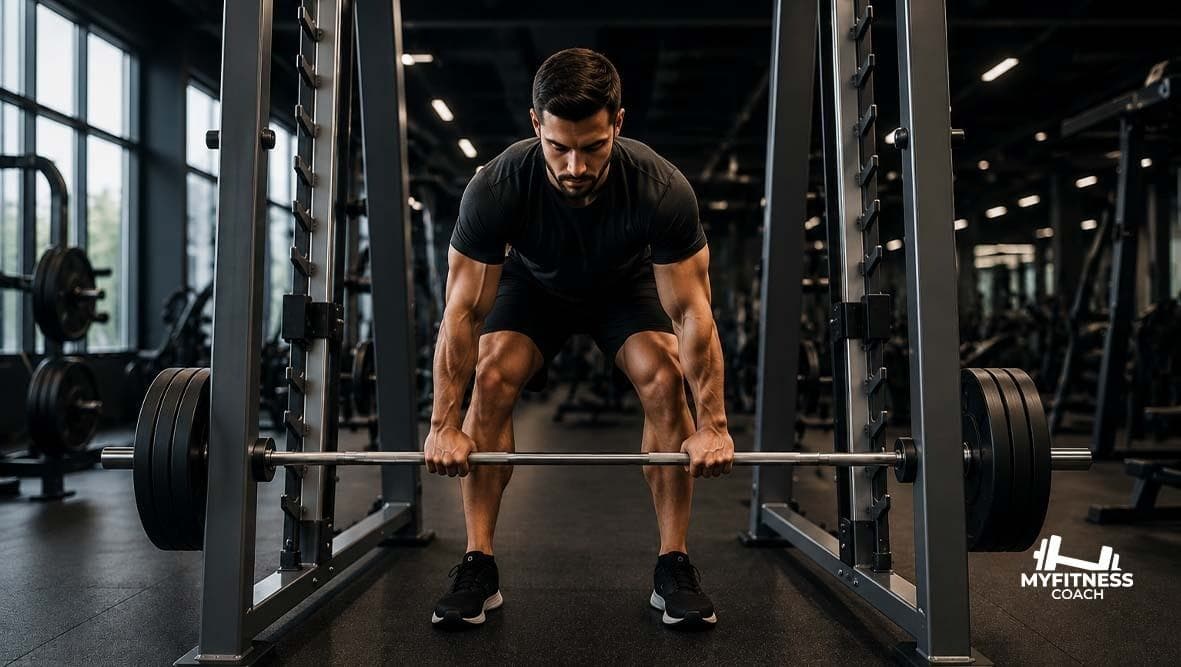
To perform a smith machine deadlift, set the bar to its lowest catch, stand with the bar over your midfoot, hinge until your hands reach it, then drive through your heels to stand tall. The rails handle balance so you handle bracing.
- Set the bar to the lowest hook and load your plates evenly.
- Confirm your side using the bar path test above.
- Stand with feet hip-width apart, bar directly over the middle of your feet, shins almost touching.
- Push your hips back and bend your knees until your hands reach the bar.
- Grip just outside your shins, double overhand or mixed.
- Set your chest, pull your shoulder blades down, and brace like someone's about to poke your stomach.
- Unhook the bar with a small wrist twist.
- Drive your feet into the floor and stand. Head leads, hips follow.
- Squeeze your glutes at the top. Don't lean back.
- Hinge the bar back down under control to the starting position.
- Repeat for reps, then re-hook the bar at the top of the final rep.
Quick tip: if the plates clang into the catches at the bottom, you're dropping the last few inches instead of controlling them. Slow that portion down.
Fixing the Short Range of Motion on a Deadlift Machine
Most Smith bars stop near knee height, which cuts the range of motion of the pull by several inches. You fix it by standing on a platform, not by lowering the bar further, because the rails won't allow it.
That missing range is real. Less distance travelled means less time under tension, and time under tension drives growth.
Building a deficit deadlift setup
Stack two 45 pound plates flat on the floor and stand on them. That gives you roughly four inches back, which is usually enough to bring the bar down to mid-shin.
Aerobic step platforms work too if your gym has them. Test the height empty before you load anything, and make sure your feet sit fully on the surface with no overhang.
Should you bother?
| Your goal | Restore full range? | Why |
| Hamstring and glute hypertrophy | Yes | Stretch under load is where the growth signal lives |
| Learning the hinge pattern | Not yet | Master the top half before adding depth |
| Working around a back or hip issue | No | The shortened range is the feature, not the flaw |
| Heavy top-end strength | No | Use a smith machine rack pull instead and load it up |
Not sure your training week actually adds up? Pair this lift with a structured split so your posterior chain gets hit twice, not four times by accident. Our 6-day gym workout schedule breaks it down day by day.
Smith Machine Deadlift Muscles Worked
The smith machine deadlift trains the glutes, hamstrings, quadriceps and erector spinae as primary movers, with the lats, traps, forearms and adductors assisting. Removing the balance demand shifts work away from the deep core stabilisers and toward the prime movers.
The posterior chain does the heavy lifting
Your glutes drive hip extension from the bottom to lockout. Hamstrings assist that extension and control the descent.
Quads matter more than people assume. They extend your knees out of the bottom position, especially when the bar starts low.
Erector spinae and grip
The erector spinae group runs alongside your spine and works isometrically the whole set. Its job is preventing your back from rounding, not producing movement.
Grip is the sleeper limiter. If your hands give out before your hips do, straps are a reasonable call on your heaviest sets.
What you train less of
Deep trunk stabilisers and the small muscles that fight side-to-side bar wobble get less work here. That's the honest trade. You're buying stability and spending stabiliser recruitment to get it.
Does It Actually Count? What the Research Says
Yes, it counts for muscle and strength. A 2023 systematic review and meta-analysis in BMC Sports Science, Medicine and Rehabilitation found no meaningful differences between free-weight and machine-based training for maximal strength, hypertrophy or jump performance.
That echoes earlier work. A 2020 study in the Journal of Strength and Conditioning Research tracked eight weeks of free weights versus machines and reported similar gains in muscle mass and strength across both groups.
The counterpoint, stated fairly
None of that means the two are interchangeable for every purpose. If your goal is a bigger competition deadlift, the barbell version trains bar path control, floor feel and full-body tension that rails hand to you for free.
Strength coaches who dislike Smith work aren't wrong about that. They're just answering a different question than "will this build my hamstrings."
When it's a smart barbell deadlift alternative
Choose the machine when the platform is occupied, when your gym has no barbell at all (several large US chains including Planet Fitness fall into this bucket), when you're rebuilding after a layoff, or when you want to load a hinge without a spotter.
Either way, resistance training is worth prioritising. The CDC recommends muscle-strengthening activity on at least two days a week for adults, and the machine you'll actually use beats the one you keep skipping.
Do you lose stabilizer muscles work?
Some, yes. The rails hold the bar steady, so your trunk and shoulder stabilisers work less than they would under a free barbell. Add carries or single-leg work elsewhere in the week if that gap bothers you.
Smith Machine Romanian Deadlift and Other Variations
The smith machine romanian deadlift is the highest-value variation here, because the fixed path suits a movement that's already meant to travel straight down the thighs. Four variations cover almost every goal.
Smith machine romanian deadlift
Set the bar at hip height and unhook it standing. Push your hips back, keep a soft knee bend, and let the bar graze your thighs on the way down.
Stop when your hamstrings tell you to, usually just below the knee. Drive your hips forward to return.
Using the RDL machine setup for hamstrings
The rdl machine setup is the easiest way to overload hamstrings without balance getting in the way. Because you're not fighting the bar sideways, you can slow the eccentric down to three or four seconds and still hold position.
Try 3 sets of 10 with a slow lowering phase. It's brutal and it works.
Sumo smith machine deadlift
Same lift, wider stance, toes turned out around 30 degrees. The sumo smith machine deadlift shortens the pull and shifts more work onto quads, adductors and glutes.
Useful if your lower back is the thing that always gives out first.
Smith machine stiff leg deadlift
Set up like the RDL but keep the knees close to locked. The smith machine stiff leg deadlift puts nearly all the tension on hamstrings and lower back.
Go lighter here than you think. This variation punishes ego.
Smith machine rack pull
Set the catches just below knee height and pull from there. The smith machine rack pull lets you handle heavier loads for the upper back and trap-dominant portion of the lift.
| Variation | Best for | Bar start height | Load |
| Standard | General strength, learning the hinge | Lowest catch | Moderate to heavy |
| Romanian | Hamstring and glute size | Hip height | Moderate |
| Sumo | Quads, adductors, easier on the back | Lowest catch | Moderate to heavy |
| Stiff leg | Hamstring stretch under load | Hip height | Light to moderate |
| Rack pull | Upper back, top-end strength | Just below knee | Heavy |
6 Common Smith Machine Deadlift Mistakes
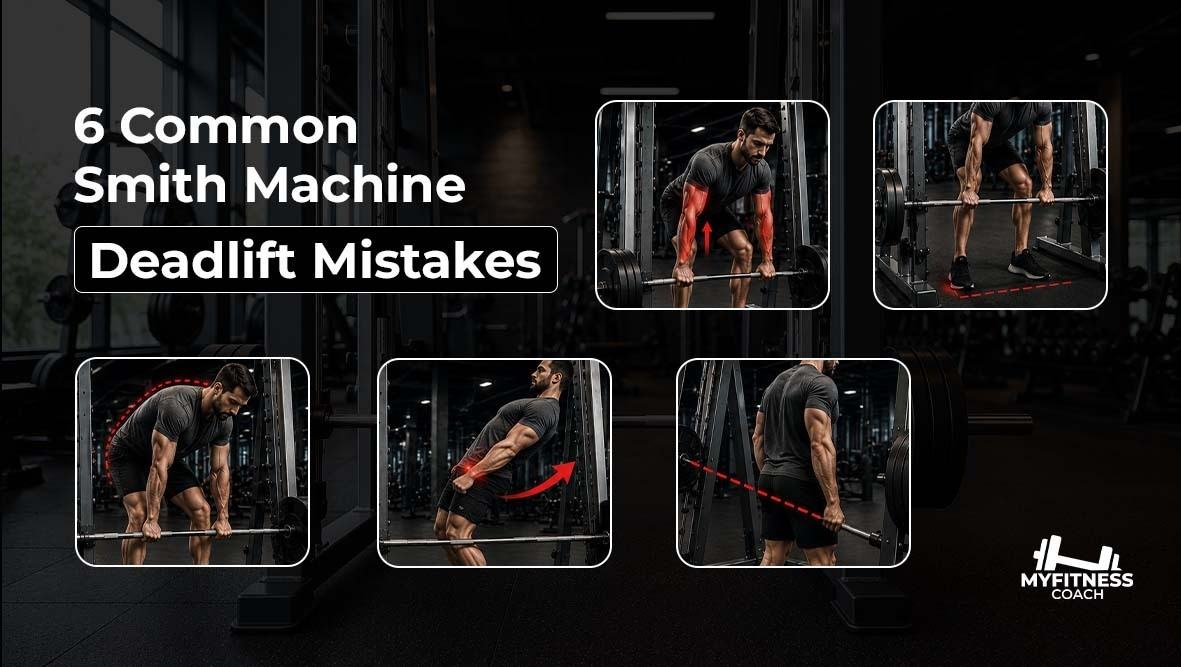
The six smith machine deadlift mistakes that cost the most are standing on the wrong side, rounding the back, leading with the hips, bouncing off the catches, standing too far from the bar, and pulling with the arms. Each has a one-line fix.
1. Standing on the wrong side of an angled machine. The bar drifts away from you and your lower back pays for it. Run the bar path test before your first set.
2. Rounding your back. Usually caused by reaching for the bar, weak bracing, or too much weight. Reset your foot position, take a real breath into your belly, and drop the load.
3. Leading with your hips. If your hips shoot up before the bar moves, you've turned the lift into a stiff-legged pull you didn't plan. Think about standing up, not lifting up.
4. Bouncing off the safety catches. Free reps that build nothing and rattle the machine. Control the last four inches down.
5. Standing too far from the bar. Your shins should be close to the rails at the bottom. Distance turns the pull into a lever your back has to fight.
6. Pulling with your arms. Your arms are hooks. Bent elbows under load are a bicep tear waiting to happen, and they steal work from your legs.
How to Program It Into Your Week
Program the smith machine deadlift once or twice a week, using 3 to 6 reps for strength and 8 to 12 for size, with 48 hours between hinge sessions. Treat it as a main lift on lower body days or a secondary lift on pull days.
| Goal | Sets x reps | Rest | Weekly frequency |
| Strength | 4 x 3–6 | 2–3 min | 1–2 |
| Hypertrophy | 3–4 x 8–12 | 90 sec | 2 |
| Muscular endurance | 3 x 12–20 | 60 sec | 1–2 |
| Technique practice | 4 x 5 (light) | 90 sec | 2–3 |
How to progress
Add weight only when your last set stays clean. Two extra reps at the same load, then bump the plates and drop back to the bottom of your rep range.
Because the bar weight is fixed and known, this lift progresses in tidy increments. Log the offset once and you'll see the trend clearly. Apps like MyFitnessCoach let you save a custom bar weight against the exercise so the numbers stay honest week to week.
Who Should Skip This Lift
Skip the smith machine deadlift if you compete in powerlifting during a peaking block, if the only machine available is steeply angled and forces an awkward stance, or if you have an active lower back injury that hasn't been cleared.
Competitive lifters need bar path skill under a free bar. Rails give you a groove you can't reproduce on the platform.
Anyone in current back pain should get cleared by a clinician before loading a hinge, machine or not. The fixed path reduces some variables. It doesn't reduce spinal load.
Very tall lifters sometimes find the bar starts too high to hinge properly even at the lowest catch. If a plate platform doesn't fix it, use dumbbells or a trap bar instead.
If none of that describes you, the smith machine deadlift earns its place in your program. Set it up right, log the real load, and it'll build the same hamstrings and glutes the barbell would.
Conclusion
Get the three setup details right and this stops being a compromise lift. Check your bar path, verify your bar weight, and add a platform if you want the full pull.
Pick one of those three today and fix it on your next session.
Start tracking it properly. Log your smith machine deadlift with the real bar weight, watch the trend over eight weeks, and let the numbers tell you when to add plates. Get MyFitnessCoach and set up your first lower-body block in under two minutes.
Frequently Asked Questions
Similar Articles
Stay informed with these similar articles.

MyFitnessCoach
May 9, 2025
Why Kneecaps Sweat? 5 Surprising Causes & Proven Fixes
Ever noticed your knees getting sweaty for no reason? You're not alone. Sweaty kneecaps might seem odd, but they're more common than you think.
MyFitnessCoach
March 6, 2025
Arm Swing Exercise: Effective Way to Boost Your Fitness
When it comes to fitness, we often think of intense workouts, heavy lifting, or long runs. But what if I told you that a simple exercise like arm swings could be just as effective in improving your overall fitness? Arm swing exercises are easy to do, require no equipment, and can be done anywhere. Whether you're a beginner or a fitness enthusiast, arm swings can help you improve flexibility, strength, and even cardiovascular health. In this article, we’ll explore the benefits of arm swing exercises, how to do them correctly, and how you can incorporate them into your fitness routine using the MyFitnessCoach app.
MyFitnessCoach
February 24, 2025
Best Deodorant for Athletes: Stay Fresh During Your Workouts
When you're an athlete or someone who loves to stay active, staying fresh and odor-free is a top priority. Whether you're hitting the gym, running a marathon, or sweating it out during a high-intensity workout, the right deodorant can make all the difference. But with so many options available, how do you choose the best deodorant for athletes? In this article, we’ll break down everything you need to know about finding the perfect deodorant to keep you feeling confident and fresh, no matter how intense your workout gets. Plus, we’ll show you how the MyFitnessCoach app can help you stay on top of your fitness game.