
Cable Shoulder Exercises: 10 Best Moves for Every Delt Head
MyFitnessCoach
March 18, 2025
The best cable shoulder exercises are the cable lateral raise for your side delts, the cable shoulder press for your front delts, and the face pull or reverse fly for your rear delts. Add one rotator cuff move and you have a complete shoulder day on a single machine.
What makes cables worth it is not the machine. It is the pulley. Move the pulley up or down and you change where the exercise is hardest, which a dumbbell cannot do. Most shoulder guides list the moves and skip this part. This one gives you the pulley height for every exercise, the most common mistake on each, a fix list for when you feel it in the wrong muscle, and three ready-to-run workouts.
Quick answer: the best cable exercise for each part of the shoulder
| Shoulder area | Best cable exercise | Pulley height | Runner-up |
| Side delts (width) | Cable lateral raise | Low (hip to knee) | Cable Y raise |
| Front delts | Cable shoulder press | Low | Single-arm cable front raise |
| Rear delts | Cable reverse fly | Shoulder height | Cable face pull |
| Rotator cuff | Cable external rotation | Elbow height | Face pull |
| Upper traps + side delts | Cable upright row | Lowest | Cable shrug |

Table of Contents
Subscribe to our newslettter
Why Cables Hit Your Shoulders Differently
A dumbbell always pulls straight down. That means a dumbbell lateral raise is almost weightless at the bottom and hardest only when your arm is level with the floor.
A cable pulls along the line of the cable. Set the pulley low and to your side, and the cable is already pulling against your delt in the first few inches of the rep. Your shoulder works through the whole range instead of just the top half.
That gives you three practical advantages:
- You choose where the rep is hardest. Pulley height and where you stand change the angle of pull, so you can load the stretched or the squeezed part of the movement.
- Single-arm work is easy. Clip on one handle and train each side alone. A weaker shoulder cannot hide behind the stronger one.
- Small jumps in weight. Most cable stacks move in small plates, which helps on isolation moves like raises where a jump of 5 lb in dumbbells is often too big.
The trade-off is honest too: heavy pressing is awkward on most cable machines. Cables shine for isolation work and shoulder health, so pair them with a free-weight or machine press if strength is your main goal.
Shoulder anatomy in 60 seconds
Your deltoid has three heads, and each needs a different line of pull:
| Head | What it does | Trained by |
| Front (anterior) | Lifts the arm forward and overhead | Presses, front raises |
| Side (lateral) | Lifts the arm out to the side | Lateral raises, Y raises, upright rows |
| Rear (posterior) | Pulls the arm back and out | Reverse flys, face pulls, rear delt rows |
Under the deltoid sits the rotator cuff, four small muscles that keep the ball of the shoulder centred in its socket. They do not add much size, but they are what keeps a heavy pressing program pain-free.
Most lifters overtrain the front head, because every bench press and push-up already works it. The side and rear heads are what make shoulders look wide and round from every angle, so this guide gives them most of the exercises.
The 10 Best Cable Shoulder Exercises
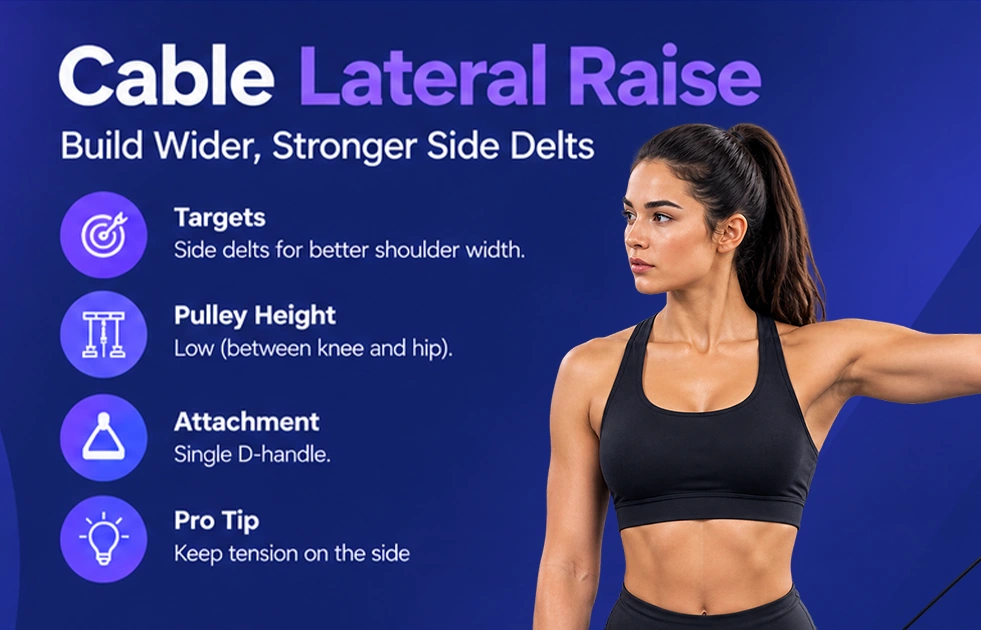
The exercises are grouped by the part of the shoulder they target. Pick at least one from each group and your shoulders are covered.
Side delts
1. Cable lateral raise
Targets: side delts · Pulley: low, set between knee and hip · Attachment: single D-handle
- Stand side-on to the machine and hold the handle in the hand farthest from it, cable crossing in front of your body.
- Keep a soft bend in the elbow and raise your arm out to the side until your hand is level with your shoulder.
- Lower for a slow two-count, stopping just before the plate touches the stack so the tension never leaves.
- Do all reps on one side, then switch.
1 mistake: setting the pulley right at the floor and yanking the first few inches with momentum. Raising the pulley to knee or hip height keeps tension on the side delt at the top, where the floor setting drops off.
For a full breakdown of lateral raise variations, see our guide to the lateral raise machine.
2. Leaning single-arm cable lateral raise
Targets: side delts, with extra load in the stretched position · Pulley: lowest · Attachment: single D-handle
- Hold the machine upright with your near hand and lean your body away from it, feet close to the base.
- With the far hand, raise the handle out to the side to shoulder height.
- Lower slowly until your arm crosses slightly in front of your hip.
1 mistake: leaning so far that you pull yourself back upright on every rep. Pick a lean you can hold still. This is the cable version of the Egyptian lateral raise.
3. Cable Y raise
Targets: side and rear delts, lower traps · Pulley: lowest, both sides · Attachment: two D-handles, or no handle (grip the cable ball)
- Stand in the middle of the station and cross the cables: left hand holds the right cable, right hand holds the left.
- Hinge slightly forward and raise both arms up and out into a "Y", thumbs pointing up.
- Stop when your arms are just above shoulder height, then lower with control.
1 mistake: going too heavy. The Y raise is a light, high-rep move. If your lower back arches to finish the rep, drop the weight.
Front delts
4. Cable shoulder press
Targets: front and side delts, triceps · Pulley: lowest, both sides · Attachment: two D-handles
- Stand (or kneel) in the middle of the station with the handles at shoulder height, palms forward.
- Brace your core and press both handles straight overhead until your arms are almost locked.
- Lower until your hands are back at shoulder height.
Variations: kneeling takes your legs and lower back out of it; seated on a bench lets you go heavier; single-arm alternating adds a core challenge.
1 mistake: arching the lower back to finish the press. Squeeze your glutes, or switch to the kneeling version, and the arch disappears.
5. Single-arm cable front raise
Targets: front delts · Pulley: lowest · Attachment: D-handle, or a rope for a neutral grip
- Stand facing away from the machine with the cable running between your legs or beside your hip.
- Raise your straight arm forward to shoulder height.
- Lower slowly.
1 mistake: leaning back to swing the weight up. If you need to lean, the weight is too heavy. Full technique in our cable front raise guide, and the muscles it hits in front raise muscles worked.
Skip it if you already bench and overhead press every week. Your front delts are probably getting enough.
Rear delts
6. Cable reverse fly (rear delt crossover)
Targets: rear delts, mid traps, rhomboids · Pulley: shoulder height, both sides · Attachment: none (grip the cable ball) or D-handles
- Stand in the middle and cross the cables: left hand takes the right cable, right hand takes the left.
- With arms almost straight, sweep both hands out and back until they are in line with your body.
- Return slowly until your hands cross again.
1 mistake: squeezing the shoulder blades hard together. That shifts the work to your upper back. Keep the shoulder blades still and think "hands wide" instead of "squeeze back". More rear delt options in our rear delt raises guide.
7. Cable face pull
Targets: rear delts, external rotators, mid traps · Pulley: forehead height · Attachment: rope
- Grab the rope with thumbs pointing back and step back until your arms are straight.
- Pull the rope toward your face, splitting the ends apart as your elbows go high and wide.
- Finish with your knuckles pointing to the ceiling and pause for a second.
1 mistake: pulling to your chest with low elbows. That turns it into a row. Step-by-step form in our cable face pulls with rope guide.
8. Single-arm cable rear delt row
Targets: rear delts, upper back · Pulley: shoulder height · Attachment: D-handle
- Face the machine and hold the handle with one hand, arm straight.
- Row the handle back with your elbow flared out to the side at shoulder height, not tucked by your ribs.
- Stop when your elbow is in line with your body, then return slowly.
1 mistake: tucking the elbow. A tucked elbow trains your lats; a flared elbow trains your rear delt.
Rotator cuff
9. Cable external rotation
Targets: infraspinatus and teres minor (rotator cuff) · Pulley: elbow height · Attachment: D-handle
- Stand side-on to the machine and hold the handle in the far hand, elbow bent 90° and pinned to your side. A rolled towel between elbow and ribs helps.
- Rotate your forearm out, away from your stomach, keeping the elbow in place.
- Return slowly.
1 mistake: going heavy. These are small muscles. Use a weight you can move for 15 to 20 clean reps.
Traps and side delts
10. Cable upright row
Targets: side delts, upper traps · Pulley: lowest · Attachment: straight bar or rope
- Face the machine and hold the bar with an overhand grip, hands just outside shoulder width.
- Pull the bar up along your body, leading with your elbows.
- Stop when your elbows reach shoulder height, then lower.
1 mistake: a close grip and pulling to the chin. Many lifters feel pinching at the front of the shoulder that way. A wider grip and stopping at mid-chest height keeps the benefit and loses the discomfort. More in our upright row benefits and muscles worked guide.
Pulley Height Cheat Sheet
Pulley height decides which part of the rep is hardest. Use this table to set up in seconds.
| Pulley height | Exercises | Main target | Where the rep is hardest |
| Lowest (floor) | Shoulder press, front raise, upright row, Y raise, leaning lateral raise | Front and side delts | Bottom and middle of the lift |
| Knee to hip | Cable lateral raise | Side delts | Evenly through the whole rep, including the top |
| Elbow height | External rotation | Rotator cuff | Middle of the rotation |
| Shoulder height | Reverse fly, rear delt row | Rear delts | When your arms are out wide |
| Forehead height | Face pull | Rear delts, rotator cuff | End position, elbows high |
Rule of thumb: the cable should point straight at the muscle you are working when your arm is in the hardest part of the rep. If it points somewhere else, move the pulley.
Troubleshooting: "I Feel It in the Wrong Place"
Feeling an exercise in the wrong muscle is the most common reason cable shoulder work does not build shoulders. Find your problem, then apply the fix.
| Problem | Likely cause | Fix |
| Lateral raise burns in the traps, not the side delt | Shrugging the shoulder up, or lifting above shoulder height | Push the shoulder down before you lift and stop at shoulder level; drop the weight |
| Lateral raise feels dead at the top | Pulley set at the floor | Raise the pulley to knee or hip height |
| Reverse fly works the upper back more than the rear delt | Pinching the shoulder blades together | Keep shoulder blades still, reach "wide" instead of "back" |
| Face pull feels like a biceps curl | Elbows dropping, pulling with the hands | Raise the pulley to forehead height, lead with the elbows |
| Rear delt row hits the lats | Elbow tucked to the ribs | Flare the elbow out to shoulder height |
| Shoulder press arches the lower back | Weight too heavy or core not braced | Squeeze glutes, or switch to the kneeling press |
| Pinching at the front of the shoulder on upright rows | Grip too narrow, pulling too high | Widen the grip, stop at mid-chest |
| One side always tires first | Strength imbalance hidden by two-arm moves | Start every raise with your weaker side and match its reps on the strong side |
| Nothing burns at all | Weight too light, or rushing the lowering phase | Take 2 to 3 seconds to lower every rep |
Sharp pain, clicking with pain, or pain that lasts after the workout is not a form issue. Stop that exercise and get the shoulder checked by a physiotherapist or doctor.
3 Cable Shoulder Workouts
Each workout runs on one cable station and takes 30 to 40 minutes. Warm up first with 5 minutes of light cardio and two easy sets of face pulls.
Workout 1: Beginner (full shoulder, 2x per week)
| Exercise | Sets | Reps | Rest |
| Kneeling cable shoulder press | 3 | 10–12 | 90 s |
| Cable lateral raise | 3 | 12–15 per side | 60 s |
| Cable face pull | 3 | 15 | 60 s |
| Cable external rotation | 2 | 15 per side | 45 s |
Add one rep per set each week. Once you hit the top of every rep range, go up one plate.
Workout 2: Hypertrophy (bigger, wider shoulders)
| Exercise | Sets | Reps | Rest |
| Cable shoulder press | 4 | 8–12 | 2 min |
| Cable lateral raise | 4 | 12–15 per side | 60 s |
| Leaning single-arm lateral raise | 3 | 12–15 per side | 60 s |
| Cable reverse fly | 3 | 12–15 | 60 s |
| Cable Y raise | 2 | 15 | 45 s |
Take the last set of each raise close to failure, stopping when you have about one clean rep left.
Workout 3: Posture and shoulder health
| Exercise | Sets | Reps | Rest |
| Cable face pull | 3 | 15–20 | 60 s |
| Single-arm rear delt row | 3 | 12 per side | 60 s |
| Cable external rotation | 3 | 15 per side | 45 s |
| Cable Y raise | 3 | 12–15 | 45 s |
This one works well as a short add-on after a chest or push day, or as a desk-worker session on its own.
If you want these sessions laid out for you with the weights and reps logged week to week, the MyFitnessCoach app builds cable-based shoulder days into its workout plans and tracks your progression.
How Many Shoulder Sets Per Week?
More weekly sets build more muscle, but each extra set adds a little less than the one before. That is the finding of the largest analysis on the topic so far.
- A 2017 meta-analysis by Schoenfeld, Ogborn and Krieger found a graded dose-response: more weekly sets per muscle produced more growth.
- A 2025 set of meta-regressions by Pelland and colleagues pooled 67 studies and 2,058 participants. Muscle growth kept rising with weekly volume, with diminishing returns. Once volume was accounted for, training a muscle more often per week made little difference to growth.
The same analysis found it worked best to count an indirect set as half a set. That matters for shoulders:
- Front delts: every set of bench press, incline press or push-ups counts as roughly half a front delt set. If you already press twice a week, you may need little or no extra front delt work.
- Side and rear delts: most chest and back training barely reaches them, so the sets you do in this guide are close to all they get.
Practical starting point: begin with 6 to 8 direct sets per week each for side delts and rear delts, split across two sessions. If you recover well and progress stalls after a few weeks, add 2 sets. If your shoulders feel beaten up, drop back. This range is a coaching starting point based on the research above, not a number any single study prescribes.
No Cable Machine? Band and Home Swaps
A resistance band anchored at the right height copies most of these movements. The band gets harder as it stretches, so the top of each rep will feel heavier than on a cable.
| Cable exercise | Home swap | How to set it up |
| Cable lateral raise | Band lateral raise | Stand on one end of the band, raise the other hand out to the side |
| Cable shoulder press | Band overhead press | Stand on the middle of the band, press both ends overhead |
| Cable reverse fly | Band pull-apart | Hold the band at shoulder height, pull it apart to your chest |
| Cable face pull | Band face pull | Anchor the band at forehead height in a door anchor |
| Cable external rotation | Band external rotation | Anchor at elbow height, same form as the cable version |
| Cable Y raise | Band Y raise | Stand on the band, cross the ends, raise into a Y |
A wall-mounted or folding home functional trainer runs every exercise in this guide exactly as written. If you are building a home gym, a dual-pulley unit with adjustable heights is what you need for the reverse fly and Y raise.
Build Shoulders That Look Good From Every Angle
Wide, round shoulders come from the side and rear delts, and cables train both better than almost any other tool. Pick one exercise per head, set the pulley so the cable points at the working muscle, and add a little weight or a rep each week.
If you want a plan that schedules these sessions and tracks your progress for you, try the MyFitnessCoach app.
Frequently Asked Questions
Similar Articles
Stay informed with these similar articles.

MyFitnessCoach
September 16, 2025
Lateral Raise Machine: The Complete Guide to Stronger Shoulders
If you want wide, well-defined shoulders, the lateral raise machine is one of the most effective tools you can use. While dumbbell lateral raises are a popular choice, using a machine provides more stability, helps you isolate the medial deltoids, and reduces the risk of form breakdown. Whether you are a beginner or an experienced lifter, the lateral raise machine can help you develop round shoulders and improve overall upper body aesthetics.

MyFitnessCoach
December 26, 2023
Power of Egyptian Lateral Raises for Strong Shoulder
Do you want your shoulders to look big, round, and strong, making you stand out in your t-shirt and feel like a superhero at the beach? Most people do!

MyFitnessCoach
September 27, 2023
Mastering the Cable Front Raise: A Comprehensive Guide
In the quest for a sculpted upper body, a diverse exercise routine is essential. Among the array of exercises available, the cable front raise stands out as a powerhouse for targeting the front deltoids. This exercise, performed using a cable machine, can be a game-changer in your pursuit of well-defined shoulders. This guide is your comprehensive resource for mastering the cable front raise, covering everything from technique and benefits to variations and expert tips.