
Personalized Workout Plan: 6 Steps to Stop Quitting Early
MyFitnessCoach
September 7, 2026
You downloaded a workout off Instagram, followed it for two weeks, then quietly let it fade. Almost everyone has that story.
The fix isn't more willpower. It's a personalized workout plan, a routine shaped around your goals, your schedule, and the gear you actually own. A plan built for one specific person beats a copied one because it accounts for the variable that generic routines ignore: you.
This guide breaks down what a personalized workout plan is, how to build one step by step, and when an app or a trainer makes more sense than doing it yourself. No fluff, no filler, just the parts that change results.
Table of Contents
Subscribe to our newslettter
What Is a Personalized Workout Plan?
A personalized workout plan is a training schedule designed around one person's fitness level, goals, available days, and equipment instead of a one-size-fits-all routine. It sets which exercises you do, how often, and how hard, and it changes as you get stronger.
Think of it as the difference between a tailored suit and one off the rack. Both cover you. Only one fits.
Three things make a plan "personalized" rather than generic:
- It starts from your current ability, not an average person's.
- It matches your real week, the days and minutes you can commit.
- It moves toward your goal, whether that's fat loss, muscle, or just more energy.
Get those three right and you have the backbone of every good custom workout plan.
Why a Personalized Plan Beats a Generic One
A personalized workout plan beats a generic one because it removes the two biggest reasons people quit: workouts that don't fit their life, and progress they can't see. When a plan matches your schedule and skill, showing up gets easier and consistency is what drives results.
The scale of the problem is real. According to the Physical Activity Guidelines for Americans, adults need 150 minutes of moderate aerobic activity a week plus muscle-strengthening on two or more days. Yet the CDC reports only about 24% of U.S. adults hit both targets, and roughly 46% meet neither.
Most of those mistakes aren't laziness. They're a mismatch. A five-day gym split handed to someone with three free evenings was never going to survive contact with real life.
A plan built around your constraints fixes that. It asks how many days you actually have, then works backward so the routine bends to your week instead of breaking against it.
How to Build a Personalized Workout Plan in 6 Steps
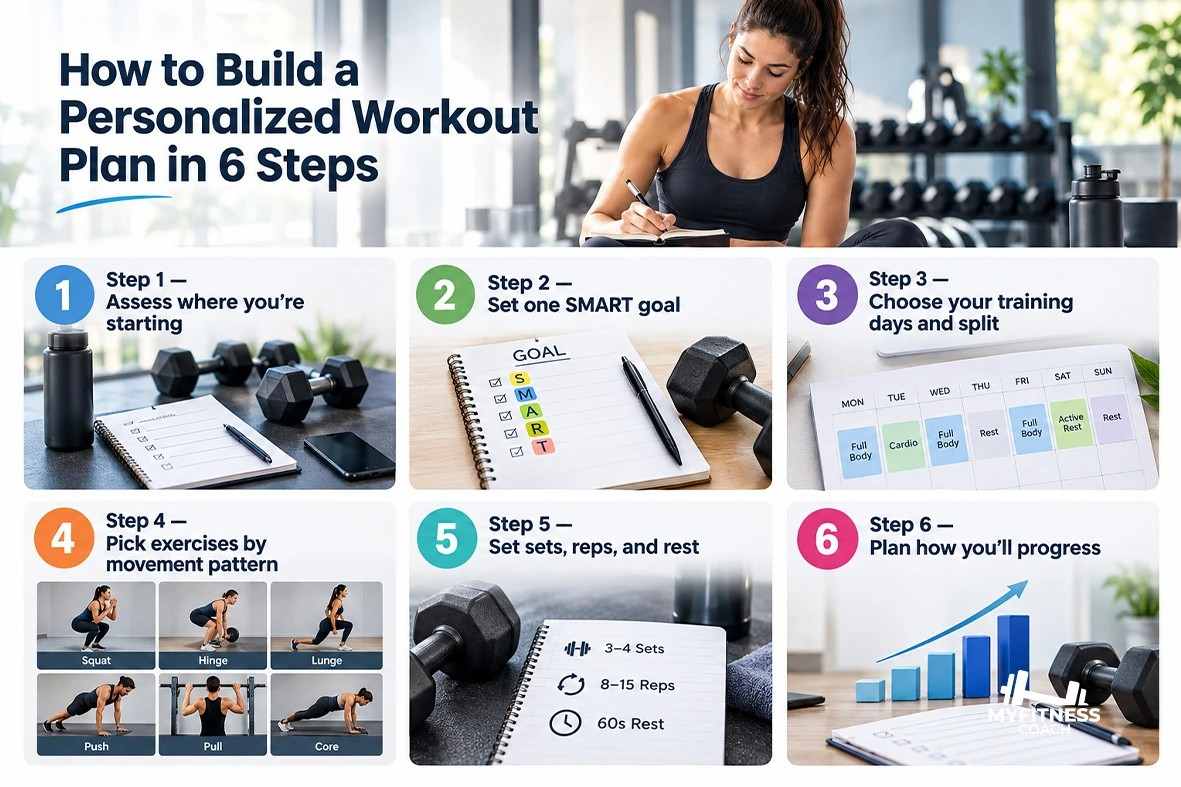
To build a personalized workout plan, assess your current level, set one clear goal, pick your training days, choose exercises by movement pattern, set your sets and reps, then plan how you'll progress. Here's each step in plain terms.
Step 1 — Assess where you're starting
Be honest about your current fitness. Note what movements feel easy, what feels shaky, and any old injuries. Write down how many days a week you can train and what equipment you have. This starting point shapes everything that follows.
Step 2 — Set one SMART goal
Pick a goal that's Specific, Measurable, Achievable, Relevant, and Time-based. "Get fit" is a wish. "Add 2 pounds of muscle in 8 weeks" or "train 3 days a week for a month" is a target you can actually chase. New to training? Make your first goal about consistency, not numbers.
Step 3 — Choose your training days and split
Match your split to the days you have. A weekly split just decides which body parts you train on which days. Fewer days means full-body sessions; more days lets you split upper and lower.
Here's a simple beginner full-body week that fits most schedules:
| Day | Focus |
| Monday | Full-body strength |
| Tuesday | Easy cardio (walk, bike) |
| Wednesday | Full-body strength |
| Thursday | Rest or light walk |
| Friday | Full-body strength |
| Saturday | Active rest |
| Sunday | Rest |
Step 4 — Pick exercises by movement pattern
Cover six patterns and you've trained your whole body: squat, hinge (bend), lunge, push, pull, and core. Choose one exercise per pattern for each session. Order them hardest to easiest big compound lifts first, small isolation moves last. That's when you have the most energy for the moves that matter most.
Step 5 — Set sets, reps, and rest
Beginners do well with 2–4 sets of 8–15 reps per exercise, resting 60 seconds between sets. Higher reps build control and endurance while you learn the movements. As you advance, heavier weight and lower reps build strength. Quality over quantity 10 clean reps beat 20 sloppy ones.
Step 6 — Plan how you'll progress
A plan isn't a one-time document. Decide how you'll make it harder over time: a little more weight, an extra rep, one more set. Without a progression rule, your personalized workout plan stops working the moment your body adapts. More on this below.
Quick start: If you only remember one thing, it's this: pick your days first, then fit the training to them. That single move is why a personalized workout plan sticks when a copied one doesn't. Prefer to skip the spreadsheet? An app can generate the whole structure from your answers in about a minute.
Custom Workout Plan for Your Schedule and Equipment
A custom workout plan works at home or in the gym. You just swap the tools, not the logic. The movement patterns stay the same; only the equipment changes. A push at the gym is a bench press; at home it's a push-up or a band press.
Match your training days to what you realistically have:
- 2–3 days: Full-body every session. Best return for a busy week.
- 4 days: Upper/lower split, alternating.
- 5–6 days: Push, pull, legs or a body-part split for more advanced lifters.
No barbell? No problem. Bodyweight, resistance bands, and a pair of dumbbells cover every pattern. The plan doesn't care where you train, only that you keep showing up. For a ready-made structure at the higher end, this 6-day gym workout schedule shows how the split scales up.
AI Workout Plan Apps vs Trainers vs Templates
The fastest way to get a personalized workout plan is one of four routes: build it yourself, hire a trainer, use a printable template, or let an AI workout plan app generate it. Each trade costs against convenience and depth. Here's how they compare.
| Route | Best for | Rough cost | Personalization | Effort from you |
| Build it yourself | People who like control | Free | High (if you know the rules) | High |
| Printable template | Simple, fixed goals | Free–$15 | Low | Medium |
| AI workout plan app | Speed + auto-adjusting | Free–$15/mo | High, and it adapts | Low |
| Personal trainer | Hands-on form + accountability | $40–$100/session | Very high | Low |
Templates are quick but static they can't react when your week changes. A trainer gives the deepest personalization and real-time form checks, at the highest price. An ai workout plan app sits in the sweet spot for most people: it takes your goals, days, and equipment, then builds and updates the plan as you log workouts. The MyFitnessCoach app works this way, adjusting your routine from what you actually complete rather than a fixed sheet.
There's no single "best" route. The right one is whichever you'll stick with.
How to Adjust and Progress Your Plan
To keep a personalized workout plan working, apply progressive overload small, steady increases in weight, reps, or sets over time. Your body adapts to a set challenge within a few weeks, so the plan has to keep nudging forward or progress stalls.
Simple ways to progress each week or two:
- Add a rep or two to each set.
- Add a little weight once you hit the top of your rep range.
- Add a set to a lagging movement.
- Shorten rest slightly to raise the challenge.
Track it. A quick note of your weights and reps turns "I think I'm improving" into proof and seeing progress is one of the strongest reasons people keep going. Review the whole plan every 4–6 weeks and swap any exercise that's stopped feeling productive. Movements like renegade rows or combination exercises are easy upgrades when a basic pattern gets stale.
Common Personalized Workout Plan Mistakes to Avoid
The most common personalized workout plan mistake is copying an advanced routine that doesn't match your level or your week. A plan you can't sustain isn't personalized, it's just someone else's plan with your name on it.
Watch for these:
- Too many days, too soon. Six sessions look great until week two. Start with what fits.
- No progression rule. Same weights forever means results flatline.
- Skipping recovery. Rest days are when muscle actually rebuilds.
- Chasing complexity. Fancy exercises don't beat consistent basics.
- No tracking. If you don't log it, you can't tell what's working.
Fix these five and you're ahead of most people who start a routine each January.
Your Next Step
A personalized workout plan isn't complicated, it's just yours. Pick your days, match the training to them, and add a little each week. That's the whole game.
Want the structure built for you? The MyFitnessCoach app turns your goals, schedule, and equipment into a plan that adapts as you go so all you have to do is show up. Try it for free.
Frequently Asked Questions
Similar Articles
Stay informed with these similar articles.

MyFitnessCoach
May 9, 2025
Why Kneecaps Sweat? 5 Surprising Causes & Proven Fixes
Ever noticed your knees getting sweaty for no reason? You're not alone. Sweaty kneecaps might seem odd, but they're more common than you think.
MyFitnessCoach
March 6, 2025
Arm Swing Exercise: Effective Way to Boost Your Fitness
When it comes to fitness, we often think of intense workouts, heavy lifting, or long runs. But what if I told you that a simple exercise like arm swings could be just as effective in improving your overall fitness? Arm swing exercises are easy to do, require no equipment, and can be done anywhere. Whether you're a beginner or a fitness enthusiast, arm swings can help you improve flexibility, strength, and even cardiovascular health. In this article, we’ll explore the benefits of arm swing exercises, how to do them correctly, and how you can incorporate them into your fitness routine using the MyFitnessCoach app.

MyFitnessCoach
February 24, 2025
Best Deodorant for Athletes: Stay Fresh During Your Workouts
When you're an athlete or someone who loves to stay active, staying fresh and odor-free is a top priority. Whether you're hitting the gym, running a marathon, or sweating it out during a high-intensity workout, the right deodorant can make all the difference. But with so many options available, how do you choose the best deodorant for athletes? In this article, we’ll break down everything you need to know about finding the perfect deodorant to keep you feeling confident and fresh, no matter how intense your workout gets. Plus, we’ll show you how the MyFitnessCoach app can help you stay on top of your fitness game.