
Overhead Press Machine: 7 Mistakes Killing Your Gains
MyFitnessCoach
September 14, 2026
You sit down at the shoulder press station, guess the seat height, and start pushing then wonder why your shoulders feel cranky instead of strong.
That small setup slip is the difference between a great shoulder day and a wasted one. The overhead press machine is one of the friendliest ways to build round, strong shoulders but only when you use it right.
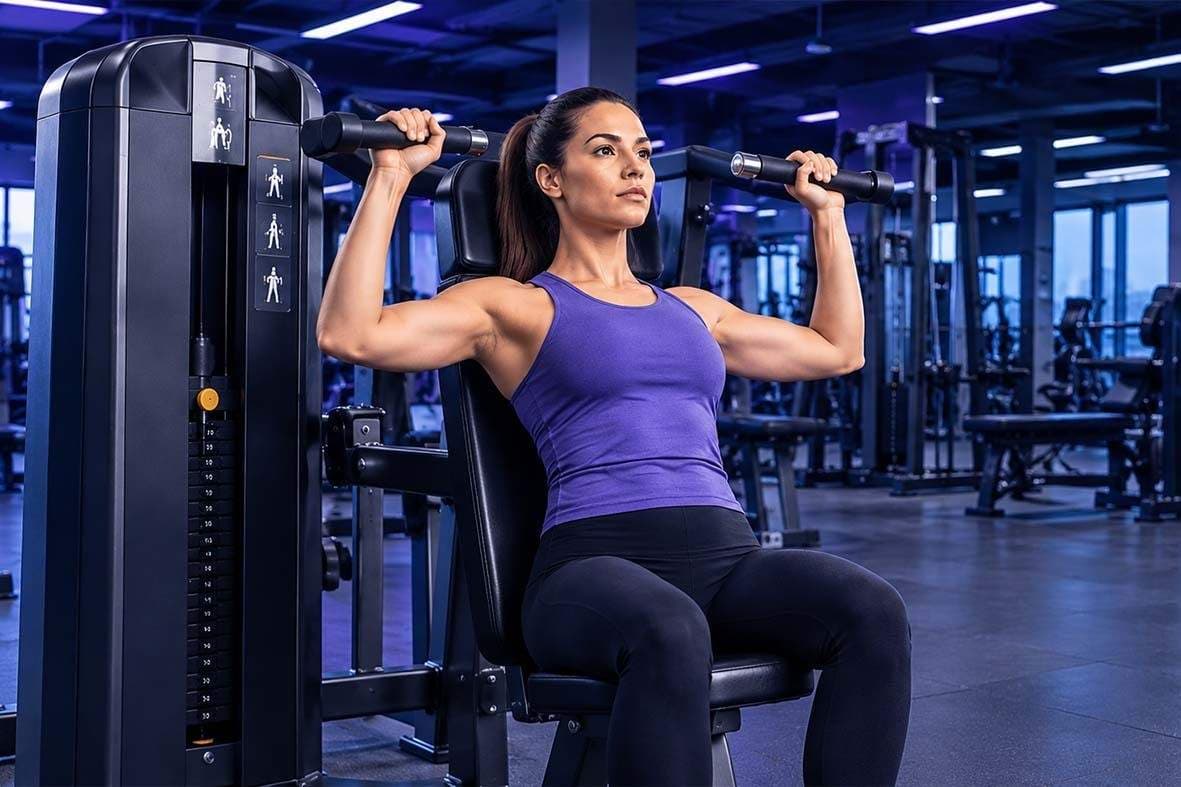
The overhead press machine, also called the shoulder press machine, is a seated resistance machine that guides your arms straight overhead along a fixed path. It trains your deltoids, triceps, and upper chest while asking far less of your balance and stabilizer muscles than free weights do.
Here's what you'll get below: how to set the machine up in seconds, which muscles it actually hits, a clean step-by-step lift, how it compares to dumbbells and barbells, the machine types you'll meet in US gyms, and the small fixes that keep your shoulders happy.

Table of Contents
Subscribe to our newslettter
Set Up the Overhead Press Machine in 4 Quick Steps
To set up the overhead press machine, adjust the seat so the handles rest at shoulder height, plant your feet flat, press your back into the pad, and grip the handles with your palms facing forward. Seat height is the single biggest factor in a safe, strong press.
Get this part right and everything else falls into place. Get it wrong and you'll either cut your range short or strain the front of your shoulder.
- Set the seat. Handles should line up at or just below shoulder level, not up by your ears.
- Anchor your body. Feet flat on the floor, hips and upper back flush against the pad.
- Check the handles. Neutral or overhand grip, wrists stacked over elbows.
- Do a light test rep. If your shoulders shrug or pinch at the top, drop the seat a notch.
Handle alignment matters as much as seat height. If the handles sit too high, you'll fight shoulder impingement on every rep, so nudge the seat until the press feels smooth from bottom to lockout.
Overhead Press Machine Muscles Worked
The overhead press machine mainly works the deltoids, the front and side heads that cap your shoulder with the triceps and upper chest assisting and the trapezius stabilizing your shoulder blades. It's a compound push that builds real overhead strength.
Here's what each muscle does during the movement:
- Deltoids (front and side). The primary movers. They lift the handles up and out, and they're the muscles you're really here to grow.
- Triceps. They straighten your elbows to finish each rep. For full triceps growth, pair pressing with an isolation move like skull crushers.
- Upper chest. The clavicular part of your pecs pitches in near the bottom of the press.
- Trapezius. The upper traps rotate and steady your shoulder blades so the load travels cleanly overhead.
The fixed path is the trade-off. Because the machine balances the weight for you, the smaller rotator-cuff and postural muscles work less than they would with dumbbells. That's a plus for beginners and a minor drawback for anyone chasing raw stability.
How to Use the Shoulder Press Machine: Step-by-Ste
To use the shoulder press machine, sit tall with your back supported, grip the handles at shoulder height, press straight up until your arms are almost locked, then lower under control. Keep the movement smooth and vertical.
- Sit and brace. Back against the pad, feet flat, core tight.
- Grip. Hold the handles with an overhand or neutral grip at shoulder height.
- Press. Exhale and push the handles up in a straight line until your elbows are nearly straight and stop just short of a hard lockout.
- Pause. Hold for a beat at the top without shrugging.
- Lower. Inhale and bring the handles back to shoulder height slowly, keeping tension on your delts.
- Repeat. Aim for controlled reps over fast, bouncy ones.
Two cues carry most of the results: don't slam into a locked elbow at the top, and don't let the weight free-fall on the way down. Slow negatives are where a lot of the shoulder growth hides.
New to shoulder training? Start light, own the technique for a week, then add weight. Nailing the pattern first pays off for months.
Overhead Press Machine vs Free Weights: Which Should You Use?
The overhead press machine is safer and easier to learn, while free weights build more stability and let you press through a natural range of motion. For most lifters, the smartest move is to use both and not to pick a side.
Here's the honest part most guides skip. According to the American College of Sports Medicine's 2026 resistance-training position, its first major update in 17 years, built on more than 130 research reviews, the choice between machines and free weights did not consistently change strength or muscle-growth outcomes for the average healthy adult. In plain terms: the machine can absolutely build your shoulders. Consistency and effort matter more than the tool.
| Factor | Overhead Press Machine | Free Weights (Barbell / Dumbbell) |
| Learning curve | Easy — guided path | Steeper — needs practice |
| Beginner safety | Higher, no spotter needed | Lower, form-dependent |
| Stabilizer demand | Low | High |
| Range of motion | Fixed | Natural, adjustable |
| Solo heavy lifting | Safer to push near-failure | Riskier without a spotter |
| Best for | Beginners, high-volume sets, injury-safe pressing | Functional strength, advanced lifters |
Which is safer for beginners? The machine. Its guided path keeps your form honest and removes the balance challenge that trips up new lifters, which is why gyms point beginners there first.
If you're brand new, coming back from a tweak, or grinding out extra volume at the end of a session, the machine wins. If you want carryover to sport and daily life, work free-weight pressing in too.
5 Types of Shoulder Press Machines You'll See in the Gym
Shoulder press machines come in a handful of styles, and the main difference is how you load them and how the arms move. Most US gyms carry at least two of the five below.
| Machine Type | How It Loads | Best For |
| Selectorized (pin-loaded) | Weight stack + pin | Quick sets, beginners, drop sets |
| Plate-loaded | Olympic plates | Heavier, natural resistance curve |
| Lever / iso-lateral | Plates, independent arms | Fixing side-to-side imbalances |
| Smith machine | Barbell on fixed rails | Guided barbell press, going near-failure alone |
| Converging | Handles arc inward | A more shoulder-friendly press path |
A quick note on the Smith machine: it isn't a dedicated shoulder press machine, but its fixed vertical bar makes seated pressing simple and safe, so plenty of lifters use it that way. Iso-lateral machines are the pick if one shoulder is stronger than the other, since each arm moves on its own.
Benefits of the Overhead Press Machine
The overhead press machine builds shoulder size and strength with a low barrier to entry. Here's why it earns a spot in most push workouts:
- 💪 Builds the front and side delts for wider, rounder shoulders
- 🎯 Guided path keeps your form tight, rep after rep
- 🔰 Beginner-friendly no balancing, no spotter
- 🛟 Lower injury risk than free-weight pressing
- 🔁 Easy to load and adjust between sets
- 🧱 Lets you safely push close to failure on your own
- ⚡ Great as a high-volume finisher after heavy free-weight work
- 🩹 Kinder on the shoulders when you're returning from a minor niggle
7 Common Mistakes (and Easy Fixes)
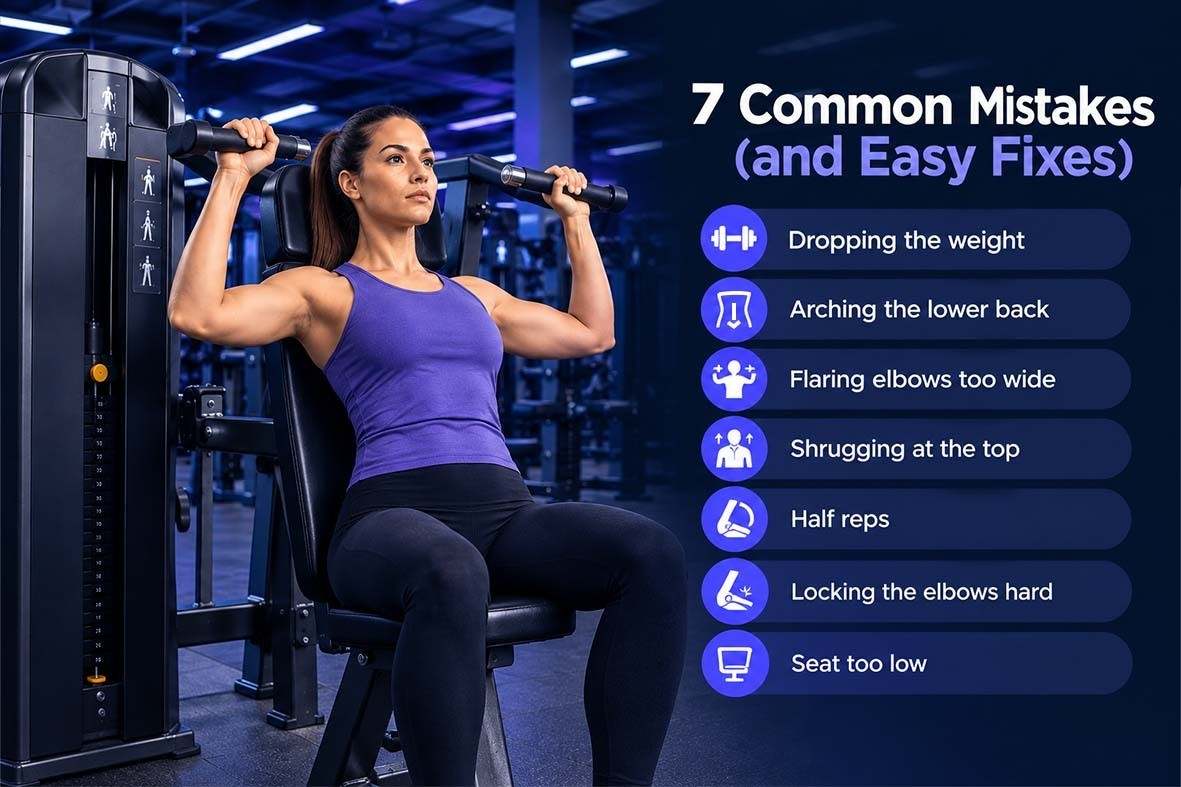
The most common overhead press machine mistakes come from a bad seat setup and rushed reps. Fix these seven and your shoulders will thank you.
- Seat too low. Handles end up by your ears and pinch your shoulders. Fix: raise the seat to shoulder height.
- Locking the elbows hard. Steals tension and stresses the joint. Fix: stop just short of lockout.
- Half reps. Cutting the range short leaves growth on the table. Fix: full press up, full control down.
- Shrugging at the top. Turns it into a trap exercise. Fix: keep shoulders down and away from your ears.
- Flaring elbows too wide. Adds shoulder strain. Fix: keep elbows slightly in front of the body.
- Arching the lower back. Usually it means the weight's too heavy. Fix: drop the load, keep your back on the pad.
- Dropping the weight. No control means no growth. Fix: lower slowly for two seconds.
Who Should Use the Overhead Press Machine?
The overhead press machine is best for beginners, lifters returning from injury, and anyone adding extra shoulder volume safely. Advanced lifters can still use it as a finisher, even if free weights lead their program.
If you're new to lifting, start here. The guided path teaches the pressing pattern without the balance demands that make barbell pressing intimidating on day one.
If you're an experienced lifter, don't write it off. The machine is one of the safest ways to chase a hard set close to failure when you're training alone.
The one group that should lean elsewhere: athletes who specifically need overhead stability for their sport. They'll get more carryover from standing free-weight presses.
How to Program It: Sets, Reps, and Placement
For shoulder growth on the overhead press machine, do 2–4 sets of 8–12 reps, one or two shoulder days a week, and place it after your heavy pressing. The ACSM recommends training every major muscle group at least twice weekly.
Where you slot it matters. If you barbell or dumbbell press first, run the machine second as a higher-rep pump. If the machine is your main shoulder move, start fresh with it and push a bit heavier.
Progress by adding a small amount of weight or an extra rep or two once you can hit the top of your rep range with clean form. Track it the easiest way to keep progressing is to log your sets and weights each session in a workout app like MyFitnessCoach so you always know the number to beat.
Give your shoulders 48 hours between hard sessions. They're a small, busy joint, and recovery is where the strength actually shows up.
Overhead Press Machine Alternatives
If no overhead press machine is free, the best alternatives are the dumbbell shoulder press, Arnold press, landmine press, and banded press all of which train the same delts.
- Dumbbell shoulder press — the closest free-weight match, with more stabilizer work.
- Arnold press — a rotating dumbbell press that hits the front delts hard.
- Landmine press — a shoulder-friendly angle that's easy on cranky joints.
- Resistance-band press — perfect for home or travel days.
Round out your shoulder day with isolation work too. A few sets on the lateral raise machine build the side delts for width, and upright rows add traps and delts in one move. For a full weekly split, slot your pressing into a structured plan like a 6-day gym workout schedule.
Want the science on sets, loads, and frequency straight from the source? The ACSM's 2026 resistance-training guidelines are the gold standard.
Conclusion
The overhead press machine gives you a safe, simple path to bigger, stronger shoulders you just have to set the seat right and control every rep. Pick your seat height, own your form, and add weight slowly.
Your next step: try it this week, log your numbers, and beat them next time.
Ready to Track Every Rep?
Building shoulders is a numbers game, and the lifters who progress are the ones who keep score. MyFitnessCoach logs your workouts, tracks your strength over time, and tells you exactly what to lift next. Start free today.
Written by the MyFitnessCoach Editorial Team · Technically reviewed by [Jason Matthews ], CSCS placeholder
Frequently Asked Questions
Similar Articles
Stay informed with these similar articles.
MyFitnessCoach
May 9, 2025
Why Kneecaps Sweat? 5 Surprising Causes & Proven Fixes
Ever noticed your knees getting sweaty for no reason? You're not alone. Sweaty kneecaps might seem odd, but they're more common than you think.
MyFitnessCoach
March 6, 2025
Arm Swing Exercise: Effective Way to Boost Your Fitness
When it comes to fitness, we often think of intense workouts, heavy lifting, or long runs. But what if I told you that a simple exercise like arm swings could be just as effective in improving your overall fitness? Arm swing exercises are easy to do, require no equipment, and can be done anywhere. Whether you're a beginner or a fitness enthusiast, arm swings can help you improve flexibility, strength, and even cardiovascular health. In this article, we’ll explore the benefits of arm swing exercises, how to do them correctly, and how you can incorporate them into your fitness routine using the MyFitnessCoach app.
MyFitnessCoach
February 24, 2025
Best Deodorant for Athletes: Stay Fresh During Your Workouts
When you're an athlete or someone who loves to stay active, staying fresh and odor-free is a top priority. Whether you're hitting the gym, running a marathon, or sweating it out during a high-intensity workout, the right deodorant can make all the difference. But with so many options available, how do you choose the best deodorant for athletes? In this article, we’ll break down everything you need to know about finding the perfect deodorant to keep you feeling confident and fresh, no matter how intense your workout gets. Plus, we’ll show you how the MyFitnessCoach app can help you stay on top of your fitness game.