
Full Body Calisthenics Workout: 7 Proven Moves, No Gym
MyFitnessCoach
September 9, 2026
You've got 30 minutes, a bit of floor space, and zero equipment. That's enough to train every major muscle you own.
A full body calisthenics workout uses your own bodyweight as resistance to build strength, muscle, and endurance in one session. No machines. No membership. You push, pull, squat, hinge, and brace your core and that mix hits your whole body at once.
This guide hands you the exact routine, how to scale it from your first push-up to one-arm variations, how often to train, and how to keep progressing once bodyweight starts feeling easy. Beginner or advanced, your level is in here.

Table of Contents
Subscribe to our newslettter
What Is a Full Body Calisthenics Workout?
A full body calisthenics workout is a bodyweight session that trains every major muscle group chest, back, shoulders, arms, legs, and core using moves like push-ups, pull-ups, squats, and planks instead of weights.
The word "calisthenics" comes from the Greek kallos (beauty) and sthenos (strength). It's one of the oldest training methods around Greek soldiers and gymnasts drilled these patterns long before barbells existed.
Most of these moves are compound exercises, so they work several muscles together. A single push-up loads your chest, shoulders, triceps, and core all at once. That's why a short list of the right exercises can cover your entire body. You don't need twenty movements. You need the right seven.
The Full Body Calisthenics Workout (Beginner to Advanced)
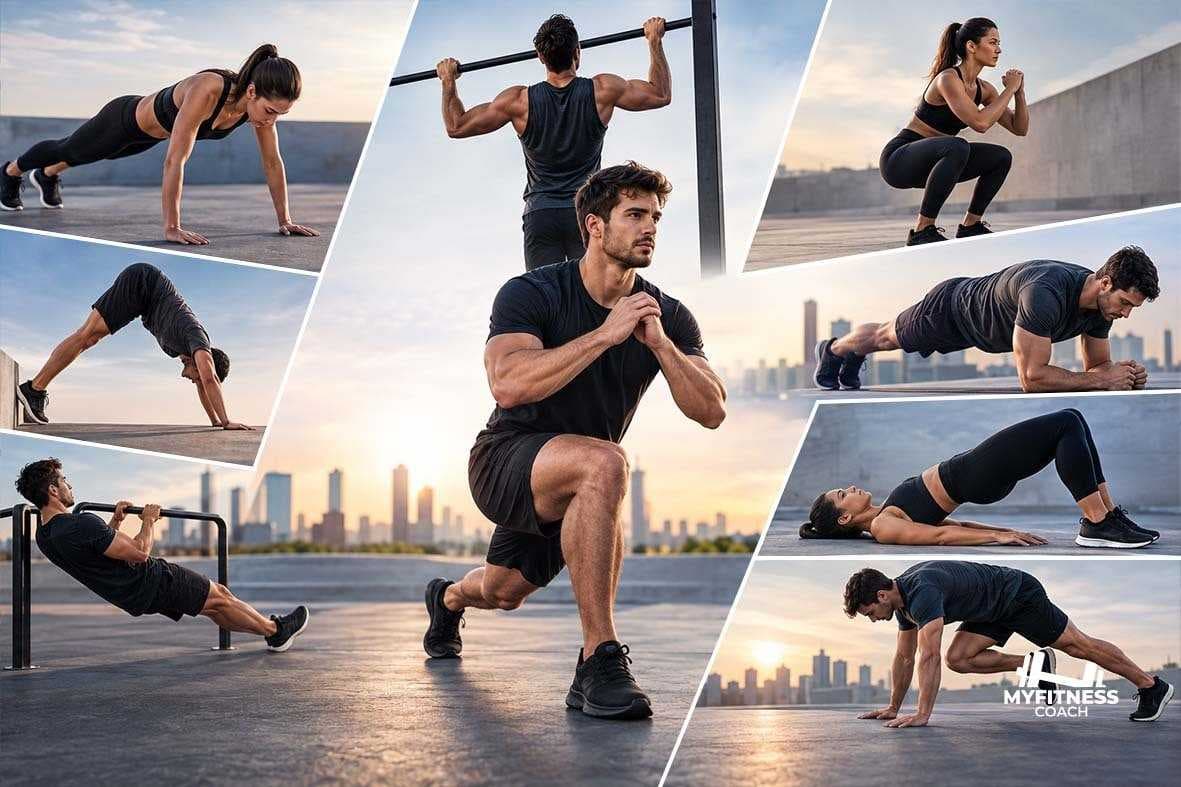
Here's the full body calisthenics workout. It's built on six movement patterns that, together, leave no major muscle behind: horizontal push, vertical push, horizontal pull, vertical pull, legs, and core.
Pick the column that matches where you are today. Do the moves in order and rest 45–90 seconds between sets.
The 5-Minute Warm-Up
Loosen up first. Thirty seconds each of arm circles, leg swings, bodyweight squats, plank, and jumping jacks two rounds. Cold muscles strain. Warm ones perform.
The Workout
| Movement Pattern | Beginner Version | Advanced Version | Sets × Reps |
| Horizontal push | Incline or knee push-up | Archer / one-arm push-up | 3 × 8–12 |
| Vertical push | Pike push-up (feet low) | Wall handstand push-up | 3 × 6–10 |
| Horizontal pull | Inverted row, knees bent | Feet-elevated inverted row | 3 × 8–12 |
| Vertical pull | Negative chin-up | Full pull-up or chin-up | 3 × 5–8 |
| Legs | Bodyweight squat | Bulgarian split or pistol squat | 3 × 10–15 |
| Posterior chain | Glute bridge | Single-leg hip thrust | 3 × 10–12 |
| Core | Plank, 20–40 sec | Hanging leg raise | 3 × 30–45 sec |
Sets, Reps, and Rest
Run all seven moves as a circuit, then repeat for three rounds. Take the last set of each exercise close to failure. Research shows bodyweight moves build muscle just as well as heavy weights when you push near your limit (Kotarsky et al., Journal of Strength and Conditioning Research, 2018). Rest one to two minutes between rounds, and you're done in about 35 minutes. Finish with two minutes of easy stretching for the shoulders, hips, and hamstrings it speeds recovery and keeps you moving well session to session.
How to Progress Without Adding Weight
You progress a full body calisthenics workout by making each move harder, not by loading a bar. Shift the leverage, slow the tempo, add range of motion, or move to a single-limb version.
The rule that matters is progressive overload. Your muscles grow only when you keep asking them for more. With weights you add plates. With bodyweight you've got four levers:
- Harder variation: knee push-up → standard → archer → one-arm.
- Tempo: lower for 3–4 slow seconds on every rep.
- Range of motion: deficit push-ups, deeper squats.
- Leverage: raise your feet or extend a limb to shift more weight onto the working side.
Track it. Write down your reps each session and beat them next time. Apps like MyFitnessCoach make logging bodyweight sets and progressions simple, so you watch the numbers climb instead of guessing whether you improved.
Beginner Full Body Calisthenics Workout at Home
A beginner full body calisthenics workout at home needs no equipment. A wall, a sturdy chair, and the floor cover every movement pattern. Start with the easier versions and take full rest.
Run this three days a week, with a rest day between:
- Incline push-ups, hands on a couch — 3 × 8
- Chair-assisted squats — 3 × 12
- Inverted rows under a table — 3 × 8
- Glute bridges — 3 × 12
- Plank — 3 × 20 seconds
Five moves, about 20 minutes. Nail clean form before chasing harder versions. Sloppy reps only build sloppy strength.
Military Calisthenics Workout: Train Like the Forces
A military calisthenics workout is a bodyweight circuit built for conditioning and grit push-ups, sit-ups, pull-ups, burpees, and running, done for time or max reps rather than tidy sets.
Armed forces have leaned on bodyweight PT for over a century because it needs no gym and fits any space. The classic format is simple and punishing:
- Push-ups — max reps in 2 minutes
- Sit-ups — max reps in 2 minutes
- Pull-ups — max reps, no clock
- Burpees — 4 rounds of 15
- Run — 1.5 miles at a hard, steady pace
This is less about muscle size and more about work capacity and the ability to keep moving once you're gassed. Add one military-style session a week if you want your conditioning to catch up with your strength.
How Many Days a Week Should You Train?
Train a full body calisthenics workout three to four days a week, with at least one rest day between sessions so muscles can repair and grow. That range works for most people.
Because each session trains your whole body, you don't need a six-day split. Full-body beats splits for bodyweight work every pattern gets practiced often, which counts when half the game is skill. U.S. physical activity guidelines already ask for muscle-strengthening work on two or more days a week, so three sessions clears the bar with room left over.
More isn't better here. Some lifters swear by daily "grease the groove" practice, and it can work for skills like pull-ups. But hard, near-failure sessions need recovery. Strength is built between workouts, not during them.
Calisthenics vs Weights: Which Builds More Muscle?
For beginners and intermediates, a full body calisthenics workout builds muscle about as well as weights. The gap only opens at advanced levels, where adding load with bodyweight alone gets tricky.
Muscle grows from tension and effort, and your body can't tell whether resistance comes from a dumbbell or your own mass. That 2018 push-up trial found bodyweight training produced upper-body strength gains close to bench pressing over four weeks. Where weights pull ahead is precise overload it's easy to add five pounds, harder to invent a tougher push-up. Where calisthenics wins is functional control, joint-friendly movement, and training anywhere. Plenty of people run both and get the best of each.
7 Common Mistakes That Stall Your Progress
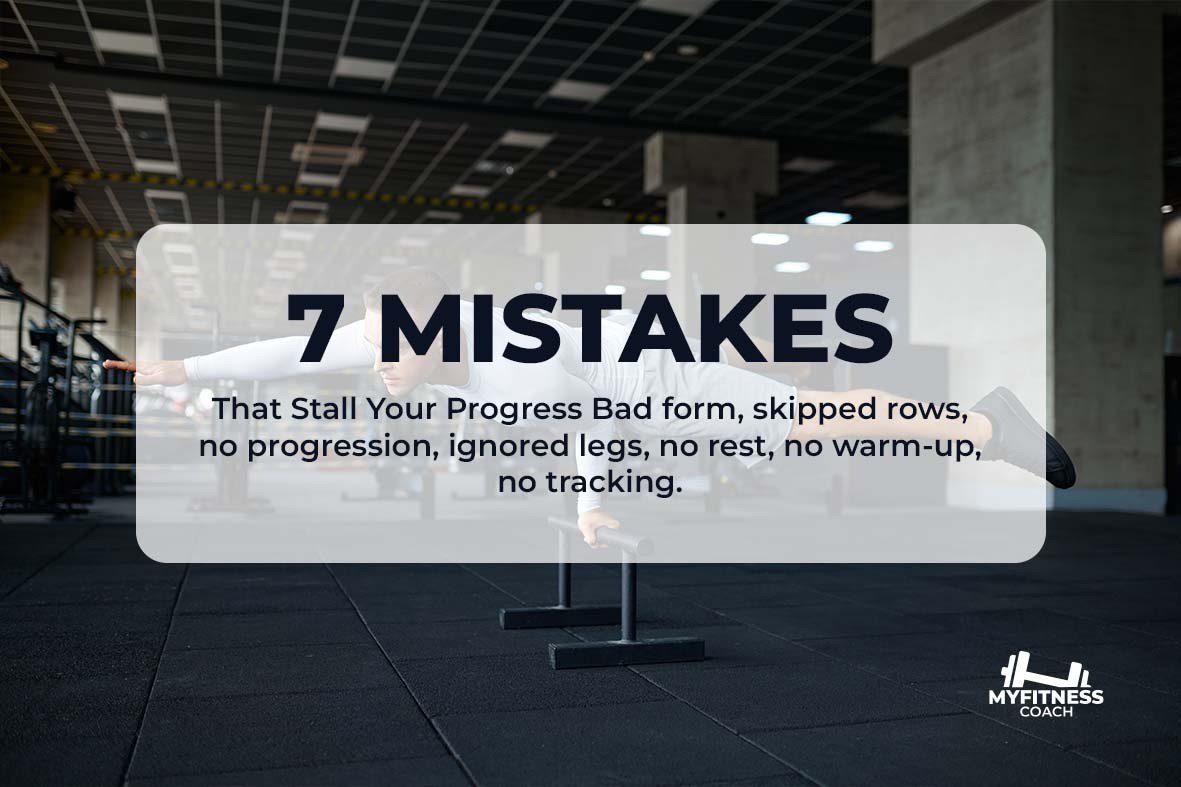
- ❌ Chasing rep counts with ugly form instead of clean, full-range reps.
- ❌ Skipping pulls — push-ups with no rows wrecks shoulder balance.
- ❌ Never progressing, doing the same 20 push-ups for months.
- ❌ Ignoring legs because they're harder to load with bodyweight.
- ❌ Training hard every day and never letting muscles recover.
- ❌ No warm-up, then wondering why the shoulders ache.
- ❌ Tracking nothing, so progress stays invisible.
How Long Until You See Results?
Most people feel strength gains from a full body calisthenics workout within three to four weeks, and see visible muscle definition in eight to twelve weeks assuming steady training and decent nutrition.
Early wins arrive fast because your nervous system gets efficient before muscle visibly grows. The people who get results aren't the gifted ones. They're the ones still showing up in week ten.
The Bottom Line
Strength doesn't wait for the perfect setup. Pick your level, run the routine three days this week, and log every rep so next week you can beat it. Track your full body calisthenics workout with MyFitnessCoach, and watch small wins stack into real change.
Frequently Asked Questions
Similar Articles
Stay informed with these similar articles.

MyFitnessCoach
May 9, 2025
Why Kneecaps Sweat? 5 Surprising Causes & Proven Fixes
Ever noticed your knees getting sweaty for no reason? You're not alone. Sweaty kneecaps might seem odd, but they're more common than you think.
MyFitnessCoach
March 6, 2025
Arm Swing Exercise: Effective Way to Boost Your Fitness
When it comes to fitness, we often think of intense workouts, heavy lifting, or long runs. But what if I told you that a simple exercise like arm swings could be just as effective in improving your overall fitness? Arm swing exercises are easy to do, require no equipment, and can be done anywhere. Whether you're a beginner or a fitness enthusiast, arm swings can help you improve flexibility, strength, and even cardiovascular health. In this article, we’ll explore the benefits of arm swing exercises, how to do them correctly, and how you can incorporate them into your fitness routine using the MyFitnessCoach app.

MyFitnessCoach
February 24, 2025
Best Deodorant for Athletes: Stay Fresh During Your Workouts
When you're an athlete or someone who loves to stay active, staying fresh and odor-free is a top priority. Whether you're hitting the gym, running a marathon, or sweating it out during a high-intensity workout, the right deodorant can make all the difference. But with so many options available, how do you choose the best deodorant for athletes? In this article, we’ll break down everything you need to know about finding the perfect deodorant to keep you feeling confident and fresh, no matter how intense your workout gets. Plus, we’ll show you how the MyFitnessCoach app can help you stay on top of your fitness game.