
Cable Kickbacks: 6 Setups, Proper Form & What Works
MyFitnessCoach
September 11, 2023
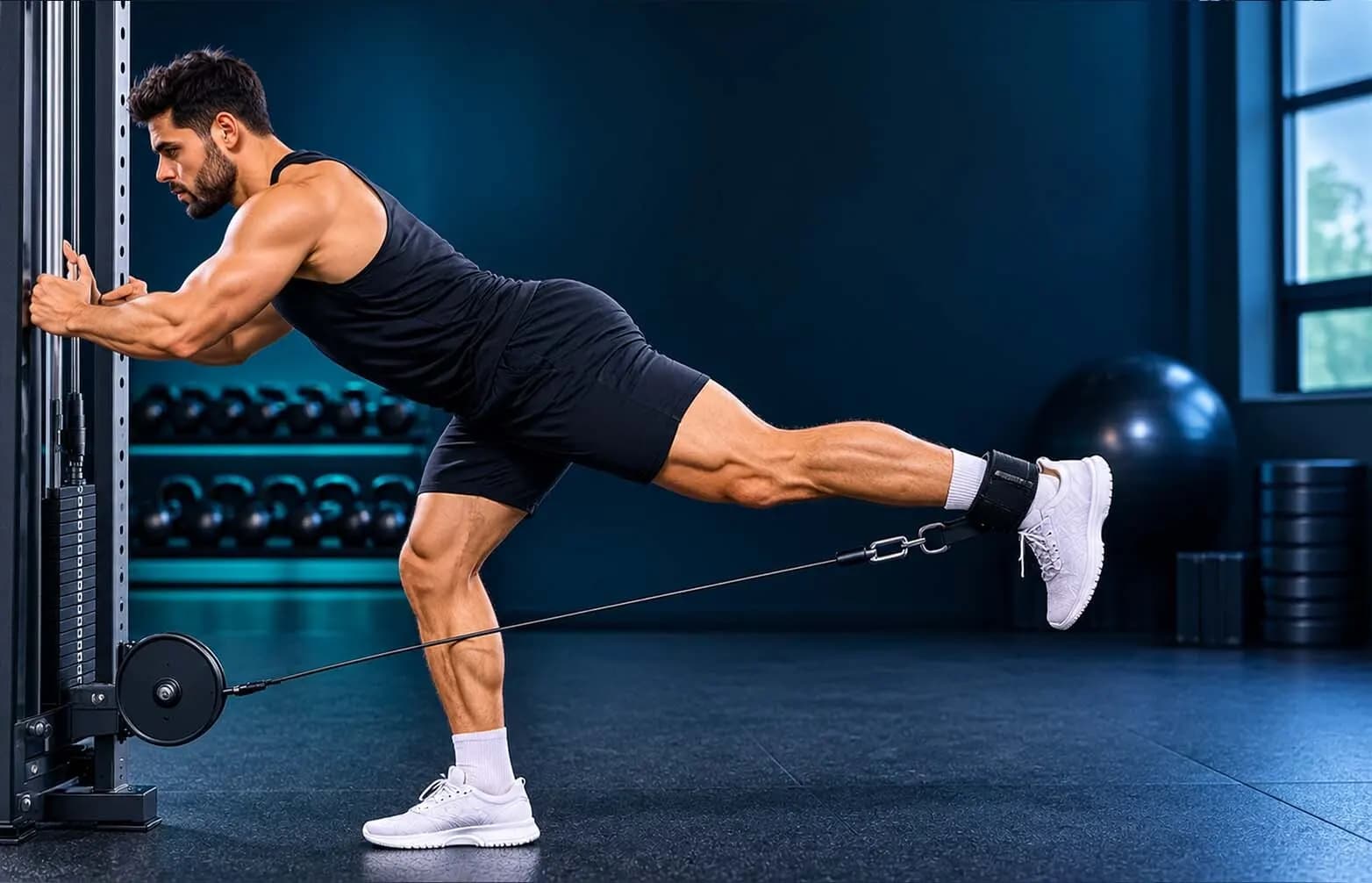
Cable kickbacks train your glutes by kicking one leg back against a cable pulley, usually with an ankle strap on a low pulley. They're a simple way to add one-leg glute work after your heavy hip exercises. Researchers have measured how active the muscles are during kickbacks, but no study found for this guide has measured glute growth from cable kickbacks alone.
This guide covers the exact form, six setups and when to use each, what the research does and doesn't show, how to fix the common "I feel it in the wrong place" problems, and a 10-minute routine.
Key takeaways
- Set a low pulley, strap the cable to your ankle, hold the frame, lean forward from the hips and kick back until your thigh lines up with your torso.
- Stop where your hip stops moving. Going higher usually means arching your lower back.
- In 15 trained women, kickbacks drew more activity in parts of the biceps femoris (a hamstring muscle) than Romanian deadlifts, step-ups and hip extensions. Bending the knee reduces hamstring involvement in hip extension.
- No study found for this guide has measured glute growth from cable kickbacks. Use them as extra volume after a heavier hip exercise, not instead of one.

Table of Contents
Subscribe to our newslettter
What Are Cable Kickbacks?
Cable kickbacks are a glute exercise where you attach a cable to your ankle with a strap and kick that leg back against the resistance. Also called cable glute kickbacks or standing leg lifts, they work one leg at a time, usually on a low pulley, and are often used as a finisher after heavier hip exercises.
You'll also see the exercise written as a cable kickback or a cable glute kickback. They all mean the same movement. The next section covers a different one with a similar name.
Glute Kickback or Triceps Kickback? Which One Do You Mean?
| Glute cable kickback (this page) | Triceps kickback | |
| Muscle | Glutes | Triceps |
| Movement | Leg goes back (hip extension) | Arm goes back (elbow extension) |
| Setup | Ankle strap on a low pulley | Handle or dumbbell in your hand |
If you wanted the triceps version, see our guide to overhead triceps extensions. The rest of this page is about the glute version.
Muscles Worked in Cable Kickbacks
Cable kickbacks mainly work the gluteus maximus, with help from the hamstrings. Here are the cable kickback muscles worked, in order of importance:
| Muscle | Role |
| Gluteus maximus | Main mover. Extends the hip and drives the leg back |
| Hamstrings | Help extend the hip. They contribute more when the knee is straighter |
| Adductor magnus (rear part) | Helps extend the hip |
| Glutes of the standing leg | The gluteus medius and maximus keep your pelvis level on one foot |
| Core and lower back | Keep your spine still as the leg goes back |
The standing-leg row is why many people feel kickbacks "in the wrong leg." The troubleshooting table below covers it.
How to Do a Cable Kickback (Step by Step)
- Set the pulley low and clip on an ankle strap. Buckle it snugly around your working ankle.
- Face the machine and step back until the weight stack lifts slightly, so the cable is taut. Hold the frame with both hands, or rest your forearms on it.
- Hinge forward from your hips with a flat back. Many coaches use roughly 30 to 45 degrees. Soften your standing knee and keep your ribs down.
- Kick the working leg back with a slight bend in the knee, until your thigh lines up with your torso. Squeeze your glute for a second.
- Bring the leg forward slowly, taking about two seconds, without letting the plates touch. Finish all your reps on one leg, then switch.
Breathing: exhale as you kick back, inhale as you return.
The cue that matters: your hip only extends a little past straight. Anything higher than that usually comes from arching your lower back, which is why so many people feel kickbacks there. Keep both hip bones facing the machine and stop when your thigh lines up with your torso.
Weight: start lighter than you think. A weight you have to fight to stay upright with turns the set into a balance drill.
Which Cable Kickback Setup Should You Use?
.webp)
The cable kickback cluster is full of variations. These six cover most situations.
| Setup | How it works | Best for | Watch for |
| 1. Standing, leaning forward | Hold the frame, hinge from your hips about 30–45° | Most people. The standard version | Rounding your back |
| 2. Standing, upright | Stand tall, hold the frame | A light finisher | Your leg can only travel a short way before your lower back arches |
| 3. Bent knee | Keep your working knee bent, roughly 90° | Feeling it in your hamstrings. A bent knee takes work off them | Keeping your hips square |
| 4. Kneeling | On all fours, strap on a low pulley | When your standing leg tires out first, because balance no longer limits the set | Enough space to set it up |
| 5. Bench-supported | Rest your chest or forearms on a bench or pad in front of the pulley | If you swing or arch | Bench height and distance from the cable |
| 6. Diagonal | Kick back and slightly out, about 30° | More glute emphasis | Rotating your pelvis open to get the leg higher |
No ankle strap? Ask the gym. Most cable stations have one, and a padded ankle strap made for cable machines is the right tool. No cable machine? Use a resistance band anchored low, or see the alternatives below.
What the evidence says about these setups: no study has compared all six. The bent-knee and diagonal points come from studies of prone hip extension (lying face down), not cable machines:
- In 20 healthy people, hamstring activity and hip extension torque were high with the knee straight and fell once the knee bent past about 60 degrees (Kwon and Lee, 2013).
- In a study of prone hip extension with a bent knee, glute activity was greatest, and hamstring activity lowest, at 30 degrees of hip abduction (Kang et al., 2013).
Treat them as reasons to try a setup, not proof that it works better on a cable.
Do Cable Kickbacks Actually Grow Your Glutes?
Short answer: probably, as extra volume, but nobody has measured how much. No study found for this guide has measured glute growth from cable kickbacks. What exists is research on muscle activity.
What the research shows.
- Stevens et al., 2022. Fifteen trained women performed six exercises at 75% of their estimated one-rep max. Kickbacks produced higher activity than Romanian deadlifts, step-ups and hip extensions in the proximal and distal parts of the biceps femoris, a hamstring muscle. The abstract doesn't say whether the kickbacks were cable kickbacks.
- A systematic review of bodyweight hip extension exercises found that unilateral exercises produced higher gluteus maximus activity than bilateral versions, and that verbal and tactile cues, and bracing, increased activity.
- A systematic review of common strength exercises found that the step-up had the highest gluteus maximus activation of the exercises it covered.
What that means.
- Cable kickbacks are a reasonable one-leg glute exercise, and the hamstrings help more than many people expect.
- Muscle activity isn't muscle growth. A 2017 meta-analysis found similar growth across a wide range of loads when sets were taken close to failure (Schoenfeld et al., 2017).
- No trial has compared cable kickbacks with a hip thrust or a squat for glute growth, so heavier hip exercises should come first.
Where Do You Feel It? Troubleshooting
| Where you feel it | Likely Cause | What to Try |
| Standing leg | It holds you up on one foot for the whole set | Hold the frame with both hands, go lighter, rest 30 to 60 seconds before switching legs, or try the kneeling setup |
| Hamstrings | They help extend the hip, more so with a straight knee | Bend your working knee to about 90 degrees and shorten the range |
| Lower back | You're kicking past where your hip stops | Stop when your thigh lines up with your torso, keep your ribs down and hinge forward a bit more |
| Nowhere in particular | Too heavy, momentum or standing too upright | Go lighter, pause for one second at the top, squeeze your glute and try the kneeling setup |
| The cable goes slack | You're standing too close to the stack | Step back until the plates lift when your knee is forward |
| Swinging | Momentum is doing the work | Take two seconds to lower the leg and use less weight |
| Pelvis opening up | You're trying to kick higher | Keep both hip bones facing the machine |
| Stuck at one weight | Stack jumps are big for one hip | Add reps first (see below) |
Sets, Reps and Weight
There's no research-based dose for cable kickbacks. These are common coaching ranges.
| Item | Starting point |
| Sets | 3 to 4 per leg |
| Reps | 10 to 15 per leg |
| Effort | Stop 0 to 2 reps short of failure |
| Where it fits | After your main hip exercise, such as a hip thrust, squat or deadlift |
| Frequency | Two or three times a week |
Because sets taken close to failure produce similar growth across a wide range of loads, pick a rep range where your form stays strict.
Progression: use double progression. When every set reaches the top of your range with clean form, add the smallest weight you can and drop back toward the bottom of the range. Stack jumps of 5 lb or more are big for one hip, so add reps first. If your gym has small add-on weights, use them.
A note on stack numbers: they aren't comparable between machines. Some functional trainers use a pulley ratio, so the number on the stack may not be the load at your ankle. Compare yourself with your own log on the same machine. For where to put kickbacks in a week, see which muscle groups to work together.
A 10-Minute Glute Finisher
| Block | Time |
| Warm-up: bodyweight glute bridges, then 10 light kickbacks per leg | 2:00 |
| Round 1: 12 cable kickbacks per leg, with a switch | 1:30 |
| Rest | 0:30 |
| Round 2: 12 cable kickbacks per leg, with a switch | 1:30 |
| Rest | 0:30 |
| Round 3: 12 cable kickbacks per leg, with a switch | 1:30 |
| Rest | 0:30 |
| Cool-down: lying figure-4 and knee-to-opposite-shoulder stretches, 30 seconds per side each (see glute stretches) | 2:00 |
| Total | 10:00 |
What Replaces Cable Kickbacks?
| Alternative | Why use it | Guide |
| Band kickback | Works at home. Anchor a band low and loop it around your ankle | — |
| Donkey kick or kickback on all fours | No equipment, easy to learn | Glute kickbacks |
| Glute kickback machine | Fixed path, no balance needed | Machine workouts for glutes |
| Glute bridge or hip thrust | Both legs, much heavier | Glute bridge with weight |
| Walking lunges | A heavier, compound option | Walking lunge, glute-focused |
| Cable pull-through | Both legs with a rope, hinge and stand | Cable exercises |
The Bottom Line
Cable kickbacks are a good finisher, not a replacement for heavy hip exercises. Hinge forward, hold the frame, stop where your hip stops, and choose the setup that lets your glutes, not your standing leg or lower back, do the work.
To log your sets and watch your weights go up, the workout logger in MyFitnessCoach is built for that.
This article is for informational purposes only and is not a substitute for professional medical advice. Stop if you feel sharp pain. If you have back or hip pain or an injury, consult a qualified healthcare provider before adding new exercises.
References
- Stevens BM, Nichols BR, Doty HI, Korak JA. Muscle activation patterns of the proximal, medial and distal biceps femoris and gluteus maximus among 6 hip extension and knee flexion exercises in trained women. Int J Exerc Sci. 2022;15(1):1179–1189. doi:10.70252/DWMB8342
- Kwon YJ, Lee HO. How different knee flexion angles influence the hip extensor in the prone position. J Phys Ther Sci. 2013;25(10):1295–1297. doi:10.1589/jpts.25.1295
- Kang SY, Jeon HS, Kwon O, Cynn HS, Choi B. Activation of the gluteus maximus and hamstring muscles during prone hip extension with knee flexion in three hip abduction positions. Man Ther. 2013. PubMed 23312068
- Examination of gluteus maximus electromyographic excitation associated with dynamic hip extension during body weight exercise: a systematic review. Int J Sports Phys Ther. 2019. PMC6350668
- Gluteus maximus activation during common strength and hypertrophy exercises: a systematic review. J Sports Sci Med. 2020. PMC7039033
- Schoenfeld BJ, Grgic J, Ogborn D, Krieger JW. Strength and hypertrophy adaptations between low- vs. high-load resistance training: a systematic review and meta-analysis. J Strength Cond Res. 2017;31(12):3508–3523. Link
Frequently Asked Questions
Similar Articles
Stay informed with these similar articles.
MyFitnessCoach
May 9, 2025
Why Kneecaps Sweat? 5 Surprising Causes & Proven Fixes
Ever noticed your knees getting sweaty for no reason? You're not alone. Sweaty kneecaps might seem odd, but they're more common than you think.
MyFitnessCoach
March 6, 2025
Arm Swing Exercise: Effective Way to Boost Your Fitness
When it comes to fitness, we often think of intense workouts, heavy lifting, or long runs. But what if I told you that a simple exercise like arm swings could be just as effective in improving your overall fitness? Arm swing exercises are easy to do, require no equipment, and can be done anywhere. Whether you're a beginner or a fitness enthusiast, arm swings can help you improve flexibility, strength, and even cardiovascular health. In this article, we’ll explore the benefits of arm swing exercises, how to do them correctly, and how you can incorporate them into your fitness routine using the MyFitnessCoach app.
MyFitnessCoach
February 24, 2025
Best Deodorant for Athletes: Stay Fresh During Your Workouts
When you're an athlete or someone who loves to stay active, staying fresh and odor-free is a top priority. Whether you're hitting the gym, running a marathon, or sweating it out during a high-intensity workout, the right deodorant can make all the difference. But with so many options available, how do you choose the best deodorant for athletes? In this article, we’ll break down everything you need to know about finding the perfect deodorant to keep you feeling confident and fresh, no matter how intense your workout gets. Plus, we’ll show you how the MyFitnessCoach app can help you stay on top of your fitness game.