
Overhead Extensions: 6 Mistakes Killing Your Triceps Gains
MyFitnessCoach
October 5, 2026
Overhead extensions train the back of your arm by bending and straightening your elbows while your upper arms point at the ceiling. That position stretches the long head of the triceps more than a pushdown does, and a 12-week MRI study found it grew more triceps muscle.
You can do an overhead tricep extension with a dumbbell, a cable and rope, a band or a weight plate. The movement is simple. The details decide whether you feel it in your triceps or in your shoulders and lower back. This guide covers how to do each version, which one fits you, what the research does and doesn't say, and how to fix the usual problems.

Table of Contents
Subscribe to our newslettter
What Are Overhead Extensions?
Overhead extensions are elbow-extension exercises done with your upper arms raised next to your ears. You hold a weight (or cable, band or plate) behind your head with bent elbows, then straighten your arms overhead. Because the arms are raised, the long head of the triceps is stretched across both the shoulder and the elbow.
You'll see the same exercise called an overhead extension, an overhead triceps extension or an overhead tricep extension. Lying versions such as skull crushers are a different exercise, because the arms sit in a different position.
Muscles Worked in Overhead Triceps Extensions
The overhead triceps extension is an isolation exercise. The elbow is the only joint that is supposed to move, and the muscle that moves it is the triceps brachii.
The three triceps heads
All three heads straighten the elbow, but they aren't identical.
- Long head. The biggest of the three, and the only one that attaches to the shoulder blade. It crosses both the shoulder and the elbow. With your arm overhead it's stretched at both ends, which is why the overhead position matters.
- Lateral head. Sits on the outer side of the upper arm and crosses only the elbow.
- Medial head. Lies deep under the other two, also crosses only the elbow, and works in nearly every elbow extension.
Shoulder and core stabilizers
Your shoulders, upper back and abs aren't the target. They keep the weight steady as it travels behind your head, and with your arms raised they have to hold that position against gravity. If they give out first, your lower back arches and the triceps lose tension. Many of the form problems below start there.
Overhead Extensions vs Pushdowns: What the Research Actually Shows
Both exercises straighten the elbow. The difference is where the arm sits. In a pushdown, the upper arm stays at your side. In an overhead extension, it points up. Because the long head attaches to the shoulder blade, raising the arm lengthens it.
A 2022 study in the European Journal of Sport Science (Maeo and colleagues) tested what that difference does to muscle growth. Twenty-one young adults without lifting experience trained twice a week for 12 weeks. One arm did cable extensions overhead, and the other did them with the arm at the side, like a pushdown. MRI scans measured muscle volume before and after.
| Muscle region | Overhead arm | Pushdown arm |
| Long head | +28.5% | +19.6% |
| Lateral and medial heads | +14.6% | +10.5% |
| Whole triceps | +19.9% | +13.5% |
The overhead arm also lifted lighter weights. The authors' muscle modeling suggests the long head produces less force at those long lengths, which fits with the lighter loads.
Three things to take from this.
First, overhead extensions grew more muscle, in every part of the triceps. You'll often read that overhead work builds the long head while pushdowns build the lateral head. In this study, the overhead arm grew the lateral and medial heads more too.
Second, pushdowns still worked. The pushdown arm gained 13.5% in triceps volume. Nothing here makes them a bad exercise.
Third, activation isn't growth. Electromyography (EMG) measures electrical activity during a set. This study measured how much muscle was added over 12 weeks. One EMG study gets cited in this debate to say the two exercises are equal, but it actually compared overhead and lying dumbbell extensions in 21 resistance-trained men, not overhead extensions and pushdowns.
The limits. The participants were untrained, the study lasted 12 weeks, it used a cable exercise, and it's one study. Results could differ in experienced lifters. It fits a growing body of evidence on training muscles at long lengths, but it isn't the final word. If your shoulders allow it, adding an overhead variation next to your pushdowns is a reasonable change.
How to Do a Dumbbell Overhead Tricep Extension
The overhead dumbbell extension is the easiest version to start with. You need one dumbbell, and you can do it standing or seated.
- Pick a light weight. The overhead position limits how much you can lift. Start lighter than your instinct says.
- Set your stance. Stand with your feet about shoulder-width apart, or sit tall. Brace your abs and keep your ribs down.
- Grip the dumbbell. Hold one dumbbell upright and cup both hands under the top plate, palms up, fingers wrapped around the inside of the plate.
- Press it overhead. Straighten your arms with your upper arms next to your ears and your elbows pointing forward.
- Lower slowly. Bend your elbows to lower the dumbbell behind your head. Only your forearms move. Take two to three seconds, and stop when you feel a deep stretch in the back of your upper arm. For most people that's around 90 degrees of elbow bend, sometimes a little deeper.
- Pause for a beat at the bottom. It removes bounce.
- Press back up. Straighten your elbows and squeeze the triceps at the top. Stop just short of a forceful lockout.
- Breathe. Inhale as you lower, exhale as you press.
Form cues. Keep your elbows pointing forward rather than flaring out. Keep your neck neutral, and don't push your chin forward to make room for the dumbbell. Let the weight travel close to the line of your spine.
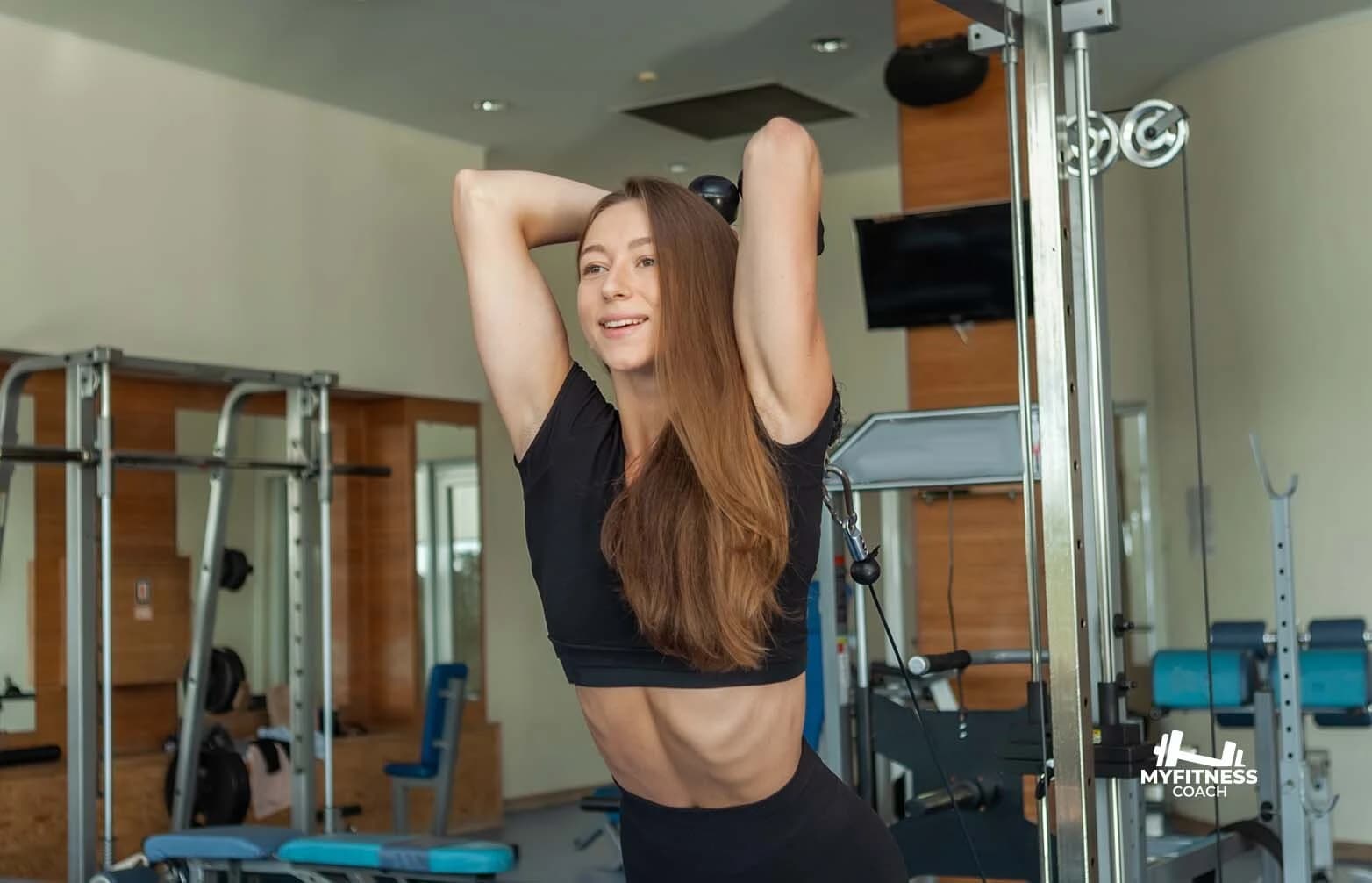
How to Do a Cable Overhead Tricep Extension
The cable overhead tricep extension gives smooth resistance through the whole range and lets you change the load in small steps. It's also the version used in the MRI study above.
A rope is the most comfortable attachment. In an overhead tricep extension with rope, your hands can rotate slightly as you move, which tends to be easier on the wrists than a straight bar.
- Set the pulley low and attach a rope.
- Face away from the stack and take the rope handles in both hands.
- Step forward until the cable is taut before you start. The cable should run up and behind you.
- Raise your hands overhead, so they sit just behind your head. Keep your elbows near your ears and pointing forward.
- Stand tall. Stack your ribs over your hips and squeeze your glutes. Leaning forward lets the cable pull your arms forward, which can reduce the stretch on the long head.
- Extend your arms up and slightly forward until they're straight.
- Return slowly. Let the rope travel back behind your head and feel the stretch before you press again. Keep your upper arms still.
For one arm at a time, swap the rope for a single handle. For other cable moves, see our guide to cable exercises.
.webp)
Which Overhead Extension Variation Should You Use?
Six setups cover most situations. The research above tested arm position, and all six keep the arm overhead, so pick the one you can do with clean form.
| Variation | Setup | Best when | Watch for |
| Two-hand dumbbell (standing) | One dumbbell, both hands | You have a dumbbell and want the simplest option | Body sway and flared elbows |
| Seated overhead tricep extension | Same dumbbell, bench with back support | Your lower back arches when you stand | Getting the dumbbell into position safely |
| Single arm overhead tricep extension | One dumbbell or cable handle in one hand. Your free hand can steady the upper arm | One arm lags, or a two-hand grip bothers your wrists | Start with the weaker arm and match reps on the other side |
| Cable with rope | Low pulley, facing away | You want smooth resistance and small jumps in weight | Leaning forward |
| Cable single handle | Handle on a low pulley, one arm | You want one-arm cable work | Keep the upper arm vertical |
| Resistance band | Stand on the band or anchor it low | Home or travel workouts | Hard to measure the load. Resistance rises as you straighten |
A weight plate or an EZ-curl bar also works if that's what you have.
Common Mistakes and How to Fix Them
Flaring the elbows. When elbows drift out, the shoulders and chest start helping and the triceps lose tension.
Fix: point your elbows forward and keep your upper arms next to your ears.
Leaning or arching. A forward lean shortens the stretch, and an arched back turns the movement into a lower-back exercise. Fix: brace, keep your ribs down, squeeze your glutes. Try the seated version if you can't stay upright.
Cutting the range short. Half reps skip the part that stretches the long head.
Fix: lower until you feel a deep stretch, then straighten the elbows fully.
Swinging the weight. Momentum shifts the work to your torso.
Fix: take two to three seconds to lower, and pause at the bottom.
Loading too heavy. The overhead position limits how much you can lift, and the stretched muscle is weaker. Heavy sets turn into partial, sloppy reps.
Fix: choose a weight you can lower with control and press with clean form.
Using the wrong grip. A straight bar can lock your wrists in one position.
Fix: use a rope, a neutral-grip handle or the cupped dumbbell hold.
Troubleshooting: Why Overhead Extensions Feel Wrong
| Problem | Likely Cause | What to Try |
| My elbows hurt | The weight is too heavy for the stretched position, your elbows are flaring, or you're snapping into a hard lockout | Cut the weight, keep your elbows pointing forward, and stop just short of a forceful lockout. Try the cable rope or single-arm version. Sharp or lingering pain deserves a clinician's opinion |
| I can't feel it in my triceps | Your upper arms are drifting forward instead of staying by your ears, the range is short, or momentum is doing the work | Reset your arm position, lower for two to three seconds to a deep stretch, and drop the weight until you can pause at the bottom |
| My shoulders pinch or burn | Limited overhead mobility, ribs flaring to get the arms up, or the load is too heavy to hold overhead | Try seated with back support, a lighter weight, or a cable at a pulley height that makes the start position easier. Persistent pinching is a reason to skip the exercise and get it checked |
| My lower back arches | Your ribs flare as the weight goes behind your head, or the load is too heavy | Brace, keep your ribs down, squeeze your glutes, or sit with back support. Lower the weight |
| The dumbbell hits my head or neck | The weight travels too close to your head, or your head is pushing forward | Keep your chin tucked and neck neutral, press into the dumbbell with your fingertips so it doesn't swing, or switch to a cable, plate or single-arm version |
| My wrists hurt | Straight bar, locked wrists or a tight grip | Use a rope or neutral-grip handle, cup the dumbbell instead of gripping hard, and keep your wrists straight |
| One arm is weaker | A normal strength gap, and two-hand lifts let the stronger arm take over | Do single-arm sets, start with the weaker arm and match the reps on the other side |
Skull Crushers vs Overhead Extensions: Which Is Better?
A skull crusher is a lying triceps extension. Your upper arms point roughly straight up over your chest, which puts your shoulders at about 90 degrees of flexion. In an overhead extension, your arms are raised well past that. The long head is stretched more overhead, and that's the reason the overhead position has a stronger rationale for long-head growth.
What hasn't been tested, as far as the research found here, is a head-to-head growth comparison between skull crushers and overhead extensions. You'll often read that skull crushers target the lateral head. That isn't something the research above measured.
In practice, the choice often comes down to your joints and your gear. Overhead extensions need enough shoulder mobility to get your arms next to your ears without flaring your ribs. Skull crushers ask less of your shoulders and are easy to load heavier. Many programs use both. Our skull crusher guide covers that exercise step by step.
Sets, Reps, and How to Progress Overhead Extensions
Where it fits. Put overhead extensions after your main presses, when your triceps are already warm, or first on an arm day. If you're not sure how to pair muscle groups in a session, see which muscle groups to work together.
Sets and reps. A reasonable starting point is 2 to 4 hard sets of 8 to 15 reps, one to three times a week. A 2017 meta-analysis found similar muscle growth across a wide range of loads when sets were taken close to failure, so you can choose the rep range where your form stays cleanest. Because the overhead position limits the weight, many people land at the moderate-to-higher end of that range. Rest one to two minutes between sets.
Progression. One simple approach is rep-range progression:
- Pick a weight and do your sets in the 8–15 range, controlling the lowering phase.
- When every set reaches the top of the range with the same clean form, add the smallest weight jump available.
- Your reps will drop back toward the bottom of the range. Build up again.
For example: 25 lb for 10, 9 and 8 reps in week one; 13, 12 and 11 reps in week three; 15, 15 and 14 reps in week five. Then move up to the next dumbbell and start over. This is one way to do it, not the only way.
What Can You Do Instead of Overhead Extensions?
| Situation | Option | Why it helps |
| Your shoulders can't get comfortably overhead | Lying triceps extension (skull crusher) | The shoulder has less to do. Angling your upper arms slightly back adds stretch |
| Free weights bother your elbows | Cable rope version, single-arm cable or a band | Smoother resistance and easier load changes |
| You have no equipment | Bench or chair dips, such as assisted triceps dips, or parallel bar dips | Bodyweight triceps work |
| You want a pushdown-style option | Cable rope pushdown | The arm stays at your side, with less stretch on the long head |
The Bottom Line
Overhead extensions are one of the simplest ways to train the triceps with the long head stretched. A 12-week MRI study found they grew more triceps muscle than pushdowns, and the gains showed up in every head, not only the long one. It's still one study in untrained adults, and pushdowns remain a solid exercise.
Pick a version you can do with your elbows forward, your ribs down and a controlled lowering phase. Start light, find a rep range where your form holds, and add weight in small steps. If you'd like to log your sets and watch the weights climb, MyFitnessCoach has a workout logger for that.
This article is for informational purposes only and is not a substitute for professional medical advice, diagnosis, or treatment. If you have a shoulder or elbow injury or persistent pain, consult a qualified healthcare provider before starting new exercises.
Frequently Asked Questions
Similar Articles
Stay informed with these similar articles.

MyFitnessCoach
October 10, 2025
Female Bodybuilding Workout Plan: Build Strength, Sculpt Muscle, and Transform Your Body
Building muscle and strength is no longer limited to men. Women worldwide are embracing bodybuilding to tone, strengthen, and empower their bodies. Whether you want to gain lean muscle, improve body composition, or boost overall confidence, a structured female bodybuilding workout plan is your roadmap to success.

MyFitnessCoach
August 1, 2025
Skull Crusher Exercise: Benefits & Step by Step Guidance
The skull crusher exercise is one of the best movements to build strong and toned triceps. It's also known as a lying triceps extension. Despite its scary name, it's totally safe when done correctly. The name comes from the position of the weights coming close to your head during the move, but don't worry, you won’t crush anything if you follow the steps carefully!

MyFitnessCoach
August 21, 2025
Cable Exercises: Best Workouts, Benefits, and Guide to Build Strength
When it comes to building strength, enhancing muscle definition, and improving movement control, few tools in the gym compare to the cable machine. Cable exercises are versatile, beginner-friendly, and effective for hitting muscles from multiple angles. Unlike free weights, cables keep continuous tension throughout the entire movement, which is a game-changer for hypertrophy and stability.