
Free Workout Planner: Build a Custom Weekly Workout Plan in 5 Steps

MyFitnessCoach
September 25, 2026
A workout planner is a tool or template that turns your goal, the days you can train and the equipment you have into a week of scheduled workouts which exercises, how many sets and reps, and which days you rest. Use the free planner below to get a plan in about a minute, then use the guide underneath to understand it, adjust it and tell whether it's working.
Free Workout Planner
Input 1 — Main goal: Build muscle · Lose fat · Get stronger · General fitness
Input 2 — Days per week: 2 · 3 · 4 · 5 · 6
Input 3 — Equipment: Full gym · Dumbbells only · Bodyweight only
Input 4 — Experience: Beginner (under 6 months) · Intermediate (6 months–2 years) · Advanced (2+ years)
Output: A 7-day grid with a focus per day (e.g. "Upper A", "Lower B", "Rest"), 4–6 exercises per session, sets × reps, and a "Download as PDF" button. Logic follows the split matrix and volume table in Steps 3 and 4 below, so the tool and the article never disagree.
Below output: "Want this plan to track your lifts and adjust itself? Open it in MyFitnessCoach." (MFC mention 1 of 2)

Table of Contents
Subscribe to our newslettter
How to Use This Workout Planner
The four inputs each change one part of your plan:
| Input | What it changes |
| Goal | Rep ranges and how much cardio is added |
| Days per week | Which split you get (full body, upper/lower or push/pull/legs) |
| Equipment | Which exercises fill each slot |
| Experience | Weekly sets per muscle and exercise complexity |
If you're between two options, pick the lower one. A 3-day plan you complete every week beats a 5-day plan you finish twice a month.
How to Build a Custom Workout Plan in 5 Steps
Every good workout plan answers the same five questions, whether a coach, an app or you wrote it: what's the goal, how many days, which split, how much work per muscle, and how does it get harder over time. Work through them in order.
Step 1: Pick One Main Goal
Choose the one outcome you care about most for the next 8–12 weeks: build muscle, get stronger, lose fat, or improve general fitness. You can still get some of everything, but the main goal decides the details rep ranges, rest times and how much cardio goes in.
| Main goal | Typical reps per set | Rest between sets | Cardio in the week |
| Build muscle | 6–15 | 1–2 minutes | Light, 1–2 sessions |
| Get stronger | 3–8 on main lifts | 2–4 minutes | Light, 1–2 sessions |
| Lose fat | 6–15 | 1–2 minutes | 2–3 sessions or daily walking |
| General fitness | 8–15 | 1–2 minutes | 2–3 sessions |
For fat loss, strength training keeps the muscle you have while nutrition drives the weight change. Don't swap lifting for cardio and add cardio around it.
Step 2: Count the Days You Can Actually Train
Look at the last four weeks, not your best week. If you trained three times most weeks, plan for three. A plan built around the days you really have gets followed; one built around the days you wish you had gets abandoned by week three.
The Physical Activity Guidelines for Americans call for muscle-strengthening activity on at least 2 days a week, working all major muscle groups, plus 150 minutes of moderate aerobic activity. So two strength days is the floor, not a failure.
Step 3: Choose a Split That Fits Those Days
A split is how you divide your muscles across the week. The right one depends almost entirely on how many days you have. Use this matrix:
| Days per week | Build muscle | Get stronger | Lose fat | General fitness |
| 2 | Full body × 2 | Full body × 2 | Full body × 2 + daily walks | Full body × 2 |
| 3 | Full body × 3 | Full body × 3 | Full body × 3 + 1 cardio | Full body × 2 + 1 cardio |
| 4 | Upper / lower × 2 | Upper / lower × 2 | Upper / lower × 2 + walks | Full body × 2 + 2 cardio |
| 5 | Upper / lower + push / pull / legs | Upper / lower × 2 + 1 light technique day | Upper / lower × 2 + 1 cardio | Full body × 3 + 2 cardio |
| 6 | Push / pull / legs × 2 | Upper / lower × 3 (advanced only) | Upper / lower × 2 + 2 cardio | Full body × 3 + 3 cardio |
Notice that every option trains each muscle at least twice a week. That's deliberate. A 2025 meta-regression of 67 studies (Pelland et al.) found that for muscle size, how often you train a muscle matters very little once total weekly sets are accounted for but for strength, gains kept rising with frequency, with diminishing returns. Twice a week covers both.
What this means in practice: the split doesn't build the muscle; the weekly sets do. Pick the split that fits your calendar, then make sure the sets add up (Step 4).
Step 4: Set Your Weekly Sets Per Muscle
This is the number most workout plans never show you, and the easiest way to tell whether a plan is too light or too much. A set counts when it's hard finished within a few reps of the point where you couldn't do another with good form.
| Experience | Hard sets per muscle per week | Why |
| Beginner (under 6 months) | 6–10 | Enough to grow; technique and recovery matter more than volume |
| Intermediate (6 months–2 years) | 10–15 | The range most research programs use |
| Advanced (2+ years) | 12–20 | More can help, but each extra set adds less |
These ranges come from the research, not a rule. A 2017 meta-analysis of 15 studies (Schoenfeld, Ogborn & Krieger) found a graded dose-response: more weekly sets produced more muscle growth, comparing fewer than 5, 5–9 and 10+ sets per muscle. The 2025 Pelland analysis confirmed the benefit but found clear diminishing returns and much steeper ones for strength than for size. Past about 20 sets, recovery usually becomes the problem.
How to count sets (the part most planners skip): compound lifts train more than one muscle. A simple, research-backed method is to count 1 set for the main muscle and ½ set for helpers.
| Exercise (1 set) | Counts as |
| Bench press | 1 chest, ½ triceps, ½ front delts |
| Barbell row | 1 upper back, ½ biceps |
| Squat | 1 quads, ½ glutes |
| Romanian deadlift | 1 hamstrings, ½ glutes |
| Overhead press | 1 shoulders, ½ triceps |
Audit example: a 3-day full-body plan with 3 sets of bench press and 2 sets of push-ups each session gives chest 15 sets a week solid for an intermediate. Triceps get 7.5 sets from those pressing movements alone, so adding 3 sets of triceps work per session may be unnecessary for a beginner.
Step 5: Plan How the Workouts Get Harder
A plan that stays the same stops working. The simplest progression method is double progression:
- Pick a rep range, such as 8–12.
- Use a weight you can lift for 8 good reps on every set.
- Each session, try to add a rep to one or more sets.
- When every set hits 12, add the smallest weight increment available and drop back to 8.
Example: dumbbell press, 3 sets with 30 lb. Week 1: 9, 8, 8. Week 3: 12, 11, 10. Week 5: 12, 12, 12 → move to 35 lb and start again at 8.
Recovery weeks: if your lifts stall for two or more sessions and you feel run down, take an easier week: keep the same exercises and weights, but cut sets roughly in half. Many lifters do this every 4–8 weeks; others only when they need it. Neither approach is required, but plan for one when progress stalls.
Weekly Workout Planner Templates (2, 3, 4 and 5 Days)
These are the same splits the planner uses. Copy the week that matches your days, then fill each session from the workouts below.
| Days | Mon | Tue | Wed | Thu | Fri | Sat | Sun |
| 2 | Full body A | Rest | Rest | Full body B | Rest | Walk | Rest |
| 3 | Full body A | Rest | Full body B | Rest | Full body A | Walk | Rest |
| 4 | Upper A | Lower A | Rest | Upper B | Lower B | Walk | Rest |
| 5 | Upper | Lower | Rest | Push | Pull | Legs | Rest |
On the 3-day plan, alternate the order each week (A-B-A, then B-A-B) so both sessions get the same total practice.
Full-body sessions (2- and 3-day plans)
| Full body A | Sets × reps | Full body B | Sets × reps |
| Squat | 3 × 6–10 | Trap bar or Romanian deadlift | 3 × 6–10 |
| Bench press | 3 × 6–10 | Overhead press | 3 × 8–10 |
| Barbell or dumbbell row | 3 × 8–12 | Lat pulldown or pull-up | 3 × 8–12 |
| Romanian deadlift | 2 × 8–12 | Walking lunge | 2 × 10 per leg |
| Plank | 2 × 30–45 sec | Dumbbell curl | 2 × 10–15 |
Upper/lower sessions (4-day plan)
| Session | Exercises (sets × reps) |
| Upper A | Bench press 3 × 6–10 · Barbell row 3 × 8–10 · Overhead press 2 × 8–10 · Lat pulldown 2 × 10–12 · Triceps pushdown 2 × 10–15 |
| Lower A | Squat 3 × 6–10 · Romanian deadlift 3 × 8–10 · Leg press 2 × 10–12 · Leg curl 2 × 10–15 · Calf raise 3 × 10–15 |
| Upper B | Incline dumbbell press 3 × 8–12 · Pull-up or assisted pull-up 3 × 6–10 · Seated cable row 3 × 10–12 · Lateral raise 3 × 12–15 · Dumbbell curl 2 × 10–15 |
| Lower B | Trap bar deadlift 3 × 5–8 · Bulgarian split squat 3 × 8–10 per leg · Hip thrust 3 × 8–12 · Leg extension 2 × 12–15 · Hanging knee raise 2 × 10–15 |
For the 5-day plan, run Upper A and Lower A early in the week, then push (chest, shoulders, triceps), pull (back, biceps) and legs. Keeping the week's total sets per muscle inside your Step 4 range five days means shorter sessions, not more sets.
Gym vs Home Workout Planner: What to Swap
The plan stays the same when the equipment changes; only the exercise in each slot does. Swap by movement pattern, not by muscle name, and the weekly sets still add up.
| Movement | Full gym | Dumbbells only | Bodyweight only |
| Squat | Barbell back squat | Goblet squat | Split squat, then Bulgarian split squat |
| Hinge | Romanian deadlift | Dumbbell Romanian deadlift | Single-leg hip bridge |
| Horizontal push | Bench press | Dumbbell floor press | Push-up (raise feet to progress) |
| Horizontal pull | Barbell row | One-arm dumbbell row | Table or door-frame row |
| Vertical push | Overhead press | Seated dumbbell press | Pike push-up |
| Vertical pull | Lat pulldown | Dumbbell pullover | Pull-up bar, or towel row on a door |
| Core | Cable crunch | Dumbbell dead bug | Plank, dead bug |
The catch with bodyweight training: you can't add 5 lb to a push-up. Progress by adding reps, slowing the lowering phase to 3–4 seconds, pausing at the bottom, or moving to a harder version (knee push-up → push-up → feet-raised push-up). Treat "a harder version" the same way double progression treats "a heavier weight."
Workout Planner for Beginners: Keep These 4 Things Simple
In your first 8 weeks, almost any sensible plan works. What derails beginners is complexity, not the wrong split. Keep these four things simple:
- Full body, 2–3 days. Don't start on a 5-day split. Full body lets you practice each lift two or three times a week, which is how technique improves.
- 4–5 exercises per session. Enough to cover squat, hinge, push and pull. Everything else is optional for now.
- The low end of the volume range. 6–10 hard sets per muscle per week (Step 4). You'll still grow, and you'll recover between sessions.
- One progression rule. Use double progression from Step 5 and nothing else, no percentages, no periodization.
Log every session, even if it's just weight and reps in your phone notes. Without a log you can't use double progression, and you can't run the 4-week check below.
Is Your Workout Plan Working? A 4-Week Check
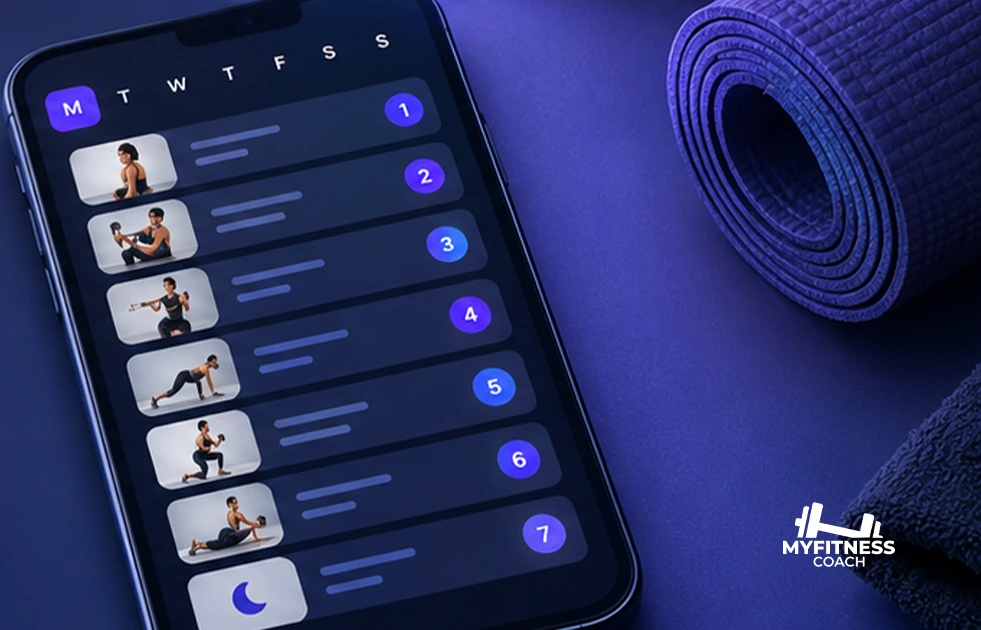
Give any plan four weeks before judging it. Then look at your log and match what you see:
| What you see | Likely cause | What to change |
| Most lifts went up in weight or reps | Plan is working | Nothing. Keep going until progress stalls |
| Lifts stuck for 2+ weeks, you feel fine | Not enough stimulus, or reps too far from failure | Push sets closer to failure first; if still stuck, add 2–3 weekly sets to that muscle |
| Lifts stuck or dropping, you feel run down | More work than you're recovering from | Take a lighter week (half the sets), then return with 2–3 fewer weekly sets |
| Sore for 3+ days after most sessions | Volume jumped too fast, or new exercises | Drop 1 set per exercise for two weeks; soreness usually fades as you adapt |
| Missing 1+ session most weeks | Plan has more days than your life does | Move to the next plan down (e.g. 4 → 3 days) and keep the weekly sets |
| Sessions run 20+ minutes over | Too many exercises or long rests | Cut the last exercise; superset opposing muscles (push with pull) |
| One muscle lags behind | It's getting fewer sets than you think | Recount with the ½-set method in Step 4, then add direct work if it's under range |
| Weight not moving on a fat-loss plan | Nutrition, not the training plan | Keep the plan; check calorie intake and daily steps |
The most common mistake is changing the whole plan when one variable was the problem. Change one thing, then give it another four weeks.
The 3-3-3 and 3-2-1 Gym Rules: Worth Following?
Both are social-media shortcuts for planning a week, not training standards from any research body. That doesn't make them bad, it means you should check them against the numbers above.
The 3-3-3 rule
There's no single definition. Depending on the source, "3-3-3" means:
- 3 exercises, 3 sets each, 3 days a week
- 3 sets of 3 heavy reps on the main lifts
- 3 days strength, 3 days cardio, 3 days rest, as a 9-day cycle
- 3 workouts a week, 30 minutes each, for 3 months
The most common version 3 exercises × 3 sets × 3 days gives 27 working sets a week for the whole body. If the three exercises are a squat, a press and a row, chest, back and quads each get about 9 sets: fine for a beginner. But hamstrings, shoulders and arms get little or no direct work.
Verdict: a reasonable first month for a beginner, if you pick exercises that cover squat, hinge, push and pull across the week. Outgrow it once your lifts slow down.
The 3-2-1 method
Three strength sessions, two Pilates sessions and one cardio session per week, plus a rest day. It clears the guideline of 2+ strength days easily.
The gap is cardio. One session rarely reaches 150 moderate minutes on its own, so add daily walking or make the cardio day longer. For muscle growth, three strength days work well as long as your weekly sets per muscle land in the Step 4 range.
Verdict: a well-balanced week for general fitness. For a muscle or strength goal, treat Pilates days as recovery and make sure the strength days carry enough sets.
Workout Plan Generator vs ChatGPT vs a Coach-Built Plan
Can ChatGPT generate a workout plan? Yes and often a reasonable one. Its weakness isn't the first plan; it's everything after. It doesn't see what you actually lifted, so it can't tell when to add weight or cut volume unless you report back every week.
| Free planner or template | ChatGPT or another AI chat | Workout app with logging | Human coach | |
| Cost | Free | Free or low | Free to subscription | Highest |
| Personalized to | A few inputs | Whatever you type | Your inputs and your log | You, in person |
| Adjusts as you progress | No | Only if you tell it | Yes, from logged sets | Yes |
| Exercise demos | Rarely | Text only | Usually video | Live feedback |
| Main risk | Doesn't change when you do | Plausible but unbalanced volume | Depends on the app | Cost and availability |
Whichever you use, run the plan through Steps 3 and 4: does the split match your days, and do the weekly sets per muscle land in range? A plan that passes both is a good plan, whoever wrote it.
Build Your Plan, Then Let It Adjust
A good workout plan comes down to five decisions: one goal, realistic days, a split that fits them, enough weekly sets per muscle, and a way to progress. Use the free planner at the top of this page to make those decisions in a minute, then check the result with the 4-week test.
If you'd rather not track sets and adjust the plan yourself, MyFitnessCoach builds a workout plan from your goal and schedule, logs every set, and adjusts as you progress with a demo video for each exercise.
Frequently Asked Questions
Similar Articles
Stay informed with these similar articles.

MyFitnessCoach
July 23, 2023
Triceps: Strengthening and Sculpting Your Arm Muscles
Welcome to the ultimate guide on triceps, the muscles responsible for the back of your upper arms. Whether you're looking to tone your arms, improve your athletic performance, or simply strengthen your upper body, understanding the triceps muscles is essential.
MyFitnessCoach
April 21, 2025
The Ultimate Gym Guide for Beginners Female
Starting your fitness journey can feel scary, especially if you’re new to the gym. You might wonder what to do, how to use the machines, or how many days a week you should go. The truth is, every fit person started where you are now nervous but ready for change. The good news? You don’t have to figure it all out alone.
MyFitnessCoach
May 10, 2023
Fitness Goals: Best Workout App For Beginners
If you are thinking of getting on your fitness journey, this is the right piece of writing for you. When you decide to kick off your fitness journey, apt guidance is the most crucial aspect. Beginners especially look for a helpful guide that gives them the right direction to their fitness aim. The right tools and techniques with a proper roadmap to your fitness goal hold very crucial importance.