
Wearable Heart Rate Monitor: 4 Types & Which One You Need
MyFitnessCoach
September 21, 2026
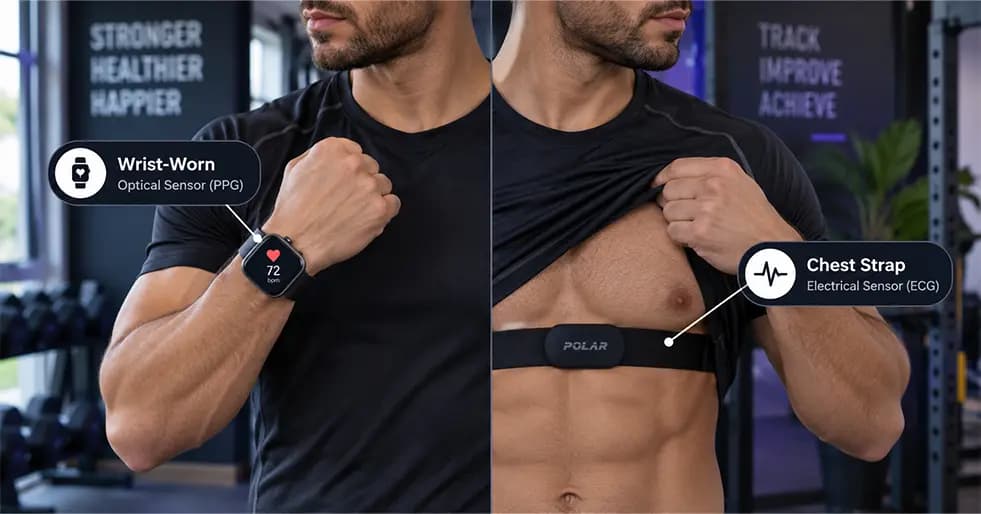
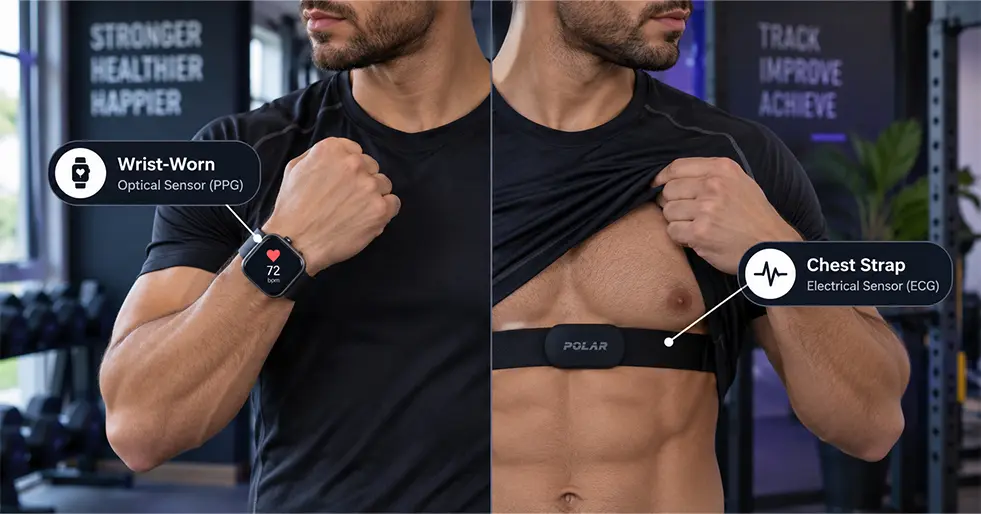
A wearable heart rate monitor is a device you wear on your body most commonly the wrist or chest that measures your heart rate continuously during daily activity or exercise, without needing to stop and manually check your pulse. Most work through one of two methods: optical sensors that read blood flow through your skin, or electrical sensors that read your heart's actual electrical activity, the same principle behind a hospital ECG.
Which type you need depends less on brand and more on what you're using it for. A device that's perfectly fine for tracking daily trends can fall short if you're pacing a race by heart rate zones or monitoring a diagnosed heart condition. This guide covers how these devices actually work, what the research says about their accuracy, and how to choose based on what you actually need.

Table of Contents
Subscribe to our newslettter
What Is a Wearable Heart Rate Monitor?
A wearable heart rate monitor is a device worn on the body, typically the wrist, chest, or upper arm that continuously tracks heart rate using either optical or electrical sensing technology. Unlike manually checking your pulse, it provides real-time, ongoing data throughout the day or during a workout, often paired with an app or fitness tracker for logging and analysis.
How Wearable Heart Rate Monitors Actually Work
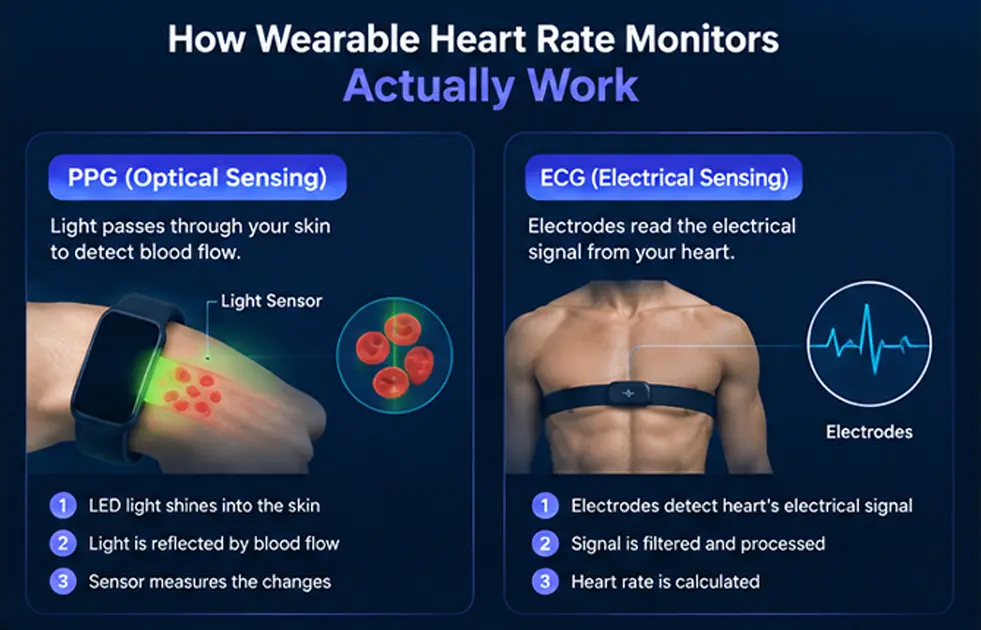
Optical sensors (PPG) wrist-based
Most smartwatches and fitness bands use photoplethysmography, or PPG. The device shines light usually green LED light into the skin and measures how much light is reflected back. Blood absorbs more light when it's pumping through vessels with each heartbeat, so the sensor detects those small changes in reflected light and calculates heart rate from the pattern.
This is convenient because it needs no direct skin contact beyond the watch itself, but it's an indirect measurement: it's reading blood flow, not the heart's electrical signal.
Electrical sensors (ECG) chest straps
Chest straps use electrodes that sit directly against the skin and detect the heart's actual electrical activity, the same signal a hospital ECG machine reads. This is a direct measurement of the event causing each heartbeat, not a downstream effect of it.
That distinction measuring the electrical trigger versus measuring its effect on blood flow is the core reason the two technologies differ in accuracy, especially during movement.
Chest Strap vs. Wrist-Worn: What the Research Actually Shows
This is where marketing claims and research diverge, so it's worth looking at actual numbers.
A widely cited 2017 study from Cleveland Clinic tested wrist-worn devices against a chest strap and an ECG across treadmill, stationary bike, and elliptical exercise. The chest strap showed a concordance correlation of 0.996 with the ECG essentially near-perfect agreement. The wrist-worn devices ranged from 0.67 to 0.92, meaning agreement varied considerably and was, at best, noticeably looser than the chest strap.
A separate 2017 study in a sports science journal found similar results: the Polar H7 chest strap matched ECG readings with a concordance coefficient of 0.996, while a tested Apple Watch came in at 0.92 under the same conditions.
The pattern across the research is consistent: chest straps, because they read electrical signals directly, track more closely with the gold-standard ECG measurement across exercise intensities. Wrist-worn optical sensors can still be accurate particularly for steady, moderate activity but they're more prone to error as intensity and movement increase.
What this doesn't mean: it doesn't mean wrist-worn monitors are unreliable for everyday use. It means their error margin widens in specific conditions, which matters for some use cases far more than others covered next.
When Accuracy Actually Matters (and When It Doesn't)
Most buying guides treat this as binary chest strap good, wrist bad but that's not a useful way to decide. What matters is what you're using the data for.
Accuracy matters a lot if:
- You're training by heart rate zones for a race and pacing decisions depend on precise numbers
- You have a diagnosed heart condition and a doctor has given you specific heart rate limits to stay within
- You do high-intensity interval training where heart rate changes rapidly and you need the device to keep up in real time
- You're doing research-grade tracking (HRV analysis, recovery monitoring) where small errors compound
Accuracy matters less if:
- You're tracking general daily trends is your resting heart rate roughly stable week to week
- You're doing steady-state cardio like walking or light cycling, where wrist sensors perform closest to their best
- You want a rough sense of effort level during a workout rather than a precise number
- Convenience (not needing to strap on a separate chest band) matters more to you than lab-grade precision
If you fall into the first group, a chest strap is worth the extra step. If you fall into the second, a good wrist-worn device is genuinely fine, and the research bears that out it's not that wrist monitors are broken, it's that they're a worse match for high-precision, high-intensity use cases.
Why Wrist Accuracy Drops During Certain Activities
Understanding why helps you work around it rather than just accepting an unreliable reading.
Motion artifact. PPG sensors work by detecting subtle changes in light reflection. Repetitive wrist motion, running arm swing, cycling, and lifting can introduce its own rhythmic pattern that the sensor sometimes confuses with the actual pulse signal. This is a major reason accuracy degrades specifically during dynamic, high-intensity movement rather than during rest.
Fit and contact. A loose band lets the sensor shift against the skin, and sweat can interfere with consistent contact. A snug, correctly positioned band produces a noticeably better signal.
Skin tone is a more contested factor than commonly reported. Melanin absorbs more of the green light many PPG sensors use, and several studies have found error rates increasing in darker skin tones as a result. However, this isn't as settled as some coverage suggests: a 2020 study testing a broader range of skin tones across various activities found that activity type was a stronger predictor of measurement error than skin tone itself accuracy dropped for everyone during movement, regardless of skin tone, more than it varied between skin tones at a given activity level. The honest takeaway is that skin tone is a documented factor in some studies, but activity intensity appears to be the larger and more consistent driver of error across the research.
None of these factors mean wrist devices are unusable; they mean the conditions under which you're measuring matter as much as the device itself.
Types of Wearable Heart Rate Monitors
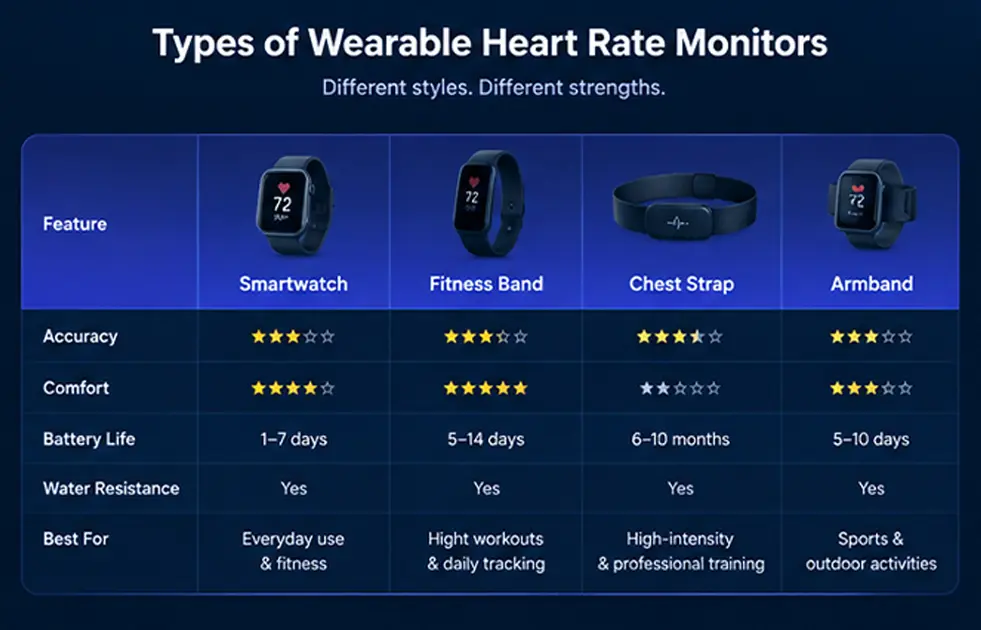
| Type | Sensor | Typical Accuracy | Best For |
| Smartwatch | Optical (PPG) | Good at rest/steady activity, less reliable at high intensity | All-day wear, general fitness tracking, notifications |
| Fitness band | Optical (PPG) | Similar to smartwatches, sometimes less refined algorithms | Budget-friendly daily tracking |
| Chest strap | Electrical (ECG) | Highest near-ECG agreement across intensities | Zone training, interval workouts, anyone needing precise numbers |
| Armband | Optical (PPG), sometimes multi-sensor | Variable generally between wrist and chest strap performance | Alternative to wrist if you dislike watches, or need to keep wrists free |
What to Look For Before Buying
Sensor type. Deciding first whether you need chest-strap precision or wrist convenience is enough this determines nearly everything else.
Battery life. Chest straps and simple bands often last longer than full smartwatches, which run displays and apps continuously.
Water resistance. Relevant if you swim or sweat heavily; check the specific rating rather than assuming "water resistant" covers swimming.
App and data integration. A monitor that syncs cleanly with the app you actually use day to day is often more valuable than one with slightly better raw sensor specs but a clunky companion app.
Comfort for your wear time. If you plan to wear it all day, prioritize a band or strap you'll tolerate for hours. The most accurate device is useless if you stop wearing it.
Getting the Most Accurate Reading from a Wrist-Worn Monitor
If you're using a wrist device and want the best data it can give you, a few adjustments help more than switching devices:
Wear it snug, above the wrist bone. A common mistake is wearing it loose, like a bracelet. Position it about a finger-width above the wrist bone and tighten it enough that it doesn't slide, without cutting off circulation.
Warm up before intense efforts. Blood flow at rest is lower, which can make the initial signal weaker. A short warm-up improves signal quality before you hit higher intensities.
Clean the sensor and your skin. Sweat, lotion, and sunscreen residue can all interfere with optical readings.
Expect more lag and error during rapid changes. If you're doing intervals, know that the reading may trail the real change in effort by several seconds; don't chase a number that hasn't caught up yet.
Consider a chest strap for the sessions where it matters, even if you wear a smartwatch the rest of the time. Many people use both: a watch for daily wear, a strap for specific high-intensity or zone-based sessions.
The Bottom Line
Wearable heart rate monitors work through one of two methods: optical sensors reading blood flow, or electrical sensors reading the heart's actual signal and that difference is why accuracy varies so much between device types. Chest straps track closest to clinical accuracy, especially during intense or fast-changing activity. Wrist-worn devices are convenient and accurate enough for daily tracking and steady-state exercise, with accuracy that narrows further if you wear the device correctly.
The right choice isn't about finding the single "most accurate" device, it's about matching the device to what you're actually trying to measure.
If you want to track heart rate trends alongside your workouts and recovery in one place, MyFitnessCoach syncs with most wearables so the data feeds directly into your training log rather than sitting in a separate app.
This article is for informational purposes only and is not a substitute for professional medical advice, diagnosis, or treatment. If you have a diagnosed heart condition, consult a qualified healthcare provider about appropriate heart rate monitoring for your situation.
Frequently Asked Questions
Similar Articles
Stay informed with these similar articles.
MyFitnessCoach
May 9, 2025
Why Kneecaps Sweat? 5 Surprising Causes & Proven Fixes
Ever noticed your knees getting sweaty for no reason? You're not alone. Sweaty kneecaps might seem odd, but they're more common than you think.
MyFitnessCoach
March 6, 2025
Arm Swing Exercise: Effective Way to Boost Your Fitness
When it comes to fitness, we often think of intense workouts, heavy lifting, or long runs. But what if I told you that a simple exercise like arm swings could be just as effective in improving your overall fitness? Arm swing exercises are easy to do, require no equipment, and can be done anywhere. Whether you're a beginner or a fitness enthusiast, arm swings can help you improve flexibility, strength, and even cardiovascular health. In this article, we’ll explore the benefits of arm swing exercises, how to do them correctly, and how you can incorporate them into your fitness routine using the MyFitnessCoach app.
MyFitnessCoach
February 24, 2025
Best Deodorant for Athletes: Stay Fresh During Your Workouts
When you're an athlete or someone who loves to stay active, staying fresh and odor-free is a top priority. Whether you're hitting the gym, running a marathon, or sweating it out during a high-intensity workout, the right deodorant can make all the difference. But with so many options available, how do you choose the best deodorant for athletes? In this article, we’ll break down everything you need to know about finding the perfect deodorant to keep you feeling confident and fresh, no matter how intense your workout gets. Plus, we’ll show you how the MyFitnessCoach app can help you stay on top of your fitness game.