
Toe Taps for Abs: 5 Easy Progressions & Mistakes to Avoid
MyFitnessCoach
February 6, 2025
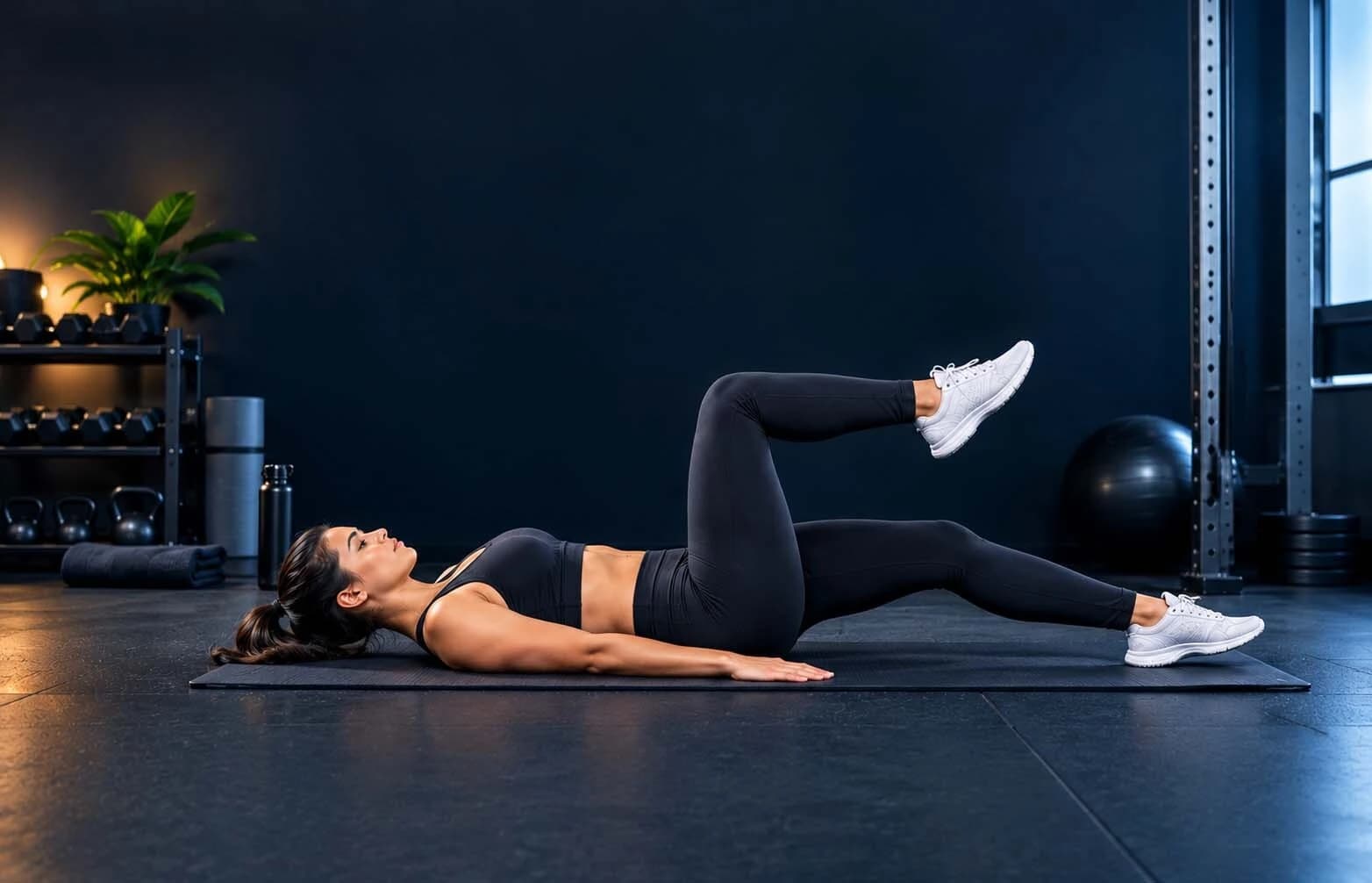
Supine toe taps are a lying core exercise: you lie on your back with your knees bent over your hips and lower one foot at a time to tap the floor, keeping your lower back steady. They're one of four types of toe taps, and the one people usually mean when they search for toe taps for abs.
This guide covers the exact form, the mistakes that make them feel wrong, five ways to make them easier or harder, and what research says about how demanding they really are.
Key takeaways.
- Supine toe taps train core control: your abs work to keep your lower back steady while your legs move.
- Aim for 8 to 10 taps per side, one or two sets, with 30 to 90 seconds of rest.
- Tap lightly and only lower your foot as far as you can control. If your back arches, you've gone too low.
- In a 2024 ultrasound study, the Pilates toe tap ranked 6th of 7 core exercises for how much it thickened the deep trunk muscles, so treat it as a starting point.

Table of Contents
Subscribe to our newslettter
What Are Supine Toe Taps?
Supine toe taps are a core exercise done lying on your back, where you hold your knees above your hips and lower one foot at a time to tap the floor. They're also called Pilates toe taps, lying toe taps or alternating toe taps. The goal is to keep your trunk still while your legs move.
Muscles Worked
- Abdominals: rectus abdominis, transversus abdominis and the obliques, which keep your trunk steady.
- Hip flexors: they lift and hold your legs.
- Deep trunk and lower back muscles: they help control your spine position.
How to Do Supine Toe Taps (Step by Step)
.webp)
- Lie on your back on a mat with your knees bent and feet flat.
- Bring your legs up one at a time into a tabletop position: knees over your hips, shins parallel to the floor.
- Keep your lower back steady. Harvard Health and Healthline describe a neutral spine and no arching. Pilates instructors often say to "imprint" your back into the mat. Use whichever cue stops your back from arching without forcing it.
- Lower your right foot until your toes tap the floor. Touch lightly without putting weight on the foot, and keep your knee angle the same.
- Bring the foot back to the tabletop and repeat with the left.
- Keep breathing steadily. Don't hold your breath.
Reps: 8 to 10 taps per side, one or two sets, with 30 to 90 seconds of rest (Harvard Health). Slower taps are harder.
5 Ways to Progress Supine Toe Taps
| Step | What to do | Move on when |
| 1. Short range | Keep the non-tapping foot on the mat, and only lower your leg as far as you can keep your back steady | You can do 10 taps per side without your back arching |
| 2. Standard | Both legs in tabletop, alternate taps | The standard version feels easy |
| 3. Slow tempo | Take about three seconds to lower each foot and pause lightly at the floor | You stay steady for the whole set |
| 4. Both feet | Tap both feet to the floor at the same time (Healthline lists this as a harder option) | You keep your back steady and your knees fixed |
| 5. Next exercises | Add bird dog or side plank, which scored significantly higher in the 2024 study. Dead bug ranked a little higher too | You're ready to add variety and challenge |
Supine Toe Taps vs Dead Bug: Which Should You Start With?
Both are lying core exercises, so people often wonder which comes first.
| Supine toe taps | Dead bug | |
| Movement | One foot taps the floor while the other leg stays in tabletop | The opposite arm and leg extend away from your center |
| 2024 study ranking (of 7) | 6th | 4th |
| Start here if | You're new, or your back arches when you lower a leg | You can do 10 controlled toe taps per side |
The study singled out bird dog and side plank as the exercises that scored significantly higher. A simple path is to start with toe taps, move to dead bug when they feel steady, then add bird dog or side plank.
A 3-Minute Beginner Routine
| Block | Time |
| Short-range toe taps (8 per side) | 0:35 |
| Rest | 0:30 |
| Standard toe taps (8 per side) | 0:35 |
| Rest | 0:30 |
| Slow toe taps (6 per side, about three seconds each) | 0:40 |
| Cool-down: knee hug and slow breathing | 0:10 |
| Total | 3:00 |
Common Mistakes and How to Fix Them
| Problem | Likely Cause | What to Try |
| My lower back lifts off the mat | You're lowering the leg past the point where your abs can hold your pelvis still | Stop the foot an inch or two above the floor. Rest the other foot on the mat until you can hold steady |
| My knee opens up as the leg goes down | You're reaching for the floor with your toes | Keep the shin level at about 90 degrees and tap with a smaller range |
| I rest my foot on the floor | Treating the tap like a step | Think of tapping something fragile. The foot should barely load |
| I hold my breath | Bracing too hard | Count your taps out loud so you keep breathing |
| I feel it in the front of my hips | Hip flexors are doing the lifting when the pelvis tips | Shorten the range and settle your lower back before each tap |
| My neck gets tense | Lifting your head or gripping with your shoulders | Let your head rest on the mat and keep your hands by your sides |
Are Supine Toe Taps Effective? What the Research Shows
In a 2024 ultrasound study of 44 healthy, recreationally active adults, researchers compared seven core exercises by how much each one thickened three deep trunk muscles. The Pilates toe tap came 6th of 7. Bird dog and side plank scored significantly higher, and dead bug sat in between. The full study details are in our toe taps guide.
What that means: supine toe taps are a gentle, beginner-friendly way to practice core control, but they aren't the most demanding option. What it doesn't mean: the study measured muscle thickness during slow repetitions in young, active adults. Nobody was trained over time, so it can't say how toe taps change strength.
The Bottom Line
Supine toe taps are a simple way to learn to keep your lower back steady while your legs move. Do them slowly, lower only as far as you can control, and move on to bird dog or side plank when they feel easy. For a wider routine, see our core workout guide.
This article is for informational purposes only and is not a substitute for professional medical advice. Stop if you feel sharp pain. If you have a back condition, consult a qualified healthcare provider before starting new exercises.
References
- Tsartsapakis I, Bagioka I, Fountoukidou F, Kellis E. A comparison between core stability exercises and muscle thickness using two different activation maneuvers. J Funct Morphol Kinesiol. 2024;9(2):70. doi:10.3390/jfmk9020070
- Harvard Health Publishing. Move of the month: Alternating toe taps
- Healthline. Toe taps exercises: standing, floor, and Pilates
Frequently Asked Questions
Similar Articles
Stay informed with these similar articles.
MyFitnessCoach
May 9, 2025
Why Kneecaps Sweat? 5 Surprising Causes & Proven Fixes
Ever noticed your knees getting sweaty for no reason? You're not alone. Sweaty kneecaps might seem odd, but they're more common than you think.
MyFitnessCoach
March 6, 2025
Arm Swing Exercise: Effective Way to Boost Your Fitness
When it comes to fitness, we often think of intense workouts, heavy lifting, or long runs. But what if I told you that a simple exercise like arm swings could be just as effective in improving your overall fitness? Arm swing exercises are easy to do, require no equipment, and can be done anywhere. Whether you're a beginner or a fitness enthusiast, arm swings can help you improve flexibility, strength, and even cardiovascular health. In this article, we’ll explore the benefits of arm swing exercises, how to do them correctly, and how you can incorporate them into your fitness routine using the MyFitnessCoach app.
MyFitnessCoach
February 24, 2025
Best Deodorant for Athletes: Stay Fresh During Your Workouts
When you're an athlete or someone who loves to stay active, staying fresh and odor-free is a top priority. Whether you're hitting the gym, running a marathon, or sweating it out during a high-intensity workout, the right deodorant can make all the difference. But with so many options available, how do you choose the best deodorant for athletes? In this article, we’ll break down everything you need to know about finding the perfect deodorant to keep you feeling confident and fresh, no matter how intense your workout gets. Plus, we’ll show you how the MyFitnessCoach app can help you stay on top of your fitness game.