
Standing Oblique Crunch: 3 Versions, Muscles Worked and Proper Form
MyFitnessCoach
January 16, 2025
A standing oblique crunch works the muscles along the sides of your waist without getting on the floor. The catch is that three different exercises go by that name, and they don't all work the side you'd expect. Pick the right one and it's a solid, low-equipment way to train your obliques. Expect it to slim your waist on its own and you'll be disappointed.
This guide shows you how to do each version, which muscles and which side each one trains, how to fix the mistakes that make it feel wrong, and what the research says about belly fat.
Key takeaways
- Three exercises share the name: the knee-to-elbow standing side crunch, the bodyweight side bend and the dumbbell side bend.
- With a dumbbell in your right hand, bending right mainly works your left obliques. They control the lowering and pull you back up.
- Hold one dumbbell, not two. Two weights largely cancel each other out.
- Ab exercises build muscular endurance, but a 6-week trial found they didn't reduce belly fat on their own.
Table of Contents
Subscribe to our newslettter
What Is a Standing Oblique Crunch?
A standing oblique crunch is a core exercise you do on your feet that bends your torso sideways to work the oblique muscles along the sides of your waist. The name covers three versions: a knee-to-elbow side crunch, a bodyweight side bend and a dumbbell side bend. None of them needs a mat.
That's why standing crunches are popular with people who don't like floor work, who have trouble getting up and down, or who want a core move they can do between sets.
One Name, Three Exercises: Which Version Are You Doing?
| Version | What happens | Equipment | Mainly works | Best for |
| Standing side crunch (standing knee to elbow crunch) | Lift one knee out to the side and bring the same-side elbow down to meet it | None | Same-side obliques, plus hip flexors | Beginners, warm-ups, circuits |
| Bodyweight standing side bend | Bend your torso straight to the side and come back up | None | Mostly the opposite side, which controls the bend | Learning the movement |
| Standing oblique crunch with dumbbell | Hold one dumbbell, bend toward it, return upright | One dumbbell | Opposite-side obliques and quadratus lumborum | Building strength with added load |
Many guides describe the side bend and call it a crunch, so if a workout tells you to do "standing oblique crunches," check which one it means.
Muscles Worked in Standing Oblique Crunches
Standing ab crunches of any kind lean on the same group of muscles:
- External obliques. The outer layer on the sides of your waist. They bend your torso to the same side and rotate it to the opposite side.
- Internal obliques. The layer underneath. They bend and rotate your torso toward the same side.
- Quadratus lumborum. A deep muscle in the lower back that helps bend the spine sideways and steady the pelvis.
- Hip flexors. Only in the knee-to-elbow version, which lifts the knee.
- Rectus abdominis. Helps a little, mostly to keep your trunk steady.
Which Side Is Actually Working?
This is where most people get the standing oblique crunch wrong.
Knee-to-elbow side crunch: you actively pull your ribs and hip toward each other on one side, so the same side does the crunching.
Side bends (bodyweight or dumbbell): gravity pulls you into the bend. When you bend right, the muscles on your left side work to control the lowering and pull you back to standing. Exercise guides describe it the same way: with a dumbbell in your right hand, bending right mainly works the left obliques. It feels backwards, but it isn't a mistake.
Why one dumbbell, not two: holding a weight in each hand balances the load, so neither side has much to resist. Use one dumbbell, finish your reps, then switch hands.
These points come from the mechanics of the movement as exercise libraries describe it, not from a published study.
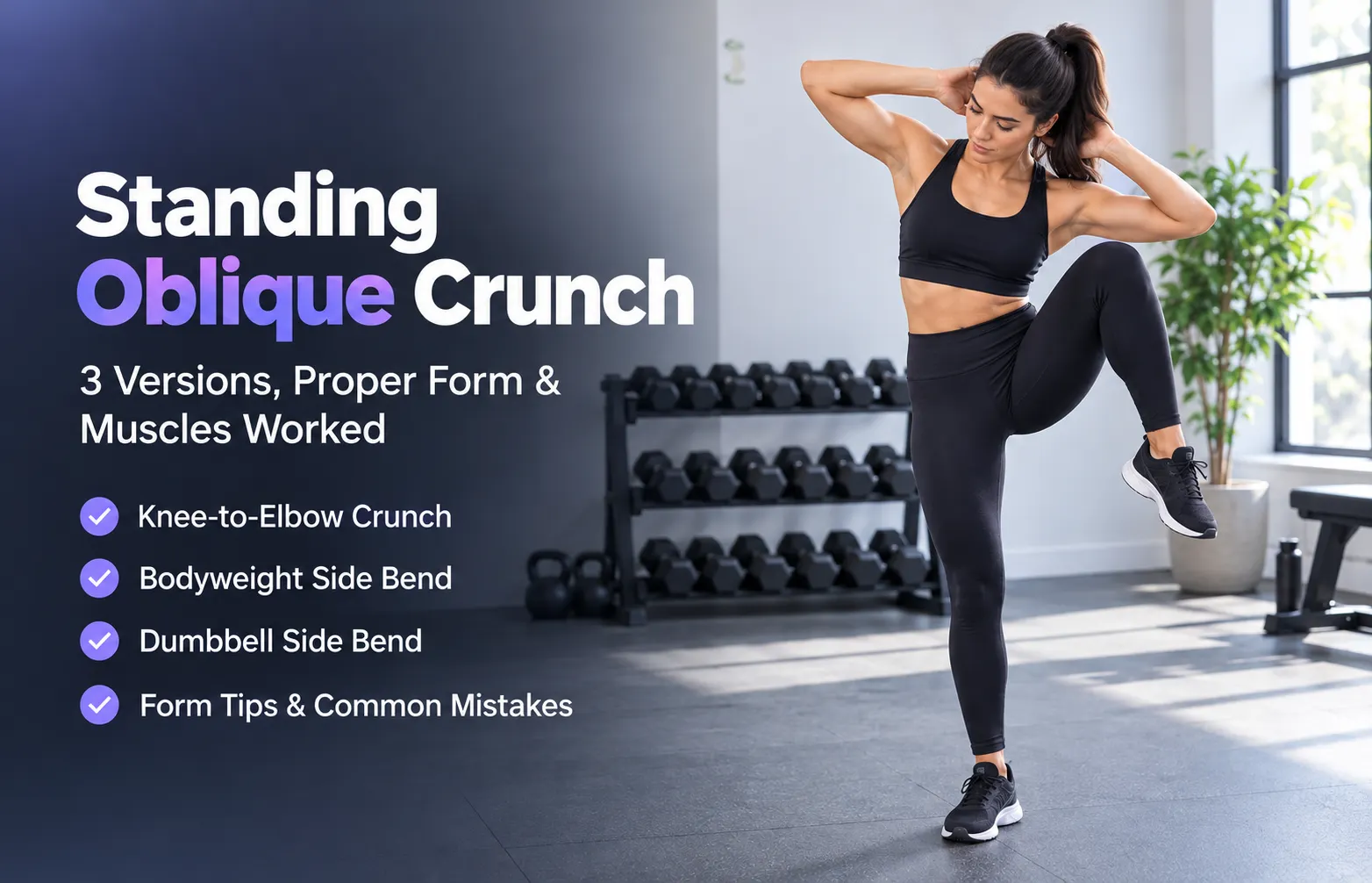
How to Do a Standing Side Crunch (Knee to Elbow)
Standing side crunches are the easiest place to start and the version most videos show.
- Stand with your feet about hip-width apart and your knees soft.
- Place your hands lightly behind your head, elbows wide.
- Shift your weight onto your left leg.
- Lift your right knee out to the side and up, and at the same time bend your torso to the right so your right elbow moves toward your right knee.
- Lower your foot and straighten up with control.
- Do all your reps on one side, then switch, or alternate sides.
Breathing: exhale as your elbow and knee come together, and inhale as you return.
Easier: hold a wall with one hand, or skip the knee lift and just bend sideways. Harder: slow the lowering to three seconds and pause at the top.
How to Do a Standing Oblique Crunch With a Dumbbell
- Hold one dumbbell in your right hand at your side, palm facing in. Put your left hand on your hip or lightly behind your head.
- Stand with your feet about hip-width apart and brace your core.
- Bend straight to the right, sliding the dumbbell down the outside of your right thigh, roughly toward your knee. You should feel a stretch along your left side.
- Pause for a second.
- Use your left obliques to pull yourself back upright. Don't let momentum do it.
- Finish your reps, then switch the dumbbell to your left hand.
Start lighter than you think. A slow, controlled bend matters more than the weight.
Bodyweight Standing Side Bend
- Stand tall with your feet hip-width apart.
- Raise your left arm overhead, or put both hands behind your head.
- Bend straight to the right, keeping your chest facing forward.
- Return to upright with control, then repeat on the other side.
It's a gentle version that's good for learning to bend sideways without leaning forward. It's light, so it mainly builds control rather than strength.
Are Standing Crunches Effective?
Short answer: for building oblique endurance and control, yes. For strength, only if you add load over time. For losing belly fat, no.
No study that tests the standing oblique crunch directly turned up in the research for this guide. What we can say:
- Bodyweight versions are light. They suit beginners, warm-ups and circuits, but most people will need a dumbbell or cable to keep progressing.
- Ab training does build muscular endurance. In the 6-week trial described in the next section, the exercise group's sit-up endurance improved more than the control group's.
- The real standing crunches benefits are practical: no floor, no equipment for two of the three versions, and easy to fit between other exercises.
Will Standing Oblique Crunches Slim Your Waist?
Not on their own. This is the most common reason people search for exercise, so here's the evidence.
The main trial. In a 2011 randomized controlled trial, 24 healthy, sedentary adults either did seven abdominal exercises (2 sets of 10, five days a week, for six weeks) or no training. Both groups kept their usual calorie intake. The ab training produced no significant change in body weight, body fat percentage, belly fat, waist circumference or abdominal skinfolds, though it improved muscular endurance.
The wider evidence. A systematic review and meta-analysis of spot reduction studies pooled 37 comparisons and found that training a muscle had no effect on the fat around it.
The exception. A 2023 randomized trial in adult men reported that high-volume abdominal endurance exercise reduced local fat more than treadmill running. It's one trial against a larger body of evidence that finds no spot reduction, so it's worth knowing about but not enough to change the overall answer.
What actually changes your waistline: losing body fat overall, which comes down to your calorie balance and total activity, plus building the muscles underneath. Our guide on how to know if you're in a calorie deficit covers the first part.
Troubleshooting: Why It Feels Wrong
| Problem | Likely Cause | What to Try |
| I feel it in my lower back | Leaning forward or back, bending too far, or a weight that's too heavy | Bend straight to the side, shorten the range and go lighter. Stop if the pain is sharp |
| I don't feel my obliques | Moving fast, a tiny range, or holding two dumbbells | Slow down, pause at the bottom, and use one dumbbell |
| My hips shift sideways | The hips are moving instead of the torso | Keep your hips level and stacked over your feet, with knees slightly soft |
| My shoulders twist | Rotating instead of bending | Keep your chest facing forward, as if you're between two panes of glass |
| My neck strains | Pulling on your head with your hands | Use light fingertips, or cross your arms over your chest |
| I lose my balance (knee version) | Unsteady standing leg | Hold a wall, make the knee lift smaller and slow down |
| The dumbbell pulls me back up | A passive return | Pause at the bottom, then pull up with the opposite side |
Sets, Reps and How to Progress
There's no research-based dose for this exercise. These are common starting points.
| Version | Reps | Sets | Rest |
| Standing side crunch | 10–15 per side | 2–3 | 30–60 sec |
| Bodyweight side bend | 10–15 per side | 2 | 30 sec |
| Dumbbell standing oblique crunch | 8–12 per side | 2–3 | 60 sec |
Progress in this order: add reps, then slow the lowering and add a pause, then add a dumbbell, then move up in weight. A cable machine also works well for side bends, because it keeps the tension more even through the movement. See our cable exercises guide.
Where it fits: two or three times a week, at the end of a workout or in a circuit. For a standing core circuit, pair it with standing toe taps, or add it to a HIIT workout. For floor-based options, see our core workout guide.
The Bottom Line
The standing oblique crunch is three exercises under one name. Use the knee-to-elbow version to start, the dumbbell side bend to build strength, and remember that the side opposite the weight does most of the work. It won't melt belly fat, but it will build oblique endurance, and with added weight, strength.
To track your sets and see your weights go up over time, the workout logger in MyFitnessCoach is built for that.
This article is for informational purposes only and is not a substitute for professional medical advice, diagnosis, or treatment. If you have back pain or a spine condition, consult a qualified healthcare provider before adding side-bending exercises.
References
- Vispute SS, Smith JD, LeCheminant JD, Hurley KS. The effect of abdominal exercise on abdominal fat. J Strength Cond Res. 2011;25(9):2559–2564. PubMed 21804427
- A proposed model to test the hypothesis of exercise-induced localized fat reduction (spot reduction), including a systematic review with meta-analysis. Human Movement. Link
- Abdominal aerobic endurance exercise reveals spot reduction exists: a randomized controlled trial. 2023. PMC10680576
Frequently Asked Questions
Similar Articles
Stay informed with these similar articles.
MyFitnessCoach
May 9, 2025
Why Kneecaps Sweat? 5 Surprising Causes & Proven Fixes
Ever noticed your knees getting sweaty for no reason? You're not alone. Sweaty kneecaps might seem odd, but they're more common than you think.
MyFitnessCoach
March 6, 2025
Arm Swing Exercise: Effective Way to Boost Your Fitness
When it comes to fitness, we often think of intense workouts, heavy lifting, or long runs. But what if I told you that a simple exercise like arm swings could be just as effective in improving your overall fitness? Arm swing exercises are easy to do, require no equipment, and can be done anywhere. Whether you're a beginner or a fitness enthusiast, arm swings can help you improve flexibility, strength, and even cardiovascular health. In this article, we’ll explore the benefits of arm swing exercises, how to do them correctly, and how you can incorporate them into your fitness routine using the MyFitnessCoach app.
MyFitnessCoach
February 24, 2025
Best Deodorant for Athletes: Stay Fresh During Your Workouts
When you're an athlete or someone who loves to stay active, staying fresh and odor-free is a top priority. Whether you're hitting the gym, running a marathon, or sweating it out during a high-intensity workout, the right deodorant can make all the difference. But with so many options available, how do you choose the best deodorant for athletes? In this article, we’ll break down everything you need to know about finding the perfect deodorant to keep you feeling confident and fresh, no matter how intense your workout gets. Plus, we’ll show you how the MyFitnessCoach app can help you stay on top of your fitness game.