
Scapular Push-Up: 7 Mistakes Killing Your Results
MyFitnessCoach
May 16, 2025
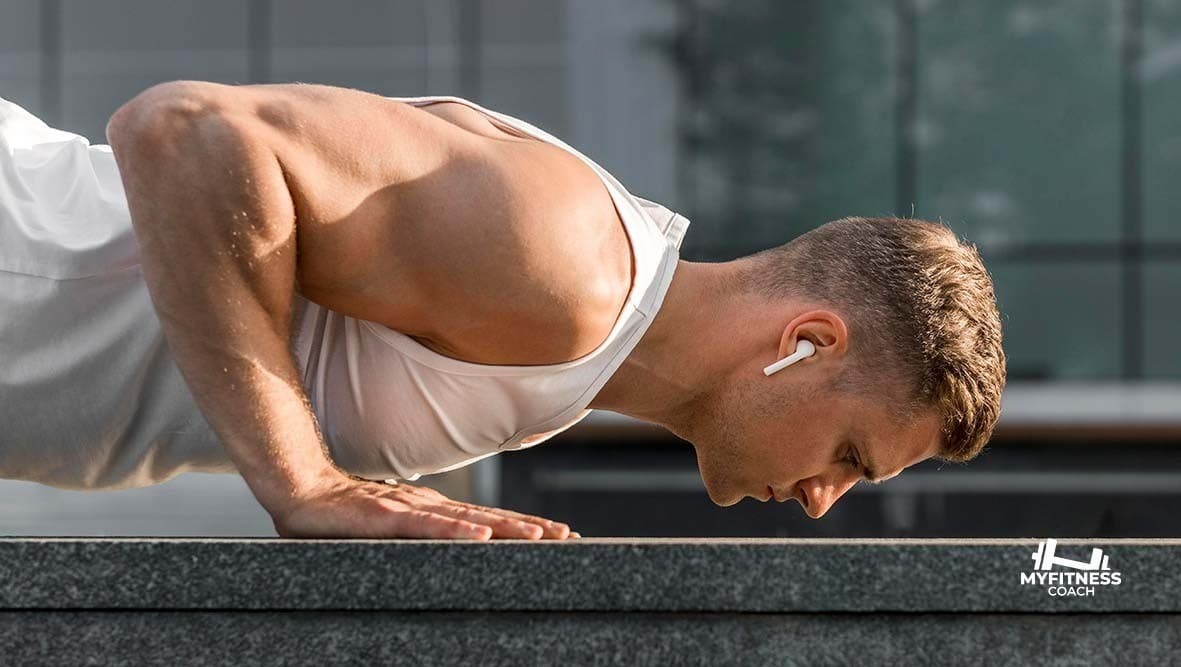
A scapular push-up is a bodyweight exercise done in a plank position where your arms stay straight and the only thing that moves is your shoulder blades. You push them apart, then let them draw back together. No elbow bend, no chest-to-floor.
It looks like almost nothing is happening. That is normal, and it is also why most people do it wrong.
The exercise exists to train the muscles that control how your shoulder blades sit and move against your ribcage, mainly the serratus anterior. When those muscles are weak, the shoulder blade loses its stable base, and everything you do overhead becomes less efficient and more vulnerable. This guide covers how to perform it properly, what it genuinely does, and how to fix it when you can't feel anything.

Table of Contents
Subscribe to our newslettter
What Is a Scapular Push-Up?
A scapular push-up is a small-range bodyweight exercise performed in a high plank with the elbows locked. You protract the shoulder blades (push them apart, letting your upper back round slightly) and then retract them (draw them together, letting your chest sink toward the floor). The movement happens entirely at the scapulothoracic joint where the shoulder blade glides across the ribcage rather than at the elbow or shoulder.
The total range is only a few inches. That is by design.
Muscles Worked
There is genuine confusion on this topic across fitness sites, with some listing the serratus anterior as primary and at least one claiming the anterior deltoid is the main muscle. The disagreement comes from mixing up two different things: the muscles holding the plank position and the muscles producing the movement.
Primary mover
Serratus anterior. This is the muscle that matters. It runs along the side of your ribcage and attaches to the underside of your shoulder blade, and its main job is scapular protraction pulling the shoulder blade forward and holding it flat against the ribs. Every rep of a scapular push-up is a direct protraction against your own body weight, which is about as targeted as this muscle gets.
Assisting muscles
Rhomboids and middle trapezius. Handle the retraction phase, drawing the shoulder blades back together.
Lower trapezius. Works with the serratus to control scapular position, particularly rotation.
Pectoralis major. Assists protraction. This matters more than it sounds, see the section on effort level below.
Core, anterior deltoid, triceps. These hold the plank. They work isometrically and they're why you feel some tension in your shoulders and midsection, but they are not producing the movement.
That distinction is worth keeping straight, because if you feel this exercise primarily in your front shoulders or triceps, you are holding a plank and not doing a scapular push-up.
How to Do a Scapular Push-Up (Step by Step)
- Set up in a high plank. Hands directly under your shoulders, arms straight, feet hip-width. Body in one line from head to heels.
- Lock your elbows. They stay locked for every rep. If they bend, it becomes a push-up.
- Brace your core and squeeze your glutes. This stops your hips from sagging once you start moving.
- Protract. Push the floor away and let your shoulder blades spread apart. Your upper back will round slightly and your torso will rise an inch or two. This is the working half of the rep.
- Hold for a beat. One second at full protraction. This is where the serratus is doing the most work.
- Retract. Let your shoulder blades draw back together, allowing your chest to sink slightly. Stay controlled, don't collapse into it.
- Repeat for 8 to 15 reps. Keep the pace slow. Fast reps turn into bouncing, and bouncing means momentum is doing the work.
Breathing: exhale as you protract, inhale as you retract.
Why Pushing Harder Makes This Exercise Worse
This is the part almost every guide gets backwards.
The instinct with any bodyweight exercise is to push as hard as you can. With scapular push-ups, maximal effort works against you. Research on isometric scapular protraction found that at maximal effort, the pectoralis major ramps up as a synergist and takes over a meaningful share of the work. At submaximal effort, serratus anterior activation is better isolated relative to the pec.
The study specifically looked at people with and without a winged scapula, and found that those with winging already show reduced serratus activity and greater compensation from the pectoralis major and upper trapezius. For them, maximal effort made the compensation pattern worse, not better, which is why submaximal resistance was the recommendation in a clinical setting.
What to do with that: aim for controlled, moderate effort with a clear pause at full protraction, not an explosive shove into the floor. If you're straining, you've likely handed the work to your chest.
Worth noting a limitation: this research measured muscle activation during isometric protraction, not long-term strength or hypertrophy outcomes from scapular push-ups specifically. It's a strong signal about how to perform the movement, not proof of a training outcome.
Do Unstable Surfaces Help? Probably Not
You'll see scapular push-ups demonstrated on BOSU balls, therapy balls and wobble boards, usually with the implication that instability means more serratus work.
A systematic review and meta-analysis of push-up variations across unstable support surfaces found no significant effect on serratus anterior activation from any unstable device. What the unstable surfaces did increase was upper trapezius activity highest on suspension equipment, then therapy ball, then wobble board.
That's close to the opposite of what you want. In most people with scapular control problems, the upper trapezius is already overactive and compensating for a weak serratus. Adding a wobble board increases the compensation rather than correcting it.
The authors graded the certainty of this evidence as low to very low, so it isn't the final word. But the practical read is clear enough: there's no reason to add instability to this exercise, and a reasonable argument for not bothering.
Do them on the floor.
Common Mistakes and How to Fix Them
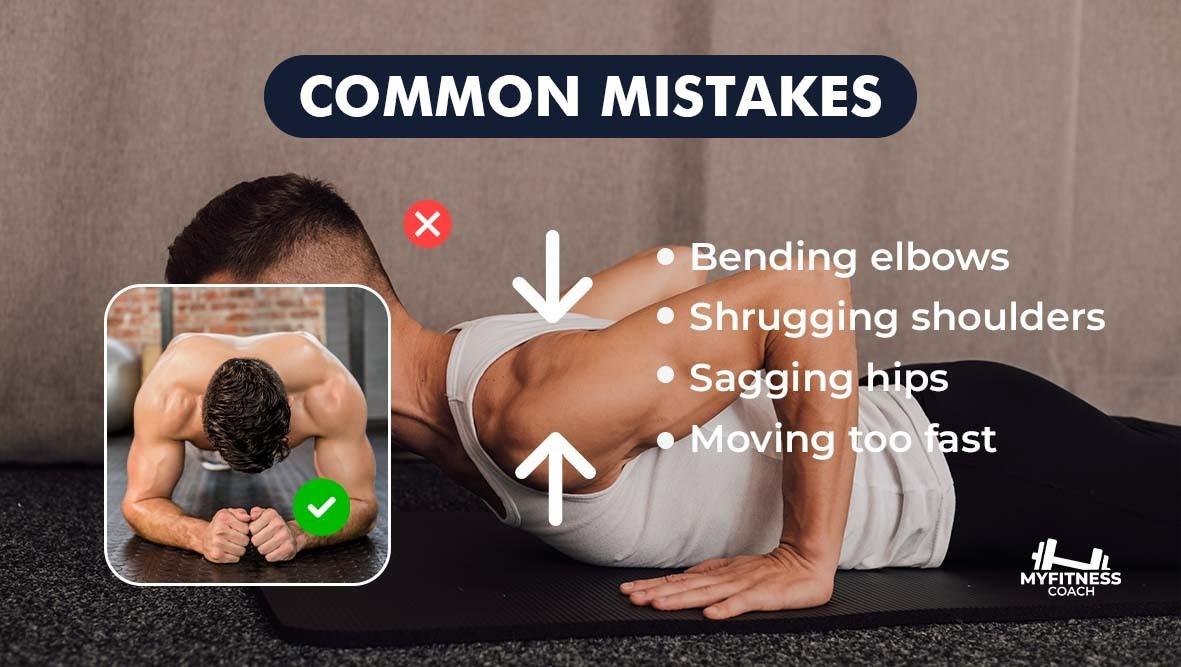
- Bending the elbows. The most common error. The moment your elbows bend, your chest and triceps take over and the shoulder blades stop working. Fix: lock the elbows and keep them locked. Film a set from the side if you're unsure.
- Shrugging instead of protracting. If your shoulders rise toward your ears, your upper trapezius is doing the job the serratus should be doing. Fix: think "push the floor away" rather than "lift my body." Keep a long neck and space between your shoulders and ears.
- Sagging hips. Losing the plank turns this into a lower-back exercise. Fix: squeeze your glutes and brace before you start the first rep, not after the third.
- Rushing the reps. The range is tiny, so speed removes almost all of the tension. Fix: one second at full protraction, controlled on the way back. Fewer, slower reps beat more, faster ones here.
- Only doing half the range. Most people protract a little and never reach either end. Fix: at the top, let your upper back genuinely round. At the bottom, let the chest sink and the blades draw fully together.
- Holding your breath. Common with small-range exercises because they feel like a hold. Fix: exhale on the push, inhale on the return.
Troubleshooting: "I Don't Feel Anything"
This is the most common complaint with scapular push-ups, and no amount of extra reps fixes it if the cause isn't addressed.
| Problem | Likely Cause | What to Try |
| You feel nothing at all | Range of motion is too small you're holding a plank and rocking slightly | Exaggerate the top: round your upper back deliberately. Pause one second at full protraction. Do 6 slow reps instead of 15 fast ones. |
| You feel it mostly in your chest | Effort is too high, so the pectoralis major has taken over protraction | Drop to moderate effort. Push smoothly, not explosively. The exercise should feel unimpressive. |
| Shoulders creep toward your ears | Upper trapezius compensating for a weak serratus — the classic pattern | Reset the plank, lengthen the neck, and focus on pushing the floor away rather than lifting the body. Regress to the wall version if it keeps happening. |
| You feel it in your wrists | Too much weight through the hands, or poor wrist extension tolerance | Try it on your fists, on parallettes/dumbbell handles, or against a wall instead. |
| It just feels like a plank | You're bracing but not moving the scapulae | Have someone place a hand lightly between your shoulder blades so you have something to push away from or do the wall version where the feedback is easier to feel. |
| Hips sag after a few reps | Core fatigue, or the plank was never properly set | Reduce reps per set. Or do them from the knees or against a wall until the plank holds for the whole set. |
| One side moves more than the other | Side-to-side difference in serratus strength or control common, especially with scapular winging | Do the wall version one arm at a time so each side works independently. Start with the weaker side and match its reps on the stronger side. |
Is This a Warm-Up or Real Training?
Both, and the distinction matters because it changes how you program it.
As a warm-up (most people, most of the time). Two sets of 10–12 before pressing or pulling work. The point is waking up scapular control before you load the shoulder, not fatiguing anything. Low effort, no soreness expected.
As corrective training (specific cases). If you have visible scapular winging, a history of shoulder impingement, or noticeably poor scapular control during pressing, this becomes actual programmed work rather than a warm-up. That means 3–4 sets, done on its own rather than squeezed in before something else, several times a week, tracked over time.
The difference is intent. Nobody's shoulder health is transformed by two casual sets before bench press. But a genuine serratus weakness, trained deliberately for a couple of months, is a different situation.
If you suspect scapular winging the shoulder blade visibly lifting away from the ribcage, particularly during a push-up or when lowering your arms, that's worth having assessed by a physiotherapist rather than self-treating. Winging has several possible causes, including nerve involvement, and not all of them are a strength problem.
Who Actually Needs This Exercise
Strong fit if:
- You spend most of the day at a desk and notice rounded shoulders
- You press or pull overhead regularly and want a better scapular base
- You're working toward your first push-up or pull-up and need scapular control first
- You've been told you have poor scapular control, winging, or scapular dyskinesis
Less of a priority if:
- You already have good scapular control and no shoulder complaints it's a reasonable warm-up but not a gap in your training
- Your shoulder pain is acute or unexplained get it assessed before adding loaded exercise
Programming: Sets, Reps, Where It Fits
| Use case | Sets × Reps | Placement |
| Warm-up before upper-body work | 2 × 10–12 | Start of session, before pressing or pulling |
| General shoulder health | 2–3 × 10–15 | Anywhere in an upper-body session |
| Corrective focus (serratus weakness) | 3–4 × 8–12, slow tempo | Its own slot, 3–4× per week |
Rest 30–60 seconds between sets. This isn't a heavy exercise and doesn't need long recovery.
Progression, in order: wall version → incline (hands on a bench) → floor plank → feet elevated → weight plate on the upper back. Move up only when you can complete every rep with a full, controlled range. Adding load to a movement you can't feel doesn't help.
Variations
Wall scapular push-up. Standing, palms on a wall at shoulder height, same protract-and-retract motion. The easiest regression and often the best starting point, because the feedback is easier to feel than on the floor.
Incline scapular push-up. Hands on a bench or box. Between the wall and floor versions in difficulty.
Knee scapular push-up. Floor plank from the knees. Useful if your core gives out before your shoulders do.
Feet-elevated scapular push-up. Feet on a bench. Shifts more body weight through the hands and increases the demand on the serratus.
Weighted scapular push-up. A light plate on the upper back, between the shoulder blades. Only worth doing once your technique is solid and you can clearly feel the target muscle working. Ask someone to place it for you.
Scapular push-up hold. Hold full protraction for 15–30 seconds instead of doing reps. A useful way to build awareness of the end position if your reps keep collapsing into a plank.
The Bottom Line
Scapular push-ups are a small, unglamorous exercise that does one job well: training the serratus anterior to control your shoulder blade against your ribcage. The two things that determine whether they work are range of motion and effort level. Most people use too little of the first and too much of the second.
Keep the elbows locked, exaggerate the protraction, pause at the top, and don't strain. If you can't feel it, fix the range before you add reps, and drop back to the wall version if your shoulders keep creeping up.
If you're tracking a specific weakness rather than just warming up, log it MyFitnessCoach makes it easier to see whether your reps and control are actually improving over weeks rather than guessing.
This article is for informational purposes only and is not a substitute for professional medical advice, diagnosis, or treatment. If you have shoulder pain, suspected scapular winging, or an existing injury, consult a qualified healthcare provider before starting new exercises.
Frequently Asked Questions
Similar Articles
Stay informed with these similar articles.

MyFitnessCoach
May 9, 2025
Why Kneecaps Sweat? 5 Surprising Causes & Proven Fixes
Ever noticed your knees getting sweaty for no reason? You're not alone. Sweaty kneecaps might seem odd, but they're more common than you think.
MyFitnessCoach
March 6, 2025
Arm Swing Exercise: Effective Way to Boost Your Fitness
When it comes to fitness, we often think of intense workouts, heavy lifting, or long runs. But what if I told you that a simple exercise like arm swings could be just as effective in improving your overall fitness? Arm swing exercises are easy to do, require no equipment, and can be done anywhere. Whether you're a beginner or a fitness enthusiast, arm swings can help you improve flexibility, strength, and even cardiovascular health. In this article, we’ll explore the benefits of arm swing exercises, how to do them correctly, and how you can incorporate them into your fitness routine using the MyFitnessCoach app.
MyFitnessCoach
February 24, 2025
Best Deodorant for Athletes: Stay Fresh During Your Workouts
When you're an athlete or someone who loves to stay active, staying fresh and odor-free is a top priority. Whether you're hitting the gym, running a marathon, or sweating it out during a high-intensity workout, the right deodorant can make all the difference. But with so many options available, how do you choose the best deodorant for athletes? In this article, we’ll break down everything you need to know about finding the perfect deodorant to keep you feeling confident and fresh, no matter how intense your workout gets. Plus, we’ll show you how the MyFitnessCoach app can help you stay on top of your fitness game.