
Military Calisthenics Workout: Simple 4-Week Plan

MyFitnessCoach
October 28, 2026
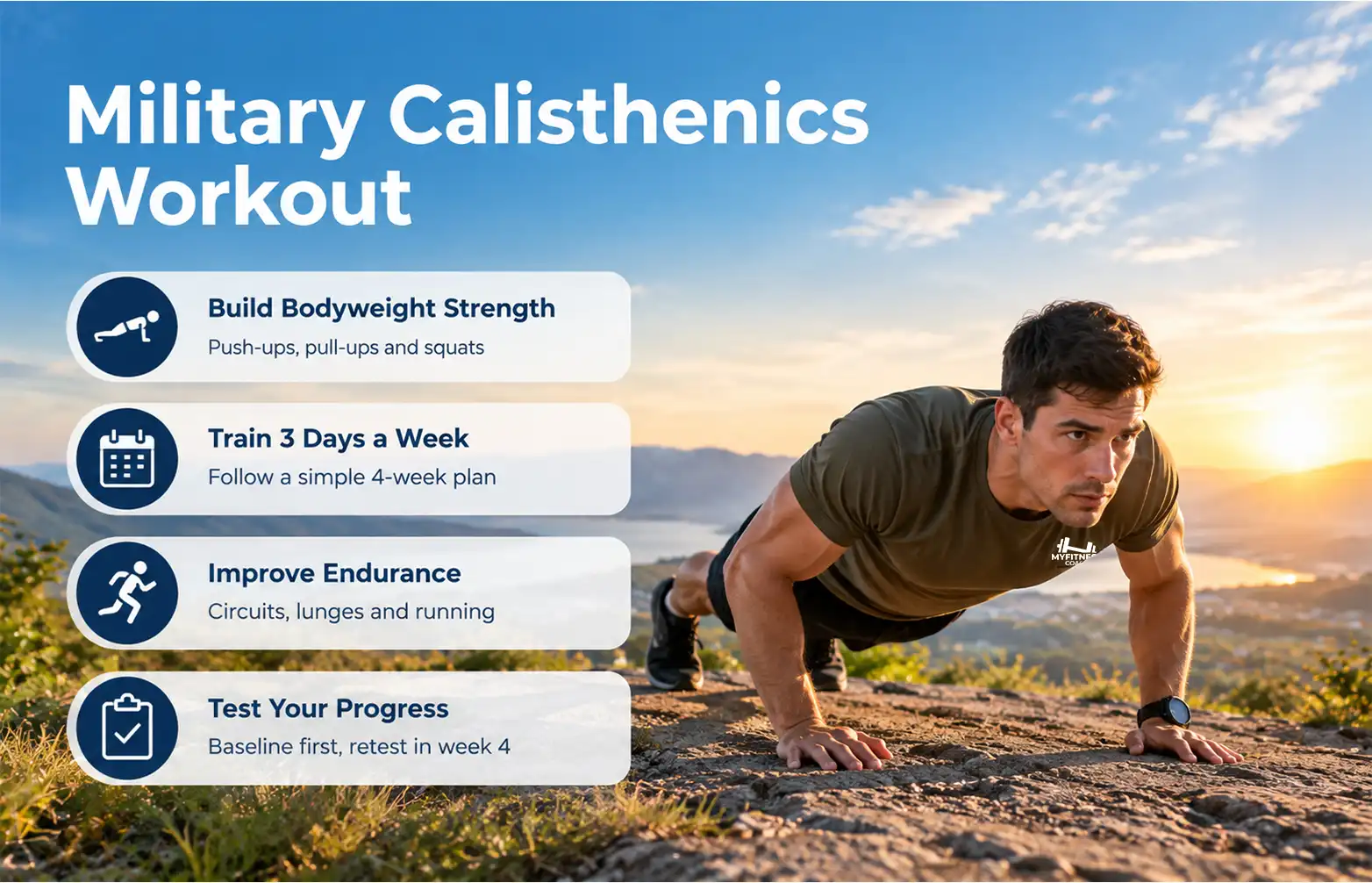
Military calisthenics is bodyweight training modeled on armed-forces physical training: high-rep push-ups, pull-ups, squats, sit-ups and lunges in circuits with short rest, plus running. It needs almost no equipment. This guide gives a 4-week plan, a baseline test, scaling for women and beginners, and what the Army, Navy and Marines actually test.
Key takeaways
- The whole plan is on this page: three days a week for four weeks. Print it or screenshot it.
- Test yourself first, pick a level, then retest in week 4.
- The real military tests differ from training: the Army test includes a deadlift and a sled drag.
[VIDEO EMBED — YOUTUBE LINK. Delete this if there's no video.]
[TRAINER NAME], [CREDENTIAL], runs the 15-minute workout from this guide.

Step 1: Baseline Test
Do this once before week 1, resting between tests. Write your numbers down.
| Test | How | Record |
| Push-ups | Max strict reps in 2 min | Reps |
| Plank | Forearm plank, max hold | Seconds |
| Pull-ups | Max strict reps, or dead hang | Reps or seconds |
| Air squats | Max in 1 min | Reps |
| Run | 1 mile, best effort | Time |
The Navy and Marine tests use a two-minute push-up event, a plank and a run, so these formats are similar. They are not the official scoring. Log your numbers in the workout logger in MyFitnessCoach.
Step 2: Pick Your Level
Choose the level where every set feels hard but your form stays clean.
| Level | Push-ups | Pull-ups | Squats | Sit-ups |
| 1 (new) | 8 (incline OK) | 3 negatives or rows | 12 | 10 |
| 2 | 12 | 5 | 20 | 15 |
| 3 | 20 | 8 | 25 | 20 |
Step 3: The 4-Week Plan
Train three days a week with at least one rest day between sessions. Warm up for 3–5 minutes first. This plan is our own design, built on common military-style circuits. It isn't from a study or an official program.
| Week | Day 1: Circuit A | Day 2: Circuit B | Day 3: Circuit C |
| 1 | 3 rounds | 3 rounds | 10 min |
| 2 | 4 rounds | 4 rounds | 12 min |
| 3 | 4 rounds, less rest | 5 rounds | 15 min |
| 4 | 5 rounds | 3 rounds, easy | Retest |
| Circuit | Moves | Rest |
| A: strength | Push-ups, pull-ups, squats, sit-ups (your level) | 60–90 sec |
| B: conditioning | 400 m run, 10 burpees, 20 lunges, 30 sec plank | 60 sec |
| C: AMRAP | 5 pull-ups, 10 push-ups, 15 squats, repeat | None |
Circuit C is as many rounds as you can in the time shown. In week 3 it's your 15-minute workout. The 5/10/15 pattern is a common military-style circuit, and it's the same one used to split up the Murph workout.
Week 4: on Day 3, repeat the baseline test and compare. Want a PDF? Use your browser's print option and save the page as a PDF.
Scaling for Women and Beginners
The plan is the same for everyone. What changes is where you start. Move up when you can do the target reps cleanly.
| Move | Start with | Then |
| Push-up | Incline | Full push-up |
| Pull-up | Dead hang, slow negatives | Rows, then pull-up |
| Sit-up | Crunch | Sit-up |
| Squat | Box squat | Air squat |
| Burpee | Step-back burpee | Full burpee |
| Run | Run/walk | Continuous |
No pull-up bar? Use rows under a stable table or ring rows. When push-ups get easy, see how to make push-ups harder. For more on bodyweight training for women, see calisthenics for women. New to calisthenics? Start with how to get into calisthenics.
What the Real Tests Measure
Training and testing are different. According to Military OneSource and the Army:
| Branch | Test | Events |
| Army | Army Fitness Test | 3-rep max deadlift, hand-release push-up, sprint-drag-carry, plank, 2-mile run |
| Navy | Physical Readiness Test | 2-min push-ups, forearm plank, 1.5-mile run |
| Marines | Physical Fitness Test | Pull-ups or push-ups, plank, 3-mile run |
The Army test replaced the Army Combat Fitness Test on June 1, 2025, and dropped the standing power throw. Each event scores up to 100 points, and at least 60 are needed to pass, though some combat jobs need more. The Navy test allows swim and stationary-bike alternatives to the run.
Standards change, vary by age and sex, and the Air Force and Space Force have their own tests. Check your branch's official page. This is general training advice, not enlistment guidance.
Does It Work?
Bodyweight training can build strength and endurance. In an 8-week study of 28 untrained men, a calisthenics program raised the push-up test by 16.4% and the pull-up test by 39.2% compared with baseline, and improved posture and body composition against a control group. A 34-week study of 74 military cadets improved body fat, aerobic fitness, push-ups and curl-ups, but its program was 12 weeks of strength and 24 weeks of endurance training, so it wasn't pure calisthenics. Both are small, and neither tests this plan.
High volume can strain the elbows and shoulders, so add reps slowly. That advice is common practice, not a study result.
The Bottom Line
Test yourself, pick a level, run the plan for four weeks and retest. Small, steady increases beat all-out days.
Track your rounds and retest results in MyFitnessCoach.
This article is for general information and isn't medical advice. If you have a heart, joint or injury concern, talk to a doctor before starting. Stop if you feel sharp pain.
Similar Articles
Stay informed with these similar articles.
MyFitnessCoach
September 12, 2025
Best Workout Logger App: Track Sets, Reps & Progress with MyFitnessCoach
When it comes to achieving fitness goals, tracking your workouts is just as important as performing them. That’s where a workout logger app becomes an essential tool. Instead of writing sets and reps on paper or trying to remember your last workout, a digital workout tracker helps you log everything in one place, monitor progress, and stay consistent.

MyFitnessCoach
October 27, 2026
Murph Workout: A Simple Guide to Scaling and a 4-Week Plan
The Murph is a CrossFit workout done for time: a 1-mile run, 100 pull-ups, 200 push-ups, 300 air squats and another 1-mile run, traditionally in a 20 lb vest (14 lb for women). It honors Navy Lt. Michael Murphy and is usually done on Memorial Day. You can scale it to any level.
MyFitnessCoach
May 14, 2023
Push Your Limits: 9 Creative Ways to Make Pushups Harder
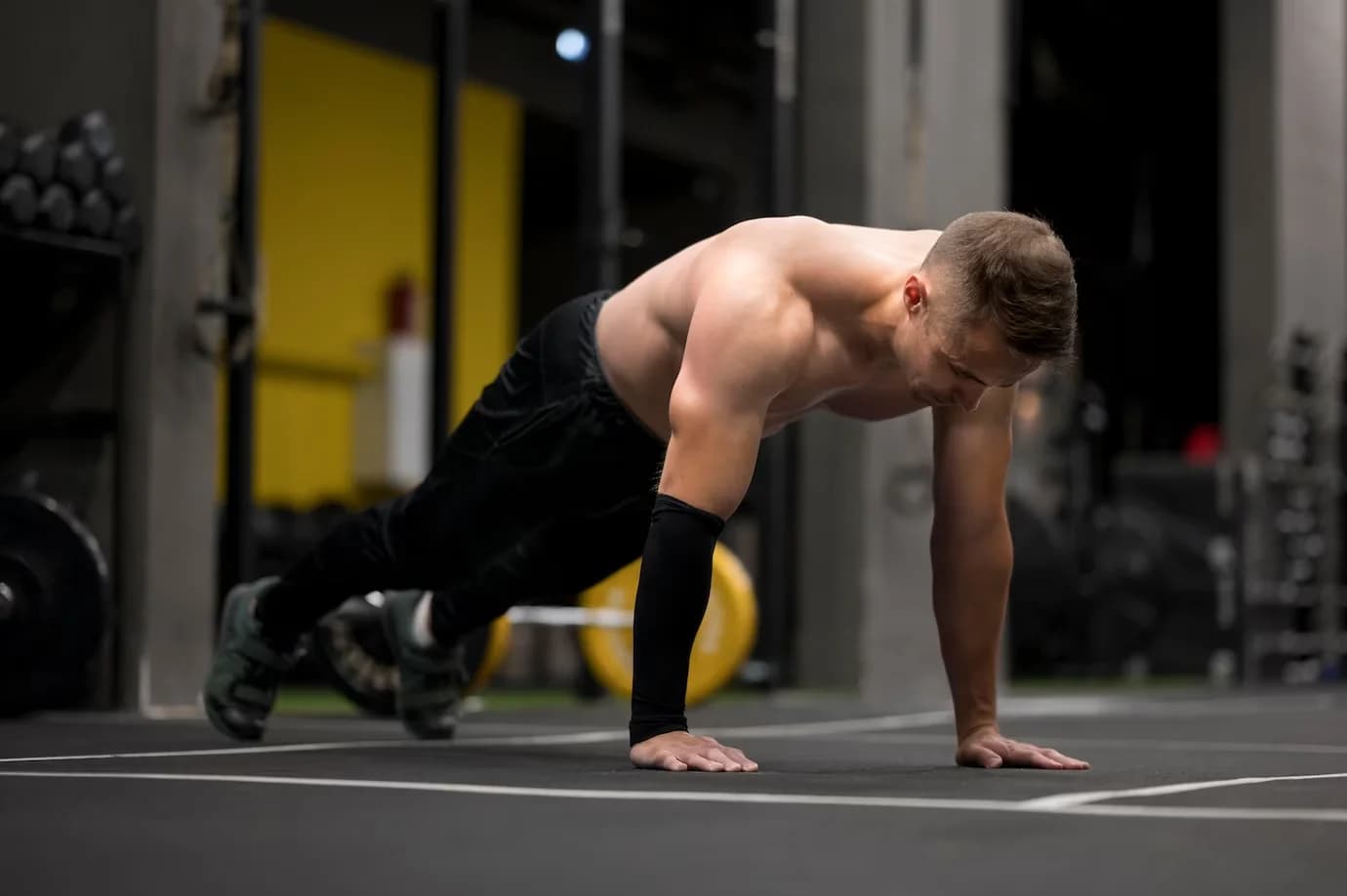
Pushups are a classic exercise that can be performed anywhere, anytime, without equipment. They are a fantastic way to build upper body strength. They also work your core muscles and improve your overall strength. They target multiple muscle groups, including the chest, shoulders, triceps, and core.