
What Is a Lat Pulldown? Muscles Worked, Form & Benefits

MyFitnessCoach
September 15, 2026
A lat pulldown is a cable-based upper-body exercise where you pull an overhead bar or handle toward your upper chest. It primarily trains the latissimus dorsi, or lats, while the biceps and several upper-back muscles assist the movement.
Because the resistance is adjustable, the lat pulldown works well for beginners who cannot yet perform pull-ups and for experienced lifters who want more control over their back-training volume.
But doing the movement is only part of the equation. Knowing where to pull the bar, why your biceps sometimes take over, which grip actually matters, and when to increase the weight can make the exercise far more useful.

Table of Contents
Subscribe to our newslettter
What Is a Lat Pulldown?
The lat pulldown is a vertical pulling exercise usually performed on a cable machine.
You sit underneath a high pulley, secure your thighs under the machine pads, grip the attachment overhead, and pull it down toward the front of your upper chest.
The movement trains a similar vertical pulling pattern to a pull-up. The difference is that a pull-up requires you to move your body weight, while a pulldown lets you choose the external resistance.
That makes the pulldown easier to scale to your current strength.
What Muscles Does the Lat Pulldown Work?
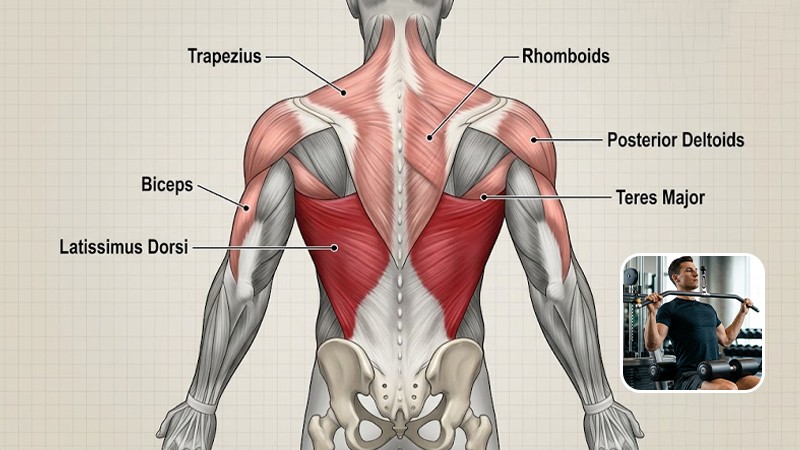
The latissimus dorsi is the main muscle targeted during the lat pulldown.
Your lats are large back muscles that help move your upper arm downward and toward your torso.
Several other muscles contribute:
- biceps brachii
- brachialis
- teres major
- rhomboids
- trapezius
- posterior deltoids
NASM identifies the latissimus dorsi as the primary muscle, with the arms and upper-back muscles assisting the movement.
This is also why some people feel their biceps working strongly during pulldowns. The biceps are supposed to help. The problem is when they become the main thing you feel while your back barely contributes.
How to Do a Lat Pulldown Correctly
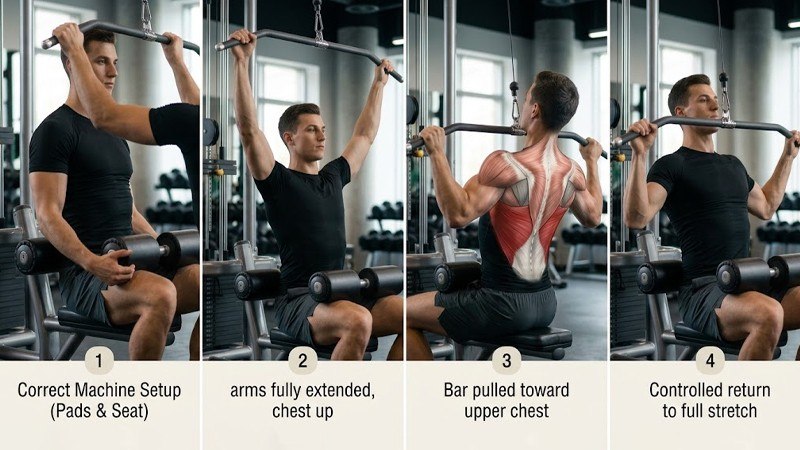
Start by choosing a weight you can control without rocking your torso.
- Adjust the thigh pad so your legs stay firmly in place.
- Sit facing the machine with your feet flat.
- Grip the bar around shoulder width or slightly wider.
- Start with your arms extended overhead.
- Keep your chest lifted and torso mostly stable.
- Bring your shoulders down away from your ears.
- Drive your elbows down toward your sides.
- Pull the attachment toward your upper chest.
- Pause briefly without forcing the bar lower.
- Return the weight slowly until your arms are extended again.
The movement should remain controlled in both directions. Swinging the torso to move more weight changes the exercise and makes your technique harder to reproduce from rep to rep.
How Far Should You Pull the Lat Pulldown Bar?
A useful target is to pull the bar toward your upper chest, but touching your chest is not a requirement for every person.
Your shoulder mobility, arm length, torso proportions, attachment, and grip can change the exact end point.
The better rule is:
Pull as far as you can while keeping your chest up, shoulders controlled, and forearms reasonably aligned with the direction of the cable.
Do not turn the last few inches into a forced shoulder movement just so the bar physically touches your body.
Likewise, pulling the bar behind your neck is unnecessary for most lifters. Front pulldowns train the target muscles effectively without requiring the same behind-the-neck position.
Why Do I Feel Lat Pulldowns in My Biceps Instead of My Lats?
Feeling some biceps work is normal because elbow flexion is part of the movement.
If your arms consistently fatigue long before your back, however, check these factors.
You May Be Pulling With Your Hands
Instead of thinking:
“Pull the bar down.”
Try thinking:
“Drive my elbows down toward my hips.”
The hands connect you to the attachment, but the elbows give you a better cue for the movement at the shoulder.
The Weight May Be Too Heavy
When the resistance is too high, people often compensate with:
- more torso lean
- momentum
- aggressive elbow flexion
- shortened range of motion
Reduce the load and see whether you can control the same path for every rep.
You May Be Shrugging at the Start
If your shoulders remain elevated near your ears while you begin the pull, it can make it harder to establish a stable pulling position.
Start by allowing the shoulders to settle down before driving the elbows.
Your Grip May Be Fatiguing First
A very tight grip can make your forearms and arms feel more dominant.
Hold the bar securely, but you do not need to squeeze it as hard as possible throughout every repetition.
How Do You Know Your Lat Pulldown Form Is Actually Working?
You do not need to judge your technique only by whether you “feel a burn” in one muscle.
Use this simple self-check instead.
Your lat pulldown technique is likely moving in the right direction when:
- your torso position stays similar from the first rep to the last
- the weight moves without jerking
- your elbows travel downward rather than dramatically behind your body
- your shoulders do not repeatedly shrug toward your ears
- you reach a similar range of motion on every rep
- the weight returns under control
- increasing the load does not immediately destroy your technique
The goal is repeatable movement, not chasing a specific sensation.
Muscle activation research can tell us which muscles participate in an exercise, but how strongly you “feel” a muscle is not a perfect measure of long-term growth.
Common Lat Pulldown Mistakes
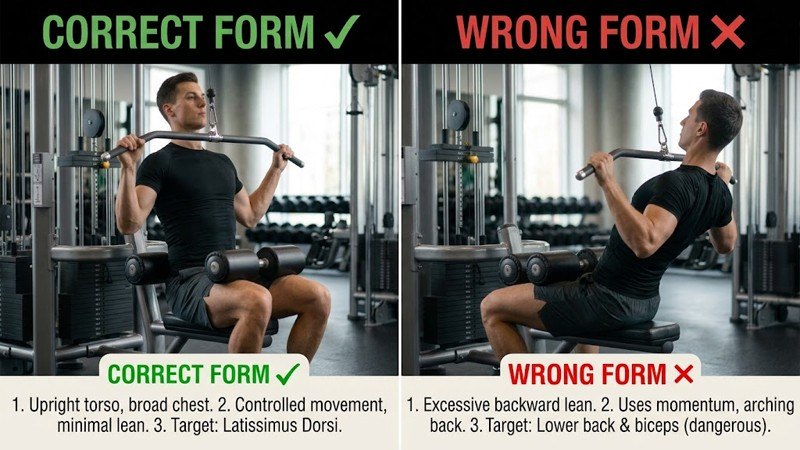
Using Momentum
If you have to swing backward to start every repetition, reduce the resistance.
A small natural torso angle is different from repeatedly throwing your body backward.
Turning the Pulldown Into a Row
Excessive backward lean changes the direction of the pull.
If the bar is travelling toward your stomach instead of your upper chest, you are moving away from a traditional vertical pulldown.
Using Too Much Weight
A heavier stack is only useful if you can still control it.
If load increases while your range of motion shrinks and momentum increases, you have not necessarily progressed the exercise.
Pulling Behind the Neck
Behind-the-neck pulldowns are not needed to train the lats effectively. A front pulldown toward the upper chest is the more practical default for most users.
Letting the Weight Snap Back Up
The return is still part of the repetition.
Allow your arms to extend overhead under control instead of letting the weight stack pull you rapidly upward.
Which Lat Pulldown Grip Is Best?
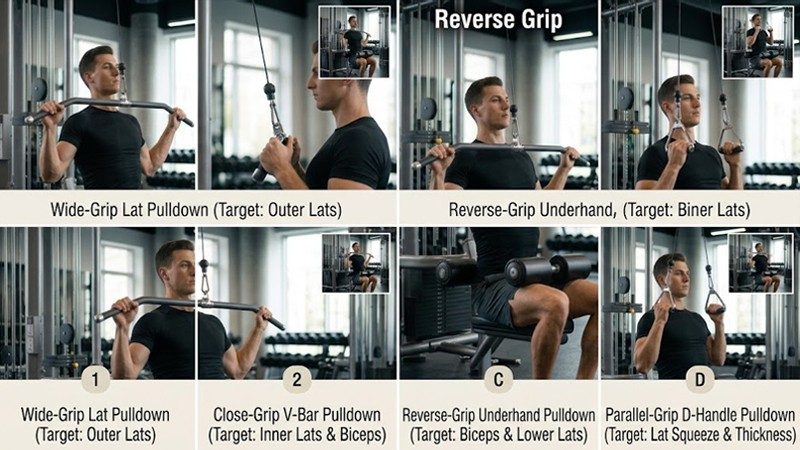
There is probably less difference between common pulldown grips than many gym discussions suggest.
A 2025 study examined seven lat-pulldown variations involving different grip widths, forearm positions and torso angles in 40 experienced male lifters. It found no significant differences in latissimus dorsi activation across the tested variations. The authors concluded that grip choice may not meaningfully change lat recruitment in the way people often assume.
That does not mean every grip feels identical or that grip never matters. It means you should be careful with claims such as:
“This is the only grip that builds the lower lats.”
A more practical approach is to select a grip that lets you use a comfortable range of motion, control the resistance, and progress consistently.
Wide Overhand Grip
A traditional wide grip can work well, but excessively wide hand placement may shorten your range of motion.
Shoulder-Width Overhand Grip
This is a simple starting point for many people and usually provides a comfortable balance between range and control.
Neutral Grip
Palms face each other.
This can feel comfortable for people who prefer a more natural wrist and shoulder position.
Underhand Grip
Palms face you.
This variation typically places the arms in a position where the biceps can contribute strongly.
Older research has also found that grip-width differences may be smaller than people expect, with moderate grip widths offering some practical advantages but broadly similar lat activation across several widths.
Practical takeaway: do not spend more time searching for the “perfect” attachment than you spend progressing the exercise.
Benefits of Lat Pulldowns
Adjustable Resistance
You can start with a manageable load and increase it gradually, which makes the exercise accessible across different strength levels.
Trains Vertical Pulling Strength
The movement strengthens the lats and supporting pulling muscles used in other exercises such as pull-ups.
Easy to Track
Most machines use clear weight-stack increments, making it simple to record load and repetitions.
Useful for Back-Training Volume
Because the load is easy to adjust, pulldowns can be used for heavier sets or moderate-repetition back work without relying entirely on your body weight.
Beginner Friendly
Someone who cannot perform a full pull-up can still train the same general vertical pulling pattern by selecting a lighter resistance.
Lat Pulldown Variations
Single-Arm Lat Pulldown
Training one side at a time can make it easier to focus on each arm's movement independently.
Straight-Arm Pulldown
This variation keeps the elbows mostly extended and emphasizes shoulder extension rather than combining shoulder movement with substantial elbow flexion.
MFC already has a dedicated guide to the straight-arm pulldown, so this variation should be internally linked rather than explained again in excessive depth.
Resistance-Band Pulldown
An overhead resistance band can recreate a vertical pulling pattern when a cable machine is unavailable.
The resistance curve will not feel identical to a weight-stack machine, but it can be useful for home training.
Lat Pulldown vs Pull-Up
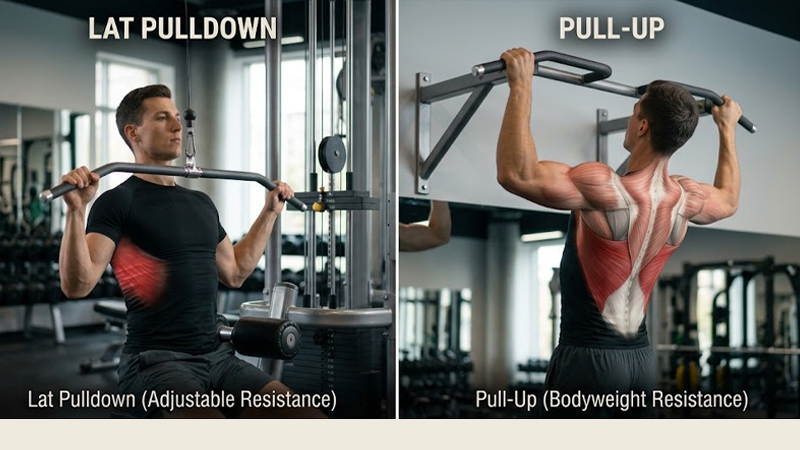
Both exercises train vertical pulling, but they solve different programming problems.
| Factor | Lat Pulldown | Pull-Up |
| Resistance | Adjustable | Primarily body weight |
| Beginner accessibility | High | Lower |
| Load control | Easy | More difficult |
| Progression increments | Small stack changes | Requires reps, assistance or added weight |
| Stability demand | Lower | Higher |
| Good for learning vertical pull | Yes | Yes |
| Useful for high-volume back work | Easy to scale | Depends on pull-up ability |
Pull-ups require you to move and stabilize your entire body, while pulldowns allow much finer control over the resistance. Both can be useful in the same training program.
How Much Weight Should You Use for Lat Pulldowns?
There is no universal good lat-pulldown weight.
The correct resistance depends on:
- your strength
- machine design
- training experience
- repetition target
- grip
- technique
Use a load that allows you to complete your target reps without needing excessive momentum.
A useful test is simple:
If adding weight changes the exercise more than it challenges the exercise, the jump was probably too large.
For example, if 80 lb allows controlled full reps but 90 lb forces you to lean dramatically backward and shorten every rep, 90 lb is not yet a useful progression.
When Should You Increase Lat Pulldown Weight?
Use a simple rep-range progression instead of adding weight randomly.
Suppose your target is:
3 sets of 8–12 reps
Session 1:
80 lb
12 reps
10 reps
9 reps
Stay at 80 lb.
Later:
80 lb
12 reps
12 reps
12 reps
If those reps are controlled and your form is consistent, try the smallest available weight increase next time.
Then repeat the process.
This creates a simple rule:
Earn the weight increase with repeatable reps first.
You do not need to add weight every workout.
You need a progression method you can measure consistently.
Lat Pulldown Troubleshooting Guide
| Problem | Likely Cause | What to Try |
| Mostly feel biceps | Arms dominating the pull | Think “elbows down,” reduce weight |
| Torso swings heavily | Load too high | Lower resistance |
| Bar cannot reach chest comfortably | Forced range of motion | Stop at your controlled endpoint |
| Shoulders shrug upward | Poor shoulder control | Set shoulders before pulling |
| Grip fails before back | Forearm/grip limitation | Adjust grip or reduce load |
| Every rep has different range | Poor load control | Use lighter resistance |
| Exercise turns into a row | Too much backward lean | Keep torso more stable |
| Progress has stalled | No clear overload plan | Use a defined rep range and progression rule |
This is more useful than simply asking whether your form “looks perfect.”
Look for the specific problem, then make one adjustment at a time.
How Many Sets and Reps Should You Do?
There is no single rep range required for lat pulldowns.
If You Are a Beginner
Start with roughly:
2–3 sets of 8–12 controlled reps
The main goal is learning repeatable techniques.
If Your Goal Is Muscle Growth
A broad moderate-repetition range can work well, such as:
8–15 reps per set
But hypertrophy is not determined by one magic rep range. The broader weekly training volume and progressive resistance matter.
The ACSM's 2026 resistance-training position stand found that hypertrophy is particularly influenced by sufficient weekly training volume, while many different resistance-training approaches can improve muscle size.
If Your Goal Is Strength
Heavier resistance with fewer repetitions can also be used once your technique is consistent.
Current ACSM evidence indicates that heavier loading, particularly around or above 80% of 1RM, tends to favor maximal strength improvements.
You do not need to calculate your exact lat-pulldown 1RM just to benefit from the exercise.
For most gym users, consistently recording load, sets and reps is more practical.
That is also where MyFitnessCoach can help: log the exercise and compare your actual training numbers over time instead of guessing whether you are progressing.
Final Takeaway
A good lat pulldown is not about moving the biggest number on the weight stack. It is about creating a repeatable vertical pull that you can gradually make stronger.
Get the setup right, control every rep, use a comfortable grip, and increase resistance only when your technique stays consistent.
Track that progression in MyFitnessCoach so you can see whether your back training is actually moving forward.
Frequently Asked Questions
Similar Articles
Stay informed with these similar articles.

MyFitnessCoach
May 9, 2025
Why Kneecaps Sweat? 5 Surprising Causes & Proven Fixes
Ever noticed your knees getting sweaty for no reason? You're not alone. Sweaty kneecaps might seem odd, but they're more common than you think.
MyFitnessCoach
March 6, 2025
Arm Swing Exercise: Effective Way to Boost Your Fitness
When it comes to fitness, we often think of intense workouts, heavy lifting, or long runs. But what if I told you that a simple exercise like arm swings could be just as effective in improving your overall fitness? Arm swing exercises are easy to do, require no equipment, and can be done anywhere. Whether you're a beginner or a fitness enthusiast, arm swings can help you improve flexibility, strength, and even cardiovascular health. In this article, we’ll explore the benefits of arm swing exercises, how to do them correctly, and how you can incorporate them into your fitness routine using the MyFitnessCoach app.

MyFitnessCoach
February 24, 2025
Best Deodorant for Athletes: Stay Fresh During Your Workouts
When you're an athlete or someone who loves to stay active, staying fresh and odor-free is a top priority. Whether you're hitting the gym, running a marathon, or sweating it out during a high-intensity workout, the right deodorant can make all the difference. But with so many options available, how do you choose the best deodorant for athletes? In this article, we’ll break down everything you need to know about finding the perfect deodorant to keep you feeling confident and fresh, no matter how intense your workout gets. Plus, we’ll show you how the MyFitnessCoach app can help you stay on top of your fitness game.