
How to Do a One-Arm Push-Up | Step-by-Step Guide for Strength Training
MyFitnessCoach
November 7, 2025
The one-arm push-up is one of the most impressive strength exercises a person can perform. It requires a combination of full-body tension, core stability, shoulder strength, chest power, and balance. Many people assume it is only for advanced athletes or calisthenics experts, but with the right progressions and a simple training plan, anyone can work toward it.
If your goal is to build real functional strength, learn complete body control, and push beyond standard push-ups, mastering the one-arm push-up is a rewarding milestone. Before jumping into the technique, it is important to learn proper progressions and form cues so you can perform the movement safely and effectively.
If you prefer following a guided program and want to track your progress easily, the MyFitnessCoach app helps you log your workouts, build custom calisthenics routines, track strength improvements, and stay consistent with training. It is an all-in-one fitness app designed to make your training organized and goal-driven.
Table of Contents
Subscribe to our newslettter
What Makes The One-Arm Push-Up Unique
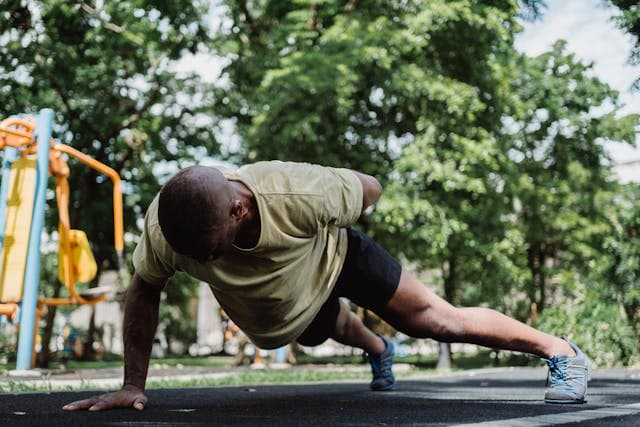
Unlike a regular push-up, where both arms share the load, a one-arm push-up forces your body to stabilize itself through a single point of contact. Instead of simply pressing up and down, your body must fight rotation, manage balance, and activate far more muscle groups at once.
Muscles required include:
- Chest
- Triceps
- Shoulders
- Core muscles and obliques
- Glutes
A standard push-up mainly targets the chest and triceps. A one-arm push-up demands full-body integration. This is why it is considered a high-level strength skill in calisthenics.
Benefits of Learning the One-Arm Push-Up
Strength and Muscle Development
You put your full body weight on one arm. This leads to significant strength development in the chest, triceps, deltoids, and core.
Core Stability and Balance
You must resist rotation. This enhances core engagement and oblique strength.
Functional Fitness
This movement builds real-world strength and improves athletic performance because the body learns to stabilize and push under uneven force.
Minimal Equipment
You can train this movement anywhere. No equipment is required.
Requirements Before Attempting a One-Arm Push-Up
Before you try the full movement, you should comfortably achieve:
- 25 perfect standard push-ups
- 10 perfect decline push-ups
- 10 controlled archer push-ups on each side
If you can do these with clean form, you have the strength to start one-arm push-up progressions.
Step by Step Progressions: How to Do a One-Arm Push-Up
The Best Way to Learn How to Do a One-Arm Push-Up
Learning a one-arm push-up requires progressions. Never skip steps or rush the movement.
Step 1: One Arm Wall Push Ups
Stand facing a wall. Place one hand on the wall at chest height. Keep your feet shoulder-width apart. Lean slightly forward and press into the wall. Perform 3 sets of 10 to 15.
Focus cue: Keep hips square. Do not twist.
This helps build stability.
Step 2: Elevated One Arm Push Ups
Place your hand on a bench or table. Lower your chest toward your hand and press back up. The goal is to feel the single arm doing the work.
Perform 3 sets of 8 to 12 for each arm.
Step 3: Archer Push Ups
This variation builds unilateral pressing strength. Position your hands wider than usual. Bend one arm while keeping the other arm straight. Push up through the bending arm.
Perform 3 sets of 6 to 8 on each side.
Step 4: Assisted One Arm Push Ups
Place your supporting hand on a wall, water bottle, box, or thigh. Your main arm does the pressing while your other hand lightly helps.
Perform 3 sets of 6 to 8 for each arm.
Step 5: Full One Arm Push Up
Hand position should be just outside your chest. Lower yourself slowly, keeping your hips square. Push up by driving the palm into the floor and squeezing your core and glutes.
Perform 3 to 5 reps each arm with perfect form.
Technique Checklist
Perfect Form for the Best Results
- Feet wide for stability
- Core tight and engaged
- Shoulders square to the ground
- The elbow should point at about a 45-degree angle
- Move slowly and controlled
Training the one-arm push-up is about tension, not speed.
Common Mistakes That Prevent Progress
- Dropping the hip or twisting excessively
- Rushing through progressions
- Training with incorrect hand placement
Slow progress with clean form will build more strength than fast progress with sloppy form.
How Many Times Per Week Should You Train?
Train the progressions 2 to 3 times per week. Allow rest days in between for recovery.
Example weekly routine:
- Day 1: Strength progressions
- Day 3: Archer push-ups and assistance work
- Day 5: One-arm push-ups or elevated progression
How MyFitnessCoach Helps You Train and Progress
Most people struggle not because the exercise is difficult, but because they do not track their progress. They repeat workouts without knowing how much they have improved.
MyFitnessCoach solves this problem through its workout logging system. You can:
- Log push-up sets and reps
- Track strength progress weekly
- Build your own calisthenics training plan
- View a full history of your progression
The app also includes guided programs like strength training, Pilates, mobility routines, yoga, and personalized workout plans.
A workout tracker keeps you consistent. Consistency builds results.
Recovery and Mobility Work for Better Results
Your shoulders, wrists, and elbows take a lot of pressure during push-up training. MyFitnessCoach includes mobility workouts that help you maintain joint health and recover faster.
Recovery matters. Progress depends on rest and adaptation.
Final Thoughts
Learning how to do a one-arm push-up is a journey. It requires patience, progressive training, and consistent tracking. Follow the steps, track your improvements, and stay consistent. Mastering this movement will increase your strength, balance, confidence, and physique.
If you want a structured plan to follow, along with workout tracking and progress analytics:
Download MyFitnessCoach and start your calisthenics transformation today.
Frequently Asked Questions
Similar Articles
Stay informed with these similar articles.
MyFitnessCoach
October 24, 2025
Best Calisthenics Workout App in 2025 | Build Strength & Mobility with MyFitnessCoach
In a world full of heavy gym machines, expensive memberships, and complicated routines, calisthenics has become a refreshing return to simplicity and strength. It’s about using your own body weight to build muscle, improve flexibility, and gain control over your movements. But while the exercises themselves are simple, staying consistent and tracking your progress can be challenging, and that’s where a calisthenics workout app comes in.
MyFitnessCoach
November 10, 2025
Russian Squat Program: Weekly Structure, Technique, and Tracking tips
If you want to build incredible lower-body strength, improve squat performance, and push your limits like athletes do, the Russian Squat program is one of the most powerful training methods ever designed. Unlike random leg workouts or inconsistent training routines, the Russian Squat follows a structured volume and intensity progression that forces the body to adapt and get stronger week after week.
MyFitnessCoach
November 10, 2025
Best Bodyweight Fitness App for Home Workouts | MyFitnessCoach
Finding the right bodyweight fitness app can completely transform how you train. You do not need a gym. You do not need equipment. You only need your body, a little bit of space, and the right program that keeps you consistent.