
HIIT Workouts Equipment: 11 Picks Ranked by Load Speed

MyFitnessCoach
September 11, 2026
You bought the air bike, used it twice, and now it holds laundry. That's the real story of most home gyms in America, and it almost never comes down to willpower. It comes down to buying gear that doesn't suit the way intervals actually work.
The right HIIT workouts equipment does one job: it lets you go from nothing to maximum effort in under four seconds, then lets you stop just as fast. Anything slower and you're not doing HIIT anymore. You're doing cardio with pauses.
High-intensity interval training is a training format that alternates short bursts of near-maximal effort with fixed recovery periods, usually inside a session of 30 minutes or less. Equipment doesn't create that effect. It just makes it easier or harder to hit.
This guide ranks 11 pieces of gear by how fast they load, matches each one to a specific interval structure, gives you a buy order at four budget levels, and covers the apartment-noise problem nobody else addresses. No product affiliate padding. Just what earns floor space.

Table of Contents
Subscribe to our newslettter
What Makes Equipment Good for HIIT? The 4-Second Rule
Good HIIT equipment reaches full resistance within about four seconds of you starting and drops it the instant you stop. That single property matters more than brand, price, or feature list.
Here's why. A classic Tabata interval is 20 seconds of work. If your machine needs eight seconds to spin a flywheel up or wait for a motor to reach speed, you've lost 40% of that interval to ramp-up. Your average output for the round is far below what it should be, even though you feel wrecked.
Self-powered gear solves this. Air bikes, curved treadmills, ski ergs and air rowers all generate resistance from your own force, so drag rises the second you push harder. Motorised treadmills do the opposite: you set a speed, then wait for the belt.
Three properties separate real HIIT gear from ordinary cardio gear:
- Instant load. Resistance responds to effort, not to a button.
- Instant unload. You can step off mid-round without a cooldown cycle.
- Full-body recruitment. More muscle working means heart rate climbs faster on the same effort.
That last one explains why an air bike feels worse than a stationary bike at the same perceived speed. Your arms are also demanding blood.
Interval training itself isn't new. Coaches were structuring work-and-rest running as early as the 1930s, and Dr. Izumi Tabata's 20-seconds-on, 10-seconds-off protocol was built for Olympic speed skaters in 1996. The equipment changed. The principal didn't.
HIIT Workouts Equipment: All 11 Picks, Ranked by Load Speed
The best HIIT workouts equipment loads fast, needs no setup between rounds, and works for both short and long intervals. Below, 11 options ranked by how quickly they reach maximum effort.
| Rank | Equipment | Load Speed | Best Interval | Rough US Price | Footprint |
| 1 | Air bike | Instant | 10–30 sec | $600–$1,400 | 4 x 2 ft |
| 2 | Battle ropes | Instant | 15–30 sec | $60–$180 | 2 x 30 ft (length only) |
| 3 | Ski erg | Instant | 20–45 sec | $700–$1,000 | 3 x 2 ft |
| 4 | Air rower | Near-instant | 30–60 sec | $500–$1,100 | 8 x 2 ft |
| 5 | Jump rope | Instant | 20–40 sec | $10–$40 | Needs 9 ft ceiling |
| 6 | Kettlebell | Instant | 20–45 sec | $40–$120 each | Nothing |
| 7 | Slam ball | Instant | 15–30 sec | $35–$90 | Nothing |
| 8 | Curved treadmill | 2–3 sec | 20–45 sec | $3,000–$6,000 | 6 x 3 ft |
| 9 | Sled (push or drag) | Instant | 15–25 sec | $200–$500 | Needs 30+ ft lane |
| 10 | Dumbbells | Instant | 30–60 sec | $80–$400 set | Small |
| 11 | Motorised treadmill | 6–10 sec | 60+ sec only | $800–$2,500 | 7 x 3 ft |
Prices reflect typical US retail ranges as of September 2026 and may vary by brand and retailer.
A few notes on the ranking. The air bike wins because there's no ramp at all and it loads arms and legs together. Battle ropes rank second purely on accessibility; they cost under $100 and spike heart rate in about eight seconds.
The motorised treadmill sits last for a reason. It's a fine machine. It's just a poor fit for intervals shorter than a minute, because the belt can't keep up with your intent.
Match Your Gear to Your Interval Structure
Your interval length should decide your equipment, not the other way around. Short intervals demand instant-load gear; longer intervals open the field to almost anything.
| Interval Structure | Total Time | Best Equipment | Avoid |
| 20 sec work / 10 sec rest (Tabata) | 4 min | Air bike, battle ropes, slam ball | Any motorised machine |
| 30 sec / 30 sec | 15–20 min | Ski erg, kettlebell, jump rope | Sled (transitions too slow) |
| 40 sec / 20 sec | 18–24 min | Air rower, dumbbells, curved treadmill | Nothing really |
| 60 sec / 60 sec | 20–30 min | Motorised treadmill, air rower, bike | Battle ropes (grip fails first) |
| Sprint / walk outdoors | 15–25 min | Nothing but shoes | — |
Pick one structure and stay with it for four weeks. Swapping protocols every session makes progress impossible to read, because you never compare like with like.
One detail people miss: grip is usually the limiting factor, not lungs. Battle ropes and kettlebells are brilliant at 20 seconds and miserable at 60, because your forearms quit before your cardiovascular system does.
Pick one machine, one structure, and track it for four weeks. Most people fail at HIIT because they keep changing the test, not because they lack effort.
HIIT Cardio Machines: Which One Actually Hurts the Most
Among HIIT cardio machines, the air bike produces the highest heart rate in the shortest time, followed by the ski erg, the air rower, and then the curved treadmill. That order holds for most people because it tracks how much muscle mass each machine recruits.
The air bike works arms and legs at once with no eccentric loading, so there's no muscular brake on how hard you can go. You simply run out of air. That's why it appears in conditioning tests across US collegiate and tactical programmes.
The ski erg sits close behind and is gentler on the knees. It's the strongest choice for anyone who needs a high intensity cardio machine but can't tolerate impact.
The air rower spreads effort across legs, back and arms, which makes it excellent for 40–60 second work but slightly slower to peak. Technique matters more here than on any other machine, and bad form caps your output before your lungs do.
The curved treadmill gives you real running mechanics with self-powered resistance. It's the most expensive entry on this list by a wide margin, which puts it firmly in the commercial-gym category for most households.
Fitness professionals surveyed for the 2026 ACSM Worldwide Fitness Trends report put wearable technology at the top of the industry list which matters here, because knowing your actual heart rate is what separates a genuine interval session from an expensive sweat.
What is the best high intensity cardio machine for beginners?
The air rower. It's low-impact, forgiving on joints, and works well at 40- and 60-second intervals where beginners can hold decent form. Air bikes punish poor pacing much harder in the first few weeks.
Is an air bike better than a rower for HIIT?
For intervals under 30 seconds, yes the air bike loads instantly and needs no technique. For intervals over 40 seconds, the rower gives better total-body work with less joint fatigue. Most well-equipped setups end up with both.
Quiet HIIT Workout Equipment for Apartments
Quiet HIIT workout equipment means anything with no floor impact and no dropped load: resistance bands, a ski erg, an air rower on a mat, sliders, and standing dumbbell work. Burpees, jump rope and slam balls are the three that generate complaints.
This is the single biggest constraint on home HIIT in US apartments, and almost nothing written about HIIT gear mentions it.
Practical swaps that keep the intensity and kill the noise:
- Jump squats → tempo squats with a 2-second pause and fast stand
- Burpees → sprawl without the jump, or band-resisted mountain climbers
- Slam balls → banded woodchops or kettlebell swings on a thick mat
- Jump rope → high knees on a 1-inch rubber mat, or invisible-rope shadow skipping
- Box jumps → step-ups at speed
Two pieces of kit make the biggest difference. A 3/8-inch rubber gym mat under everything, and a set of long resistance bands that let you train explosively without any landing at all.
Ceiling height is the other hidden limit. Jump rope needs roughly nine feet of clearance for most adults. Standard US apartment ceilings run eight feet, which is why so many people catch the rope on the light fitting and give up.
Build Your Setup by Budget:
You can run effective HIIT sessions with zero equipment, and every tier after that buys you either variety or lower joint impact. Buy in this order.
| Budget | What to Buy | What It Gets You |
| $0 | Bodyweight only squats, sprawls, mountain climbers, sprints outdoors | Full cardiovascular benefit, zero variety |
| ~$200 | Rubber mat, long resistance bands, jump rope, one kettlebell (16kg men / 12kg women) | Loaded intervals, quiet options, strength carryover |
| ~$600 | Add an air rower or used ski erg, plus adjustable dumbbells | Low-impact machine work, longer interval formats |
| ~$1,500 | Add an air bike, second kettlebell, slam ball, plyo box | A setup you won't outgrow |
Budget estimates based on US retail pricing as of September 2026 and may shift with sales or new models.
Skip the tier-one impulse buys almost everyone regrets: vibration plates, ab rollers marketed as cardio, and mini steppers. None of them load fast enough to matter.
Buying used is the highest-leverage move here. Air rowers and ski ergs hold up for a decade with almost no maintenance because they have so few moving parts, and US listings for lightly used units routinely sit 40–50% below retail.
3 HIIT Machine Workouts You Can Run Today
These HIIT machine workouts are built around the load-speed rules above. Each one fits in under 25 minutes including warm-up.
1. Air Bike — The 4-Minute Test (beginner-friendly, brutal) Warm up 5 minutes easy. Then 20 seconds all-out, 10 seconds coast, 8 rounds. Record total calories. Repeat weekly and chase the number. Cool down for 5 minutes.
2. Rower + Kettlebell Ladder (35/25, 12 rounds) Alternate 35 seconds of rowing with 25 seconds rest, then 35 seconds of kettlebell swings with 25 seconds rest. Six rounds of each, alternating. Stop the set the moment your swing form breaks.
3. Quiet Apartment Circuit (40/20, 4 rounds) Band sprints in place, tempo squats, banded rows, sprawls without the jump. Forty seconds each, twenty seconds transition, one minute between rounds. No impact, no complaints from downstairs.
Run any of these twice a week, not five times. HIIT creates a real recovery cost, and two or three hard sessions alongside easier movement beats daily maximum effort every time.
Equipment Mistakes That Quietly Ruin Sessions
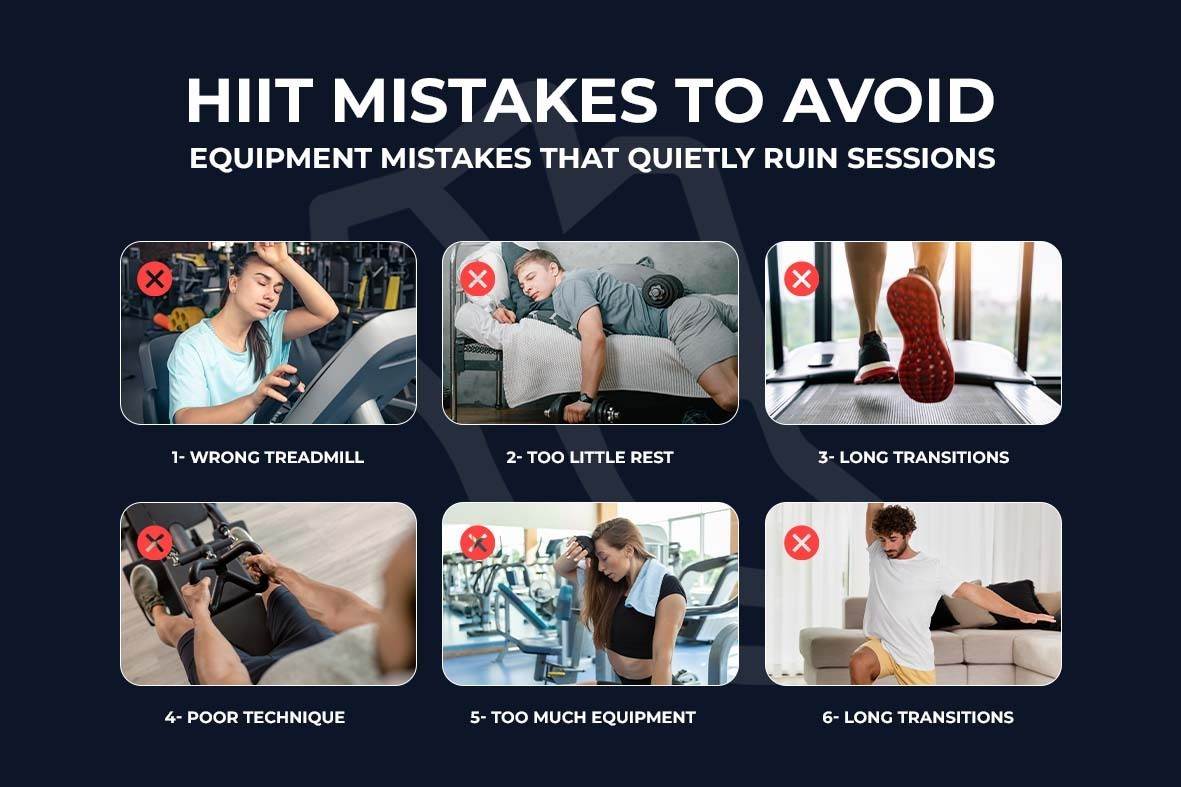
Most failed HIIT setups fail for one of six reasons, and only one of them is about the gear being cheap.
- Buying a motorised treadmill for short intervals. The belt can't accelerate as fast as you can.
- Not resting long enough. If the work feels sustainable, the rest was too short and the intensity was too low.
- Ignoring transition time. Moving between two machines eats 10–15 seconds. Build it into the plan or use one station.
- Choosing gear that needs technique you don't have yet. A rower with bad form is a lower-back session, not a cardio one.
- Filling the room before filling the calendar. Four consistent weeks with a $30 jump rope beats a $4,000 room you visit monthly.
- Training HIIT daily. Frequency here is the most common cause of stalled progress and nagging joint pain.
Do you actually need equipment for HIIT?
No and this is where the retail sites and the training research disagree. Equipment marketers frame gear as the deciding factor; the physiology says intensity is. A set of sprints on a hill produces the same interval response as a $1,400 air bike.
The honest counterpoint is that equipment changes adherence, not effect. Machines lower the skill barrier, remove weather excuses, give you a number to beat, and reduce joint impact for anyone carrying extra weight or coming back from injury. That's a real benefit, it's just not the one it's usually sold as.
How to Confirm You're Actually in the HIIT Zone
You're training at genuine HIIT intensity when your heart rate reaches roughly 80–95% of your maximum during work intervals and drops to about 60–70% during recovery. Below that range, its interval cardio, not HIIT.
Rough max heart rate is 220 minus your age, which is imprecise but workable as a starting point. A 35-year-old lands near 185, so work intervals should push past about 150 beats per minute.
Two things people get wrong here. First, perceived effort is unreliable in the first two weeks beginners routinely overestimate intensity, and trained athletes underestimate it. Second, your recovery heart rate tells you more than your peak. If it isn't falling within 60 seconds, your rest periods are too short for the work you're doing.
Any chest strap or wrist wearable handles the measurement. Logging the sessions is the part that gets skipped, and it's the part that shows whether four weeks of work moved anything. Apps like MyFitnessCoach pull heart rate data alongside your workout log so the interval trend is visible instead of guessed at.
Conclusion
Start with one machine and one interval structure, and give it four honest weeks before you buy anything else. The right HIIT workouts equipment is simply whatever loads fast and sits somewhere you'll actually walk past every day.
Ready to stop guessing at your intervals? MyFitnessCoach tracks your heart rate, interval structure and recovery in one place, so you can see whether the work is actually moving the needle. Start free →
Written by the MyFitnessCoach editorial team. We build training and nutrition guidance around what people can actually sustain, not what sells equipment.
Frequently Asked Questions
Similar Articles
Stay informed with these similar articles.
MyFitnessCoach
May 9, 2025
Why Kneecaps Sweat? 5 Surprising Causes & Proven Fixes
Ever noticed your knees getting sweaty for no reason? You're not alone. Sweaty kneecaps might seem odd, but they're more common than you think.
MyFitnessCoach
March 6, 2025
Arm Swing Exercise: Effective Way to Boost Your Fitness
When it comes to fitness, we often think of intense workouts, heavy lifting, or long runs. But what if I told you that a simple exercise like arm swings could be just as effective in improving your overall fitness? Arm swing exercises are easy to do, require no equipment, and can be done anywhere. Whether you're a beginner or a fitness enthusiast, arm swings can help you improve flexibility, strength, and even cardiovascular health. In this article, we’ll explore the benefits of arm swing exercises, how to do them correctly, and how you can incorporate them into your fitness routine using the MyFitnessCoach app.
MyFitnessCoach
February 24, 2025
Best Deodorant for Athletes: Stay Fresh During Your Workouts
When you're an athlete or someone who loves to stay active, staying fresh and odor-free is a top priority. Whether you're hitting the gym, running a marathon, or sweating it out during a high-intensity workout, the right deodorant can make all the difference. But with so many options available, how do you choose the best deodorant for athletes? In this article, we’ll break down everything you need to know about finding the perfect deodorant to keep you feeling confident and fresh, no matter how intense your workout gets. Plus, we’ll show you how the MyFitnessCoach app can help you stay on top of your fitness game.