
Best Workout Split: 5 Proven Gym Splits for Every Schedule

MyFitnessCoach
September 25, 2026
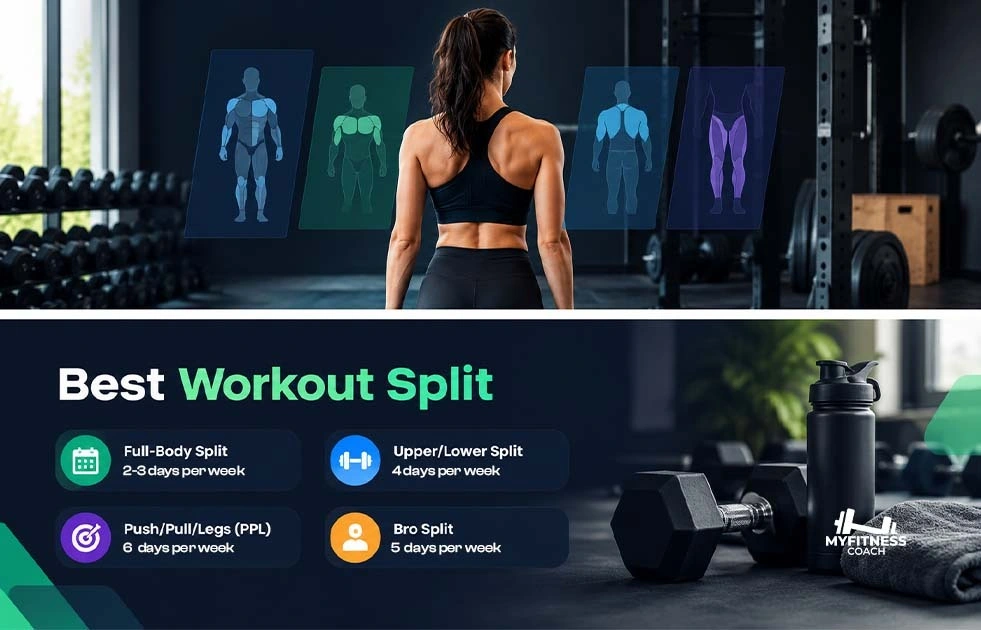
The best workout split is the one you can follow consistently that trains each muscle group with enough weekly volume. For most people, that means a full-body split at 2–3 days per week, an upper/lower split at 4 days, or push/pull/legs at 6 days. The split itself matters far less than whether it fits your schedule and survives a busy week.
That runs against a lot of gym advice, which labels certain splits as "best for muscle" or "best for strength." Recent research doesn't back those labels up very well. This guide covers what a workout split is, how the common gym splits compare, what the research says, and a simple way to pick yours based on how many days you can actually train.

Table of Contents
Subscribe to our newslettter
What Is a Workout Split?
A workout split is how you divide your strength training across the week deciding which muscle groups or movement patterns you train on which days. A full-body split trains everything each session; other splits divide the body into parts, such as upper and lower body or push, pull, and legs, so each session focuses on fewer muscle groups.
Is There a "Best" Workout Split? What the Research Says
Most guides assign each split a goal: body-part splits for size, upper/lower for strength, full body for beginners. It's a neat system. The evidence is less tidy.
A 2024 systematic review and meta-analysis in the Journal of Strength and Conditioning Research pooled 14 randomized controlled trials with 392 participants and compared split routines directly against full-body routines. When weekly training volume was equated, there was no significant difference in strength gains or muscle growth between the two approaches, across programs lasting 4 to 12 weeks.
The authors' interpretation was that the distribution of training volume through the week doesn't play a significant role in muscle growth. Earlier research on training frequency points the same way: when volume is matched, how many times per week you train a muscle has little effect on hypertrophy.
Two honest caveats:
- These were relatively short studies (4–12 weeks), and many participants were not advanced lifters. Long-term, highly trained outcomes are less studied.
- Equal volume is the condition that matters. In real life, splits aren't equal, some make it easier to accumulate volume, and some make it easier to lose it when you miss a day.
So the useful question isn't "which split builds the most muscle?" It's "which split lets me do enough quality sets every week, consistently?" That's what the rest of this guide helps you answer.
The 5 Most Common Gym Splits Compared
Full-body split
Every session trains all major muscle groups, usually with one or two compound exercises per area. Typically run 2–3 days per week.
Upper/lower split
Alternates upper-body days (chest, back, shoulders, arms) with lower-body days (quads, hamstrings, glutes, calves). I usually run 4 days per week, training each muscle twice.
Push/pull/legs (PPL)
Push day covers chest, shoulders, and triceps; pull day covers back and biceps; legs day covers the lower body. Run for 3 days (each muscle once a week) or 6 days (each muscle twice).
Bro split (body-part split)
One or two muscle groups per day: chest day, back day, arm day, and so on. Usually 5 days, with each muscle trained once per week.
Hybrid splits
Combinations such as upper/lower plus a PPL cycle, used to fit 5 training days while keeping each muscle trained about twice a week.
| Split | Days/week | Times each muscle trained | Session length | Best fit |
| Full body | 2–3 | 2–3× | Moderate–long | Beginners, busy schedules |
| Upper/lower | 4 | 2× | Moderate | Most intermediate lifters |
| PPL (3-day) | 3 | 1× | Long | People who prefer focused sessions, fewer days |
| PPL (6-day) | 6 | 2× | Moderate | People who enjoy training almost daily |
| Bro split | 5 | 1× | Moderate | Lifters who like single-focus sessions and rarely miss days |
| Hybrid (e.g. UL + PPL) | 5 | ~2× | Moderate | Fitting 5 days while keeping 2× frequency |
Best Workout Splits by Days Per Week
The fastest way to choose is to start with an honest answer to one question: how many days can you reliably train, even in a busy week? Not your ideal week, your realistic one.
| Days you can reliably train | Best workout split | Why |
| 2 | Full body | Only way to hit every muscle twice |
| 3 | Full body | Each muscle 3× per week; very forgiving |
| 4 | Upper/lower | Each muscle 2×, shorter sessions than full body |
| 5 | Upper/lower + push/pull/legs hybrid | Keeps ~2× frequency across 5 days |
| 6 | Push/pull/legs, twice through | Each muscle 2×, manageable session length |
What's the best 5-day gym split? A hybrid for example, upper, lower, rest, push, pull, legs gives each muscle roughly two sessions per week. A classic 5-day bro split works too, but trains each muscle only once, so each session has to carry that muscle's entire weekly volume.
What's the best 6-day workout split? Push/pull/legs run twice through the week is the most common choice. It keeps sessions shorter and trains each muscle twice. It's also the most demanding on schedule which leads to the next point.
What Happens When You Miss a Day?
This is the factor most guides skip, and it's often what decides whether a split works for you in practice.
Every split looks balanced on paper. Real weeks include late meetings, travel, and illness. The question is how much of your weekly training disappears when one session does.
| Split | If you miss one session… | Resilience |
| Full body (3 days) | Every muscle still trained 2× that week | High |
| Upper/lower (4 days) | Half the body drops to 1× that week | Medium–high |
| PPL (6 days) | One movement group drops to 1× | Medium |
| PPL (3 days) | One movement group gets zero training that week | Low |
| Bro split (5 days) | One muscle group gets zero training that week | Low |
The practical rule: the fewer times a split trains each muscle per week, the more a single missed day costs you. If your schedule is unpredictable, choose a split with higher frequency per muscle full body or upper/lower even if a bro split sounds more appealing. You can always move to a more specialized split once your schedule settles.
How to Check Your Split Has Enough Weekly Volume
Since total weekly volume is the variable research keeps pointing to, it's worth checking your split actually delivers it.
Count hard sets per muscle per week. A hard set is one taken reasonably close to failure roughly 1–3 reps short of being unable to do another rep with good form. Warm-up sets don't count.
A practical starting target: around 10 hard sets per muscle group per week is a commonly used starting point for most lifters. Some research suggests that trained lifters can see additional growth from higher volumes, with ranges such as 12–20 weekly sets suggested for trained individuals but more isn't automatically better if recovery and technique suffer.
Worked example chest on a 4-day upper/lower split:
- Upper A: bench press 3 sets + incline dumbbell press 2 sets = 5 chest sets
- Upper B: incline bench 3 sets + cable fly 2 sets = 5 chest sets
- Weekly total: 10 chest sets ✅
Same check on a 3-day PPL:
- Push day: bench 4 + incline press 3 + fly 3 = 10 chest sets, all in one session
Both reach 10 sets. The difference is that the PPL version puts all 10 into a single long session, where the last few sets are usually done fatigued and if you miss push day, your chest gets zero that week.
Run this count for your main muscle groups chest, back, shoulders, quads, hamstrings, glutes, arms. If any muscle comes in well short, add sets or pick a split that trains it more often.
Sample Gym Splits You Can Use This Week
3-day full-body split (beginners or busy schedules)
- Monday: Squat, bench press, row, Romanian deadlift, plank
- Wednesday: Deadlift or leg press, overhead press, lat pulldown, lunges, core
- Friday: Squat variation, incline press, row variation, hip thrust, core
Each 3–4 sets of 6–12 reps. Rest days in between.
4-day upper/lower split (most intermediate lifters)
- Monday — Upper: Bench press, row, overhead press, close grip pulldown, curls, triceps
- Tuesday — Lower: Squat, Romanian deadlift, leg press, calf raise
- Thursday — Upper: Incline press, Pendlay row, lateral raise, face pulls, arms
- Friday — Lower: Deadlift, split squat, leg curl, hip thrust
6-day push/pull/legs split (high availability)
- Mon/Thu — Push: Bench, overhead press, incline press, lateral raise, triceps
- Tue/Fri — Pull: Row, pulldown, face pulls, curls
- Wed/Sat — Legs: Squat, Romanian deadlift, leg press, leg curl, calves
- Sunday: Rest
If you're unsure which muscles pair well within a session, the guide on what muscle groups to work together covers the logic in detail.
Troubleshooting Your Workout Split
| Problem | Likely Cause | What to Try |
| Not progressing after 6–8 weeks | Weekly volume too low, or effort not close enough to failure | Count hard sets per muscle; add 2–4 sets for lagging muscles, and push working sets closer to failure |
| Constantly sore or exhausted | Too much volume, too many training days, or poor sleep | Drop a day, or cut 20–30% of sets for two weeks, then rebuild |
| Keep skipping sessions | Split demands more days than your real schedule allows | Move to a split with fewer days and higher per-muscle frequency (e.g. 6-day PPL → 4-day upper/lower) |
| One muscle group lagging | It's getting fewer sets, or always trained last when tired | Move it to the start of a session and add 2–3 weekly sets |
| Sessions running too long | Too much volume packed into each session (common with 3-day PPL or bro splits) | Spread the same volume over more sessions, or cut low-value exercises |
| Bored of the program | Same exercises for too long | Keep the split, rotate exercise variations every 6–8 weeks |
Tracking your sets and loads is what makes this troubleshooting possible without numbers, "not progressing" is just a feeling. MyFitnessCoach lets you build a custom split and log every set, so you can see weekly volume and progress per muscle at a glance.
The Bottom Line
The best workout split isn't a secret formula. Research shows that split and full-body routines produce similar results when weekly volume is equal, so the split that wins is the one that fits your real schedule, survives missed days, and gets each muscle enough hard sets every week.
Start with how many days you can reliably train, pick the matching split from the table above, count your weekly sets, and adjust from there.
This article is for informational purposes only and is not a substitute for professional medical or training advice. Consult a qualified professional before starting a new training program, especially if you have an injury or health condition.
Frequently Asked Questions
Similar Articles
Stay informed with these similar articles.

MyFitnessCoach
September 18, 2023
Close Grip Pulldown: 7 Proven Fixes for Better Results
The close grip pulldown is a cable machine exercise where you pull a narrow attachment down toward your upper chest with your hands positioned close together, usually shoulder-width or narrower. It trains the latissimus dorsi as the primary mover, with support from the rhomboids, trapezius, teres major, and biceps.

MyFitnessCoach
July 28, 2025
What is Pendlay Row: Benefits & How to Perform Properly
If you’re serious about building a strong back, then the Pendlay row is an exercise you need to know. It’s simple to learn, targets the right muscles, and helps you grow stronger quickly. This guide will teach you everything about the Pendlay row, including how to do it, why it’s effective, and how you can include it in your workout routine.

MyFitnessCoach
June 26, 2025
What Muscle Groups to Work Together for the Best Workout Results
Want to get stronger, tone your body, or just feel better each day? One big question most people ask is: what muscle groups to work together during a workout? This simple choice can help you train smarter, avoid injury, and achieve your goals more quickly.