
Back Extension Workout: Benefits, Proper Form & Beginner Plan
MyFitnessCoach
May 20, 2025
Your lower back does more work than you realize. Every time you pick something up, stand for an hour, or sit through a long commute, those muscles are working often without enough strength to handle the load comfortably.
That's where a proper back extension workout comes in. It's one of the most direct, equipment-optional ways to build the muscles that keep your spine stable, your posture upright, and your everyday movement pain-free.
In 2026, lower back pain remains one of the most searched fitness complaints in the US and most people don't realize that targeted back extension exercises are often the missing piece. This guide walks you through everything: the muscles behind the movement, step-by-step form, a training plan by level, and the mistakes that silently hurt your progress.
Let's get into it.
What Are Back Extensor Muscles and Why Do They Matter?
The back extensor muscles are a group of muscles running vertically along your spine, from your lower back up to the base of your skull. The main ones are the erector spinae made up of three columns called the spinalis, longissimus, and iliocostalis. Supporting them are the multifidus and quadratus lumborum, which fire isometrically to stabilize each vertebra as you move.
Think of these muscles as the guy-wires of a suspension bridge. When they're strong, the load gets distributed evenly. When they're weak, your passive structures discs, ligaments, and facet joints take the extra hit every single day.
According to the Journal of Physical Therapy Science (Ko et al., 2015), regular back extension training reduced chronic low back pain scores by 47% over just 8 weeks. That's not a small number for something you can do on a floor mat at home.
One thing most guides skip: your back extensors also work during sitting. If you sit for 6-8 hours a day with weak erectors, your spine is essentially unsupported for most of your waking hours. Strengthening these muscles fixes that not just at the gym, but everywhere.
What Is a Back Extension Workout?
A back extension workout is a targeted training session or part of one that focuses on the back extensor muscles through spinal extension movements. The defining motion is lifting your upper body (or hips, depending on the variation) against gravity, then lowering back with control.
It's an isolation pattern, not a hip hinge like a deadlift. The goal isn't to move heavy weight but to build endurance, stability, and strength in the muscles that hold your spine together.
Back extensions can be done on the floor with zero equipment, on a 45-degree hyperextension bench, or on a Roman chair. Each version trains the same muscles with progressively more demand.
5 Real Benefits of Back Extension Exercises
Back extension exercises do more than just strengthen one muscle group. Here's what actually changes when you train them consistently.
1. Reduced Lower Back Pain
Weak back extensors are one of the most common causes of non-specific lower back pain in the US. Strengthening the erector spinae gives your spine the muscular support it needs instead of relying on passive structures like discs and ligaments.
2. Better Posture — Without Thinking About It
Strong back extensor muscles pull your shoulders back and keep your spine in a neutral position naturally. You won't have to consciously remind yourself to sit up straight.
3. Injury Prevention During Lifting
Every time you pick something off the floor groceries, a child, a box your back extensors activate. Weak ones mean higher injury risk on these everyday movements. Trained ones absorb that load properly.
4. Improved Athletic Performance
Runners, swimmers, cyclists, and team sport athletes all rely on a strong posterior chain. Back extensions target the exact muscles that generate power from the ground up.
5. Real Core Stability
Most people think "core" means abs. But your deep spinal stabilizers multifidus, quadratus lumborum, transverse abdominis are part of your core too. Back extensions train all of them together.
"A strong back is a pain-free back and the two things that build it faster than anything else are consistency and correct form."
How to Do a Back Extension the Right Way
Back extensions are safe when the form is right. They can cause strain when it isn't. Here's exactly what to do.
Starting position:
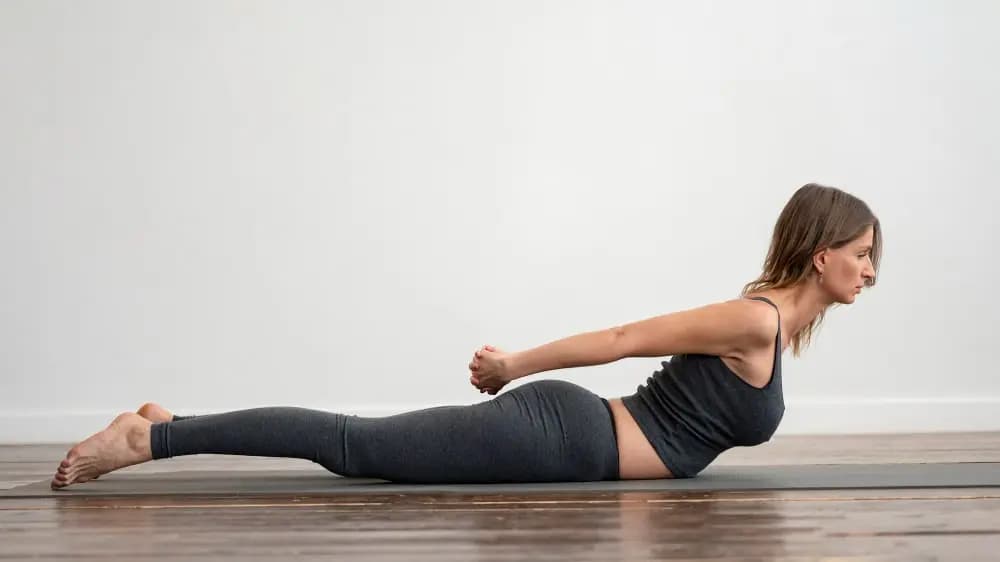
Lie face down on a mat. Extend your legs behind you, toes pointing toward the floor. Place your fingertips lightly behind your ears with elbows pointing out or cross your arms over your chest if that's more comfortable. Rest your forehead just above the mat.
The lift:
Squeeze your glutes first, then engage your lower back to slowly lift your chest off the floor. The movement comes from your spinal erectors, not from pushing with your hands. Keep your neck neutral by looking at the floor a few feet in front of you. Lift until you feel a strong contraction in your lower back, then stop. Don't chase height.
The hold:
Pause at the top for 1–2 seconds. You should feel the contraction from your lower back through your glutes. Your hips stay on the mat throughout.
The descent:
Take 2–3 seconds to lower back down. Don't drop. The controlled lowering phase is where most of the strength adaptation happens. Touch down lightly and go into the next rep without fully relaxing.
Sets and reps:
| Level | Sets × Reps | Tempo |
| Beginner | 2–3 × 10–12 | 2 sec up / 1 sec hold / 2 sec down |
| Intermediate | 3 × 12–15 | 2 sec up / 2 sec hold / 3 sec down |
| Advanced | 3–4 × 10–15 (with load) | Controlled throughout |
One form note that most articles miss: fire the glutes before the back. Initiating with the glutes first stabilizes the pelvis and takes direct pressure off the lumbar spine on every rep. It's a small cue that makes a meaningful difference.
Lower Back Extension: Floor vs. Machine vs. Roman Chair
Not all lower back extension variations are the same. Here's how to choose the right one for where you are right now.
Floor back extension (no equipment)
The most accessible version. Your upper body lifts while your legs stay on the mat. Limited range of motion, which actually makes it safer for beginners. According to StrengthLog, this version effectively activates the lower back with zero equipment and works well as both a warm-up and a standalone exercise.
45-degree hyperextension bench
Found in most gyms. Your hips rest on the pad, your feet are locked in, and you hinge through a larger range of motion against gravity. This version loads the erector spinae more meaningfully than the floor variation and is a standard in intermediate programs.
Roman chair (90-degree)
The most advanced equipment version. Your body starts nearly horizontal, which increases the lever arm and demands more from your back extensors. This is where you'd add a weight plate across your chest for progressive overload.
Which should you start with?
Floor version. Master 3 sets of 15 clean reps there before moving to a bench. There's no rush; the floor version done properly builds the same foundation.
From our testing at MyFitnessCoach, users who spent 3–4 weeks on the floor version before progressing to the bench reported noticeably better muscle activation and fewer form breakdowns under load.
Ready to build a back extension plan that actually fits your schedule and fitness level? Download MyFitnessCoach our AI fitness app creates a personalized workout plan around your goals, tracks your progress, and tells you exactly when to progress. Get it free here.
How to Train the Back Extensor Progressively
Training the back extensor effectively isn't about doing more reps it's about increasing the demand over time in a way your spine can actually handle.
Here's a simple 4-week progression for beginners:
Week 1–2: Floor back extension, arms crossed over chest. 2 sets × 10 reps. Focus entirely on the glute-first cue and the 2-second descent. Rest 60 seconds between sets.
Week 3–4: Same exercise, hands behind head. 3 sets × 12 reps. Add a 2-second hold at the top. Rest 60 seconds.
Week 5+: If you have gym access, move to the 45-degree bench. Start with bodyweight only. 3 sets × 10 reps. Add a small plate (10 lbs) only when you can do 15 clean reps.
One thing most people skip: the back extensors respond well to higher reps and moderate frequency. Training them 2–3 times per week at moderate volume rather than once a week heavy builds both strength and endurance, which is what your spine actually needs for daily life.
Some people argue that back extensions are redundant if you're already deadlifting. And there's truth to that deadlifts do work the erectors. But back extensions allow you to train the erectors with isolation and higher rep ranges that compound lifts can't match. Both have their place in a complete program.
Back Extensor Exercises That Support Your Main Work
These back extensor exercises pair naturally with your main back extension sets. They don't replace the primary movement, they reinforce it.
Bird-Dog
Get on your hands and knees. Extend your right arm and left leg simultaneously, hold 3 seconds, then switch. This builds spinal stability and anti-rotation control. It's one of the best beginner-level back extensor exercises because it trains the deep stabilizers (multifidus, QL) that the floor extension doesn't isolate as directly.
Glute Bridge
Lie on your back, knees bent, feet flat. Push your hips up and squeeze your glutes at the top. The glutes are the secondary movers in every back extension training them separately makes your main lifts stronger.
Superman Hold
Lie face down and lift both arms and legs off the floor simultaneously. Hold for 3–5 seconds. Unlike back extensions, the superman hold is isometric; it builds endurance in the erectors rather than dynamic strength. Use it as a finisher.
Dead Bug
Lie on your back, arms pointing up, knees at 90 degrees. Slowly lower one arm and the opposite leg toward the floor while keeping your lower back pressed flat. This teaches anti-extension bracing the front-side complement to your back extensor work.
Forearm Plank
The anterior-core counterpart. A strong plank balances out your back extension training by building front-to-back trunk stability. Hold 20–40 seconds, 2–3 sets.
Marcus, a MyFitnessCoach user from Atlanta, added bird-dogs and glute bridges alongside his back extension workout and noticed his lower back tightness after work disappeared within three weeks. He hadn't changed anything else in his routine.

Table of Contents
Subscribe to our newslettter
Mistakes People Make During Back Extensions
These are the form errors that either cause injury or quietly kill your results.
Hyperextending at the top. Going past neutral compresses the lumbar discs and facet joints. Stop when you feel a strong contraction not at maximum arch. About 30 degrees off the floor is usually the right stopping point.
Yanking the head up. Leading with your chin strains the neck and creates false range. Look at the floor a few feet in front of you for the entire set.
Rushing the reps. Speed uses momentum and bypasses the muscles you're trying to train. Each rep should take 4–5 seconds total. If you're going faster than that, you're not training you're bouncing.
Skipping the warm-up. Cold lower back muscles are more prone to strain. A 5-minute light cardio warm-up and some cat-cow stretches before your first set makes a real difference.
Training through pain. Muscle fatigue and discomfort are normal. Sharp, pinching, or radiating pain is not. Stop immediately if you feel either.
Need help checking your form? MyFitnessCoach includes video demonstrations and rep-by-rep guidance so you can train with confidence even without a trainer.
Who Should and Shouldn't Do Back Extensions
Good candidates:
- Desk workers with chronic lower back tightness
- Beginners building a functional fitness foundation
- Athletes adding posterior chain work to their training
- Older adults working on posture and balance
- Anyone returning from mild lower back discomfort (with clearance)
Modify or avoid if you have:
- Diagnosed disc herniation or active sciatica — extension can either help or worsen this depending on the specifics; see a physical therapist first
- Spinal stenosis — extension narrows the spinal canal and often worsens symptoms
- Acute lower back pain — wait for it to settle, then start with bird-dogs and dead bugs before progressing to extensions
- Spondylolisthesis — loaded extension can worsen vertebral slippage; get specific clearance
- Second or third trimester pregnancy — prone positions aren't comfortable or safe; substitute with quadruped exercises
If you're unsure, a single session with a physical therapist to confirm the movement is safe for your specific situation is worth far more than any online article.
Isaac Kasey , a MyFitnessCoach user from the USA, had been avoiding all lower back work after a pulled muscle. She started with just the bird-dog and dead bug for two weeks before adding floor back extensions. Within a month she was doing 3 sets of 15 without discomfort.
Track and Customize with MyFitnessCoach
Knowing the exercise is one thing. Knowing when to do it, how often to progress, and how it fits into your full week is what makes the difference between results and spinning your wheels.
With MyFitnessCoach, you get:
- A personalized workout plan that includes back extension exercises at the right volume and frequency for your level
- A Workout Logger to track every set, rep, and progression
- Wearable integration to monitor recovery alongside your training
- Rehab and prehab workout options for those coming back from lower back issues
- A "Build Your Own Workout" tool if you want to customize your own back-focused routine
- Pilates, yoga, and meditation options to pair with your strength work for complete spine health
Whether you're a complete beginner or someone who's been training for years, MyFitnessCoach adjusts to where you are not where someone else is.
Download MyFitnessCoach today and build a back that supports everything you do. myfitnesscoach.fit
Conclusion
Your lower back is working every day whether you train it or not. A consistent back extension workout done with the right form and progressing properly is one of the most practical things you can do for your long-term health, posture, and pain-free movement.
Start with the floor version. Master it. Then build from there.
Download MyFitnessCoach to get a plan that puts all of this into action personalized to your level, tracked automatically, and built to actually work. myfitnesscoach.fit
Frequently Asked Questions
Similar Articles
Stay informed with these similar articles.

MyFitnessCoach
May 9, 2025
Why Kneecaps Sweat? 5 Surprising Causes & Proven Fixes
Ever noticed your knees getting sweaty for no reason? You're not alone. Sweaty kneecaps might seem odd, but they're more common than you think.
MyFitnessCoach
March 6, 2025
Arm Swing Exercise: Effective Way to Boost Your Fitness
When it comes to fitness, we often think of intense workouts, heavy lifting, or long runs. But what if I told you that a simple exercise like arm swings could be just as effective in improving your overall fitness? Arm swing exercises are easy to do, require no equipment, and can be done anywhere. Whether you're a beginner or a fitness enthusiast, arm swings can help you improve flexibility, strength, and even cardiovascular health. In this article, we’ll explore the benefits of arm swing exercises, how to do them correctly, and how you can incorporate them into your fitness routine using the MyFitnessCoach app.

MyFitnessCoach
February 24, 2025
Best Deodorant for Athletes: Stay Fresh During Your Workouts
When you're an athlete or someone who loves to stay active, staying fresh and odor-free is a top priority. Whether you're hitting the gym, running a marathon, or sweating it out during a high-intensity workout, the right deodorant can make all the difference. But with so many options available, how do you choose the best deodorant for athletes? In this article, we’ll break down everything you need to know about finding the perfect deodorant to keep you feeling confident and fresh, no matter how intense your workout gets. Plus, we’ll show you how the MyFitnessCoach app can help you stay on top of your fitness game.