
How Many Tablespoons in 1/3 Cup? Quick & Easy Kitchen Answer
MyFitnessCoach
June 19, 2026
Ever grabbed a recipe that calls for 1/3 cup and realized your only measuring cup is dirty? You're not alone. It's one of the most common kitchen mix-ups, and the fix is simpler than it looks.
In this guide, we'll break down exactly how many tablespoons make up a 1/3 cup, cover the metric equivalent, and give you a quick chart so you never have to do the math twice.
Table of Contents
Subscribe to our newslettter
How Many Tablespoons Are in 1/3 Cup?
1/3 cup equals 5 tablespoons + 1 teaspoon. That's the number most cooks end up memorizing, since a plain "5 tablespoons" guess is close but not quite right.
The extra bit comes from the math: 1 cup holds 16 tablespoons, so 1/3 cup works out to 16 ÷ 3 = 5.33 tablespoons. That leftover 0.33 is just under a third of a tablespoon, which is exactly 1 teaspoon (since 1 tablespoon = 3 teaspoons).
Tablespoons-to-Cups Conversion Chart
| Cup | Tablespoons | Fl oz | mL |
|---|---|---|---|
| 1/4 cup | 4 tbsp | 2 fl oz | 59 mL |
| 1/3 cup | 5 tbsp + 1 tsp | 2.67 fl oz | 79 mL |
| 1/2 cup | 8 tbsp | 4 fl oz | 118 mL |
| 2/3 cup | 10 tbsp + 2 tsp | 5.33 fl oz | 158 mL |
| 3/4 cup | 12 tbsp | 6 fl oz | 177 mL |
| 1 cup | 16 tbsp | 8 fl oz | 237 mL |
Keep this one handy. Once you know a cup is 16 tablespoons, every other row on this chart is just quick multiplication or division from there.
What Is a Tablespoon?
A tablespoon (tbsp) is a standard US volume measurement equal to 3 teaspoons, 0.5 fluid ounces, or about 14.8 mL. It's the go-to unit for measuring oils, spices, baking powder, and other small quantities where a full cup would be overkill.
What Is a Cup?
A cup is the next size up: 16 tablespoons, 8 fluid ounces, or 237 mL. It's the standard reference point for most US recipes, whether you're measuring flour, sugar, milk, or water.
Note that a metric cup (used in Australia, the UK, and much of Europe) is slightly larger at 250 mL. The difference is small, but it can matter in precise baking.
Metric Conversion
If your recipe uses milliliters instead of cups, 1/3 cup comes out to roughly 79 mL. That's close enough to round to 80 mL for most cooking, though bakers who want exact precision should stick with 79.
For reference: 1 US cup ≈ 237 mL, so dividing that by 3 gets you to the 1/3 cup figure.
Quick Math Check
- 1 cup = 16 tbsp
- 1/3 cup = 16 ÷ 3 = 5.33 tbsp = 5 tbsp + 1 tsp
- 1/4 cup = 4 tbsp, 1/2 cup = 8 tbsp — so 1/3 cup naturally falls between them
If you ever want to double-check yourself: 5 tbsp + 1 tsp = 15 tsp + 1 tsp = 16 tsp, and 16 teaspoons is exactly a third of a cup's 48 teaspoons.
Tips for Accurate Measuring
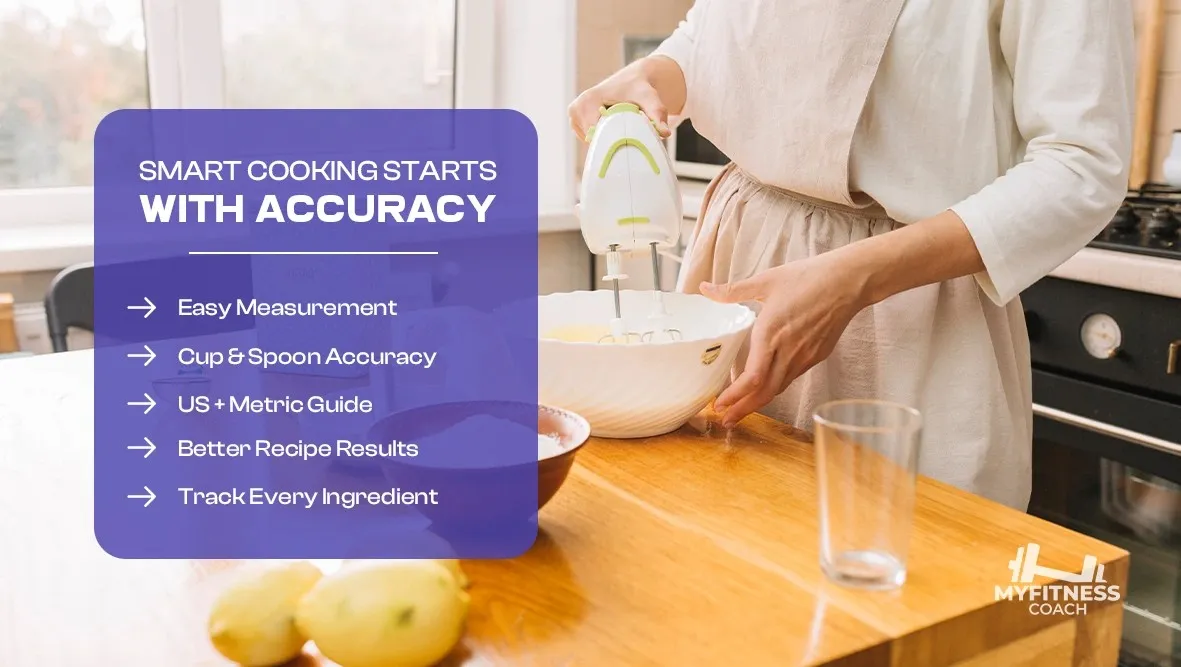
- Use a real measuring spoon set, not a random spoon from the drawer. Even small differences add up in baking.
- Level off dry ingredients with the flat edge of a knife instead of guessing.
- Measure liquids at eye level in a clear measuring cup to avoid over- or under-pouring.
- Keep wet and dry measuring cups separate. Dry cups are made to be leveled off; liquid cups are made to be read from the side.
- For sticky ingredients like honey or peanut butter, lightly oil the spoon first so it releases cleanly.
Track Every Ingredient You Measure with MyFitnessCoach
Getting your tablespoons and cups right is the easy part knowing what those ingredients add up to nutritionally is where it actually helps your goals. With MyFitnessCoach, you can log your meals, scan ingredients, and see a clear breakdown of calories, macros, and portions, so every recipe you cook fits into your day.
Frequently Asked Questions
Similar Articles
Stay informed with these similar articles.
%20(1)%20(1)%20(1)%20(3).webp&w=3840&q=75)
MyFitnessCoach
May 8, 2023
Delicious Fitness Meal Prep Recipes For A Healthy Lifestyle
Fitness is all about having a balance between workouts and an appropriate diet. Getting a proper nutritious meal is as important as doing a workout. Exercise and diet both go hand in hand. Hence, adding fitness meal prep recipes to your fitness routine is important to reach your goal. This article has articulated some delicious and healthy meal prep recipes for you. These recipes surely make your meal tasty as well as full of nutrients. Let’s wait no further and check them out.
.webp&w=3840&q=75)
MyFitnessCoach
March 5, 2025
Net Calories Meaning: A Simple Guide to Understanding Your Fitness Goals
When it comes to fitness and weight management, the term "net calories" is often thrown around. But what does it really mean? If you're trying to lose weight, gain muscle, or simply maintain your current physique, understanding net calories is crucial. In this article, we’ll break down the concept of net calories in simple words, explain how it impacts your fitness journey, and introduce you to a powerful tool—MyFitnessCoach—that can help you track and achieve your goals.