
Fitness Band vs Smartwatch: A Simple Guide (5 Key Specs)
MyFitnessCoach
October 19, 2026
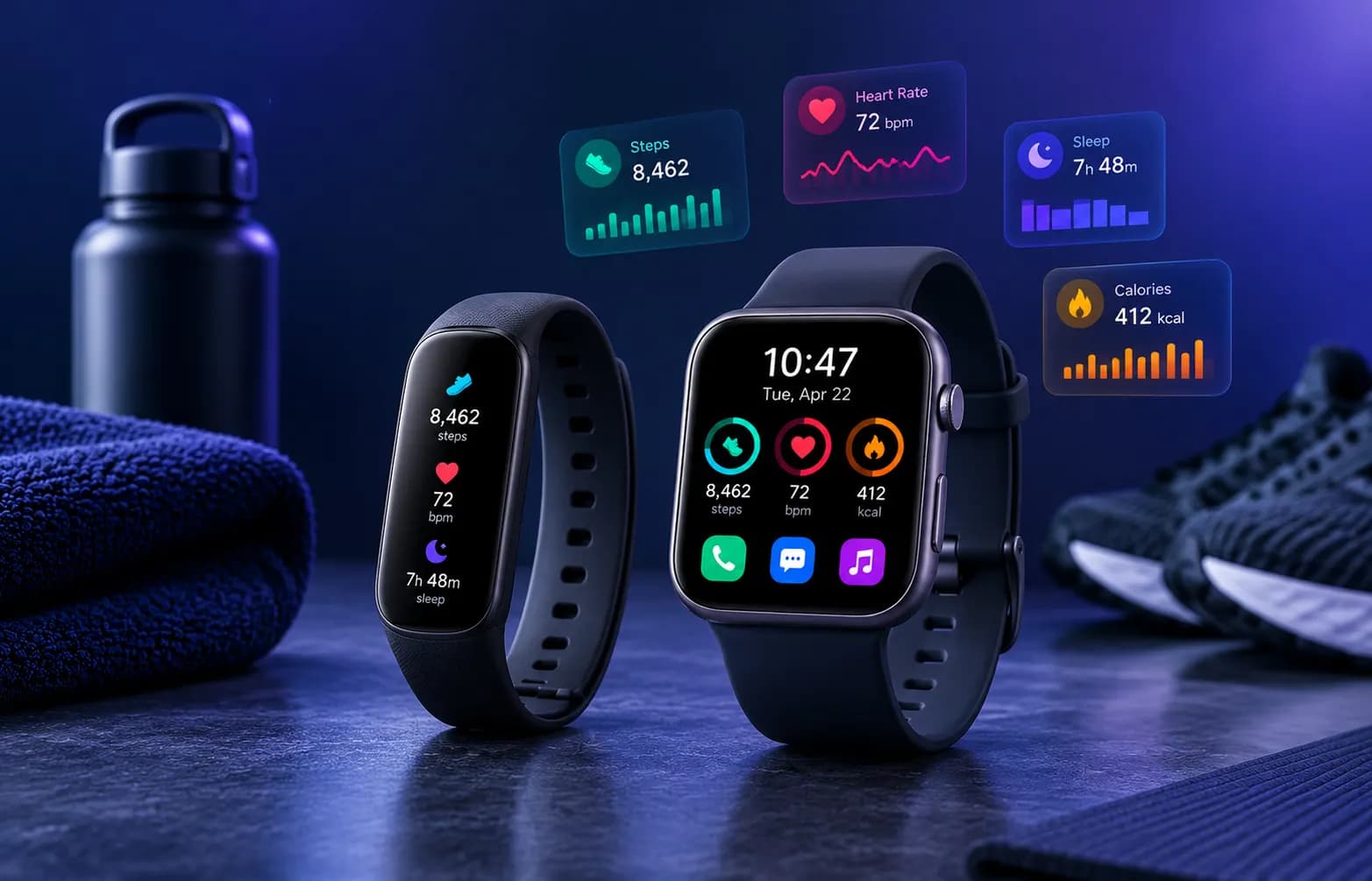
A fitness band is a simple wrist tracker built around steps, heart rate and sleep, often with a battery that lasts a week or more. A smartwatch does all of that plus apps, calls, messages and a touchscreen, and often needs charging more frequently. Neither one is "better." The right choice depends on whether you want a tool that fades into the background or a small computer on your wrist.
This guide compares the two categories side by side, helps you match one to your goal, and looks honestly at how accurate these devices are, based on published research rather than marketing claims.
Key takeaways
- A fitness band is smaller, usually cheaper, and built to be worn and forgotten. A smartwatch adds a full screen, apps and notifications, and often needs more frequent charging.
- If you only want steps, sleep and heart rate, a band usually covers it for less money and with more battery life.
- Heart rate from wrist devices is generally close to a chest strap at rest and light activity, but less accurate during high-intensity exercise.
- Calorie-burn estimates on bands and watches are far less reliable than heart rate. In a 2017 Stanford study, the most accurate device was off by 27% on average, and the least accurate by 93%.

Table of Contents
Subscribe to our newslettter
What's the Actual Difference?
"Fitness band" and "smartwatch" both describe wrist-worn health trackers, but they're built for different jobs.
A fitness band is a slim tracker focused on health and activity data: steps, heart rate, sleep, sometimes blood oxygen. It has a small display or none at all, and its battery is built to last many days because it isn't running apps.
A smartwatch does everything a band does, plus it runs a full operating system: a touchscreen, apps, calls and texts, maps, payments and voice assistants. The fitness tracking is often just as good, but it shares the battery with everything else, so many smartwatches need charging every day or two, though some last a week or more.
The line blurs at the edges. Some bands now show notifications, and some watches strip features back to save battery. But the core trade-off hasn't changed: a band trades features for size and battery life, and a watch trades battery life for features.
Fitness Band vs Smartwatch: Side by Side
.webp)
| Fitness band | Smartwatch | |
| Main job | Steps, heart rate, sleep | Everything a band does, plus apps, calls, notifications |
| Display | Small screen or none | Full touchscreen |
| Battery life | Often several days to a couple of weeks | Roughly a day to a week or more, depending on the model. GPS and an always-on display shorten it |
| Price range | Usually the lower end of the wearables market | Usually the higher end, though budget models exist |
| GPS | Some rely on your phone's GPS ("connected GPS"), and some have it built in | Many have built-in GPS, which tracks without your phone but drains the battery faster |
| Water resistance | Varies by model. Check the specific rating | Varies by model. Check the specific rating |
| Best for | People who want health data without another screen to manage | People who want one device for fitness, notifications and apps |
Water resistance is often given as an ATM rating (atmospheres of pressure). As a rough guide, 3 ATM covers splashes and rain, 5 ATM is the common rating for swimming in a pool, and 10 ATM suits regular swimming. These ratings come from static pressure tests, so they don't cover scuba diving, and makers' guidance on showers and saunas varies. Always check the specific model's rating and the maker's guidance.
How to Choose a Fitness Tracker: Which One Fits Your Goal?
| If you mainly want... | Consider a... | Why |
| Steps, sleep and heart rate, nothing else | Fitness band | Covers the basics for less money and with less charging |
| Notifications, apps and fitness in one device | Smartwatch | You get a full computer on your wrist, often at the cost of more frequent charging |
| To run or cycle outdoors without your phone | A device with built-in GPS | Connected GPS (phone-based) won't track your route if you leave your phone behind |
| The longest battery life possible | Fitness band | Bands with simple displays or no display often outlast smartwatches by days |
| To track swimming | A model rated for it | Check the specific ATM rating. Don't assume from "water resistant" marketing alone |
| A simple habit-tracking tool you'll actually wear | Whichever one you'll charge and wear daily | The best tracker is the one that's on your wrist, not in a drawer |
How Accurate Are These Devices, Really?
Short answer: heart rate is reasonably good at rest and light activity, gets less reliable during hard efforts, and calorie-burn numbers on any wrist device should be treated as rough estimates, not facts.
Heart rate. Wrist devices measure heart rate optically, using light sensors that detect blood flow through the skin, rather than the electrical signal a chest strap reads directly. Multiple studies, including a widely cited 2017 Cleveland Clinic analysis of five popular trackers, found that wrist-worn optical monitors read less accurately than chest straps, and that accuracy drops as exercise intensity rises. Later studies point the same way: accuracy is generally good at rest and during steady, lower-intensity activity, and declines during high-intensity or rapidly changing efforts. The Cleveland Clinic researchers said that people who need accurate heart rate data, for example because their doctor has set safe limits, are better served by a chest strap.
Calories burned. This is where the gap is largest. A 2017 Stanford University School of Medicine study tested seven popular wearables against lab-grade measurements. Heart rate was accurate, within about 5% on average for six of the seven devices. Energy expenditure (calorie burn) was not: the most accurate device was still off by 27% on average, and the least accurate by 93%.
A 2026 preprint (a study posted publicly before peer review) tested four wearables from Apple, Garmin, Samsung and Fitbit against lab metabolic testing during cycling. It also found calorie estimates inaccurate, in line with earlier research reporting errors often above 20%. It found that accuracy was worse for people with a higher body fat percentage, and the authors say many of these models are calibrated on leaner populations.
What that means for you. Treat the step count and heart rate trend as reasonably solid day-to-day signals. Treat the calories-burned number as a rough estimate you can use to compare your own workouts over time, not as an exact figure to plan your eating around.
What to Look For in a Fitness Tracker: 5 Key Specs
Skip the marketing language and check these five things directly in the product listing or manual:
- Battery life, under real use. "Up to" battery figures are usually measured under limited use, so continuous GPS tracking will typically shorten them.
- GPS type. Built-in GPS tracks your route without your phone. Connected GPS needs your phone nearby to record a route.
- Water resistance rating. Look for the actual ATM or meter rating, not just the word "waterproof."
- Sensor set. Optical heart rate is standard. Some devices add blood oxygen (SpO2), skin temperature or ECG. Decide whether you need these before paying more for them.
- App and phone compatibility. Confirm the device works with your phone's operating system, and check whether its own app can sync or export data to the apps you already use, such as MyFitnessCoach.
Common Mistakes When Choosing One
| Mistake | Why it backfires |
| Buying the one with the most sensors | Extra sensors (ECG, skin temperature) add cost and battery drain, and you may never use those readings |
| Ignoring battery life until after buying | A device that needs frequent charging is easy to leave uncharged, and then it tracks nothing |
| Trusting the calorie counter over your own tracking | The research above shows meaningful error. Use it as a trend, not a target |
| Choosing based on looks alone | A band or watch you don't want to wear every day won't give you useful data, however accurate it is |
| Assuming "fitness band" and "fitness tracker" always mean the same thing | Some brands use "tracker" for both bands and full smartwatches. Check the actual specs, not just the product name |
The Bottom Line
A fitness band and a smartwatch measure similar things. The real choice is how much device you want on your wrist and how often you're willing to charge it. Whichever you pick, treat the step count and heart rate as useful trends and the calorie number as a rough estimate.
If you already have a band or watch, or you're deciding between the two, MyFitnessCoach can sync with your wearable to bring your steps, heart rate and activity into one place alongside your food and workout logs.
This article is for general information and isn't medical advice. If you use a wearable to manage a heart condition or another medical issue, follow your doctor's guidance rather than relying on consumer-grade sensors alone.
References
- Shcherbina A, Mattsson CM, Waggott D, et al. Accuracy in wrist-worn, sensor-based measurements of heart rate and energy expenditure in a diverse cohort. J Pers Med. 2017;7(2):3. doi:10.3390/jpm7020003 (confirm the DOI before publishing). Summary: CNBC
- Cleveland Clinic / American College of Cardiology. Wrist-worn heart rate monitors less accurate than standard chest strap (press release, 2017).
- Pasadyn SR, et al. Accuracy of commercially available heart rate monitors in athletes: a prospective study. Cardiovasc Diagn Ther. 2019.
- Etiwy M, et al. Accuracy of wearable heart rate monitors in cardiac rehabilitation. Cardiovasc Diagn Ther. 2019.
- Body fat, skin tone, and the accuracy of smartwatch caloric expenditure estimates. arXiv:2601.22391 (preprint, not peer reviewed).
Frequently Asked Questions
Similar Articles
Stay informed with these similar articles.
MyFitnessCoach
September 4, 2023
Heart Rate During Exercise: Key to a Healthier Lifestyle
When it comes to exercise, understanding your heart rate is crucial for optimizing your fitness routine. Whether you're a seasoned athlete or just starting your fitness journey, knowing how to monitor and interpret your heart rate can make a significant difference in achieving your health and fitness goals.

MyFitnessCoach
March 5, 2025
What Are Net Calories? Simple Definition, Formula and MFP Explained
Net calories are the calories left after subtracting the calories you burn through exercise from the total calories you eat.
MyFitnessCoach
September 12, 2025
Best Workout Logger App: Track Sets, Reps & Progress with MyFitnessCoach
When it comes to achieving fitness goals, tracking your workouts is just as important as performing them. That’s where a workout logger app becomes an essential tool. Instead of writing sets and reps on paper or trying to remember your last workout, a digital workout tracker helps you log everything in one place, monitor progress, and stay consistent.